Hematite Meaning: The Density Stone for Physical Grounding
This article contains affiliate links. If you purchase through our links, we may earn a small commission at no extra cost to you.
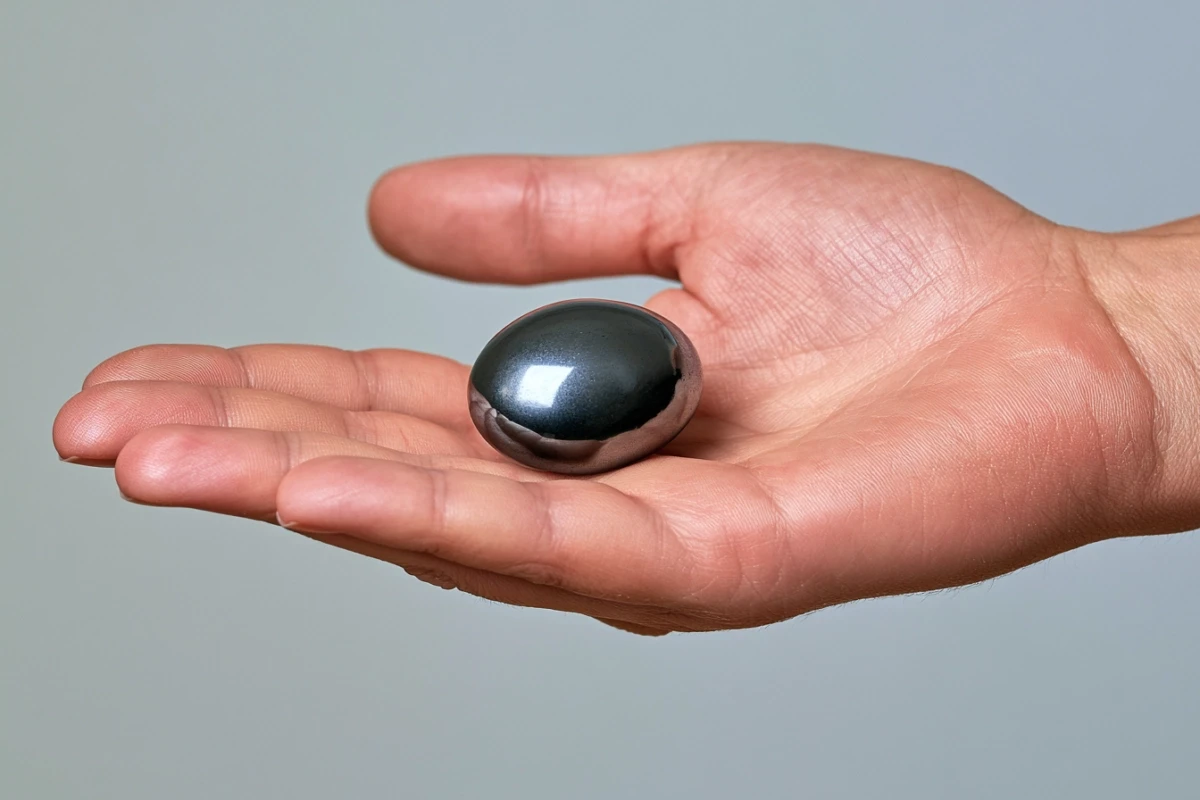
Hematite is iron oxide with a density of 5.3 g/cm³, roughly twice the weight of quartz. That density is the whole point: pick up a tumbled hematite stone and it feels heavier than it looks, which pulls your attention into your hand and out of whatever mental loop you were stuck in. The most practical way to understand hematite is through its physical properties. A stone this dense creates a grounding effect you register through weight alone, making it useful during stress, scattered focus, or moments when you feel disconnected from your body.
Iron Oxide at 5.3 g/cm³: What Hematite Actually Is
Hematite is Fe₂O₃: two iron atoms bonded to three oxygen atoms. That iron content accounts for about 70% of the mineral's mass and explains why it feels like holding a small piece of metal rather than a rock. With this density, a palm-sized tumbled hematite weighs noticeably more than an identical piece of quartz, which sits around 2.65 g/cm³. Hold one in each hand and the difference is immediate. Most people who pick up hematite for the first time assume it's synthetic.
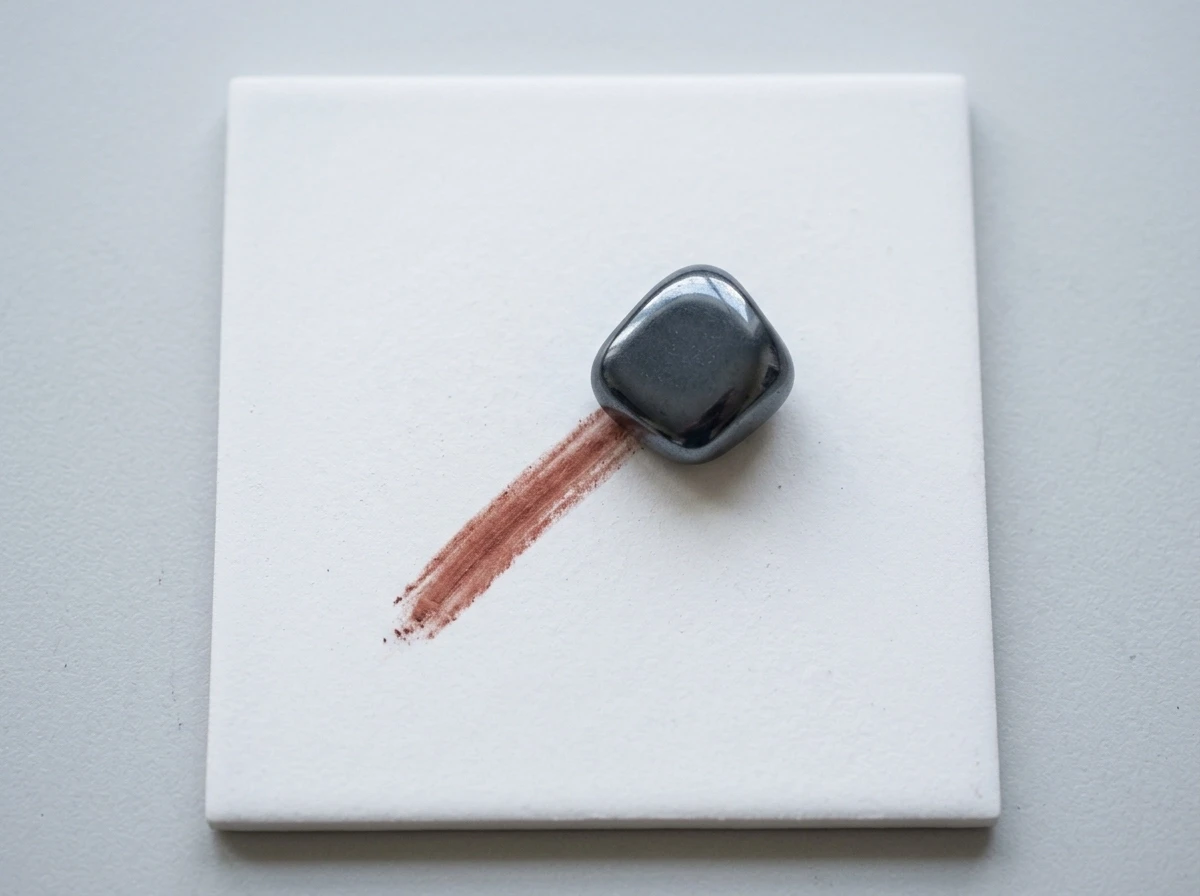
It crystallizes in the trigonal system, forming compact, tightly packed atomic layers that contribute to both its density and its distinctive metallic luster. Polished hematite looks steel-grey to black, almost mirror-like on smooth surfaces. Scratch it across unglazed porcelain, though, and the streak comes out red, sometimes dark rust, sometimes closer to dried blood. That red streak is why the Greeks named it after haima (blood) and why it was ground into pigment for thousands of years before anyone called it a crystal.
Hardness falls between 5 and 6.5 on the Mohs scale, making it hard enough for daily pocket carry or a bracelet, but not as scratch-resistant as quartz. Drop it on tile and it can chip.
Most commercial hematite comes from Brazil's Minas Gerais region, Australia's iron ore belts, and the US Midwest, particularly Minnesota's Iron Range. These deposits produce the dense, metallic-grade material that ends up tumbled and sold as pocket stones or beads. Raw specimens with botryoidal (grape-cluster) surfaces or specular (glittery) finishes exist, but they're collector pieces, not carry stones.
Hematite is one of several dense stones that work through physical weight rather than metaphysical claims, a category explored in depth in the complete guide to crystals for men.
How Hematite Grounds You Through Weight, Not Energy
A tumbled hematite stone the size of a large grape weighs roughly 30–40 grams. Pick up a piece of rose quartz the same size and you're holding maybe 15. That difference registers instantly in the palm, and the registration itself is the grounding mechanism. It requires no energy field or chakra alignment. Your hand notices something unexpectedly heavy, your fingers adjust their grip, and your attention drops from wherever it was circling back into your body.
The Sensory Interrupt
When stress or overthinking pulls you into your head, the loop feeds on itself because nothing physical breaks it. A dense object placed in the palm forces a sensory interrupt. The hand's proprioceptors, the nerve endings that track load and position, fire harder than they would for a lighter stone or a phone. That firing redirects neural attention from abstract thought to physical sensation. The hematite stone meaning in practical terms is exactly this: a weight anchor that pulls awareness downward into the body.
Temperature as Ongoing Feedback
Iron oxide starts cool against skin and warms slowly. Slower than glass, slower than most silicate crystals. That gradual temperature shift creates a second layer of tactile information. You notice the cold, then you notice it fading, and that transition keeps the stone present in your awareness for longer than something that matches body heat within seconds. For someone dealing with dissociation, where the body feels distant or unreal, that sustained temperature contrast acts as a tether. The stone keeps reminding you it's there.
Proprioceptive Load and Dissociation
Dissociation strips away the sense that your body belongs to you. Dense objects counter this because they demand physical accommodation. Your wrist adjusts. Your forearm muscles engage slightly more than expected. That muscular response is hard to ignore, which is precisely the point. A lighter crystal can sit in your pocket unnoticed for hours. This level of density stays perceptible. The weight doesn't fade into background noise the way a wooden bead or plastic token does.
None of this requires belief in crystal energy. The mechanism relies entirely on physical feedback like mass, temperature, and grip adjustment. Grounding through hematite works the same way a heavy blanket works, by giving the nervous system a physical load to register instead of letting attention float untethered.
Hematite vs Black Tourmaline vs Smoky Quartz: Choosing by Situation
All three stones get labeled "grounding," but they ground through completely different physical mechanisms. Picking the wrong one means the stone sits in your pocket doing nothing useful.
Hematite | Black Tourmaline | Smoky Quartz | |
|---|---|---|---|
Primary mechanism | Density: weight pulls attention into the body | Tactile interrupt: striated ridges catch your fingers | Stress absorption: cool, smooth surface slows breathing |
Density (g/cm³) | 5.3 | 3.1 | 2.65 |
Texture | Smooth, cold, heavy for its size | Rough vertical ridges, angular edges | Glassy, translucent, slightly waxy |
Best situation | Mental overload, dissociation, scattered focus | Draining environments, boundary-setting, social fatigue | Emotional overwhelm, grief, anxious tension |
Where it falls short | No tactile variation: once warm, you stop noticing unless you shift it | Lighter than expected, ridges can snag fabric | Too light for a strong physical anchor |
Hematite is the right pick when you need a blunt physical reminder that you have a body. A palm stone with this mass registers immediately against your thigh or in your hand, and that weight-based signal cuts through rumination faster than texture alone. If your problem is feeling unmoored or mentally scattered, density does the work.
Black Tourmaline solves a different problem. Those vertical striations running along the crystal face give your thumb something to track, which redirects attention through repetitive touch rather than mass. That makes it more useful in situations where external pressure is the issue: a crowded room, a difficult conversation, a workplace that leaves you drained by noon. The stone itself weighs roughly 40% less than hematite at the same size, so the grounding signal is tactile, not gravitational.
Smoky quartz operates on a softer register entirely. Its translucent surface stays cool longer than opaque stones, and the visual depth gives it a contemplative quality that hematite lacks. Reach for it when the issue is emotional weight rather than mental noise. It won't snap you back into your body the way hematite does, but for sustained tension or grief, the gentler feedback loop works better over hours.
If you're choosing one stone and your main complaint is "I can't get out of my head," hematite is the obvious starting point. Skip it if your issue is more emotional than cognitive.
How to Carry Hematite So the Weight Stays Noticeable
Because that weight difference is the entire point of carrying it, the form factor you choose should keep its density perceptible rather than letting it disappear into your day.
Pocket carry for scattered days
Drop a tumbled stone into your front pocket when your attention keeps scattering. Every time you shift your weight, stand up, or walk between rooms, the stone slides and presses against your thigh. That passive contact works because you never have to remember to use it. Tumbled hematite is the right choice here: smooth enough that it won't snag fabric or scratch a phone screen, heavy enough that you feel it land when you sit down. A raw piece would dig into your leg within an hour.
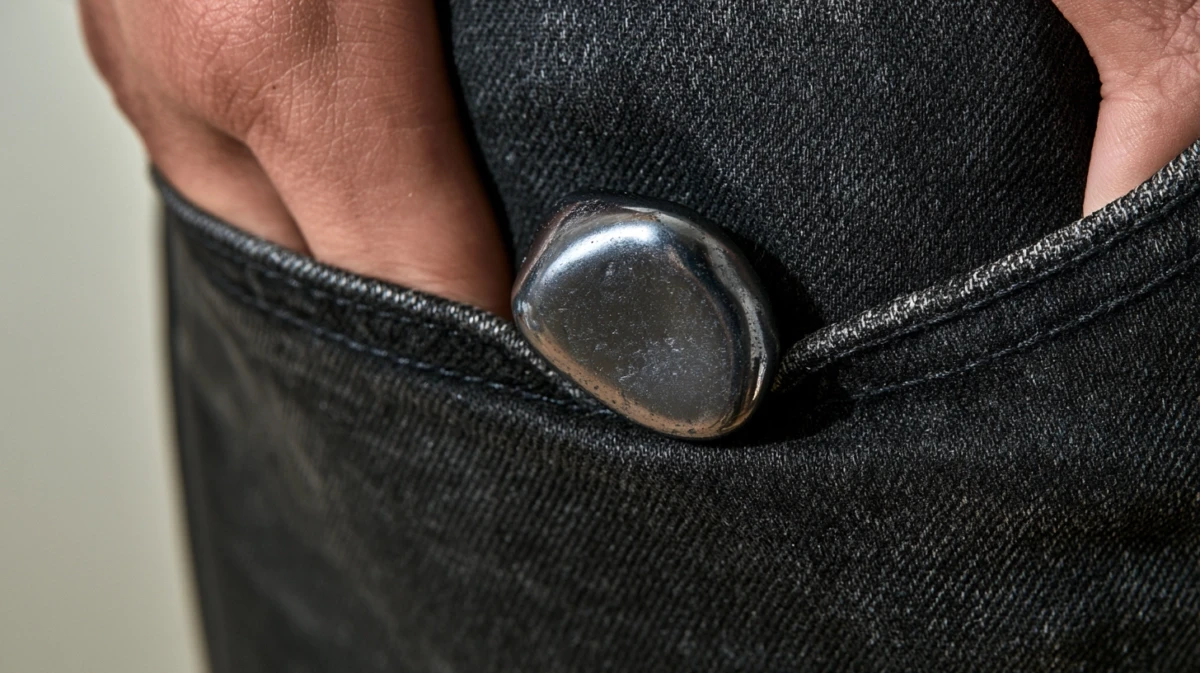
However, because of its density and mineral hardness, a loose hematite stone will quickly scratch your phone screen or keys if they share the same space. Dedicate a small pocket exclusively to the stone, or keep it in a thin leather slip to protect your other everyday carry items while maintaining the weight.
Desk piece for high-pressure blocks
A raw or semi-polished hematite chunk on your desk solves a different problem. During a tense call or a focus block where your jaw tightens, picking up a dense stone and gripping it redirects physical tension into your hand. Raw hematite works better than tumbled in this context because the uneven surface gives your fingers something to map, which pulls attention out of your head and into tactile sensation. A piece around 80–120 grams sits heavy enough in your palm that you register the weight without needing to think about it. Keep it next to your keyboard, not in a drawer. If you have to search for it, you won't reach for it when pressure spikes.
Bracelet for continuous contact
A hematite bead bracelet, available on Amazon, keeps weight on your wrist all day. The grounding signal is subtler than pocket carry but more constant: you feel the beads cool against your skin when you pause, and the weight shifts when you gesture or type. Where this falls short is intensity. A bracelet distributes weight across many small beads, so no single moment feels as heavy as gripping a palm stone. It works best as a background anchor rather than an active reset tool. If you already carry a pocket stone for acute moments, a bracelet adds a quieter layer underneath.
Your choice depends on timing: pocket carry for scattered days, a desk piece for predictable pressure, and a bracelet for background contact.
Real Hematite vs Synthetic Magnetic Fakes: Three Tests
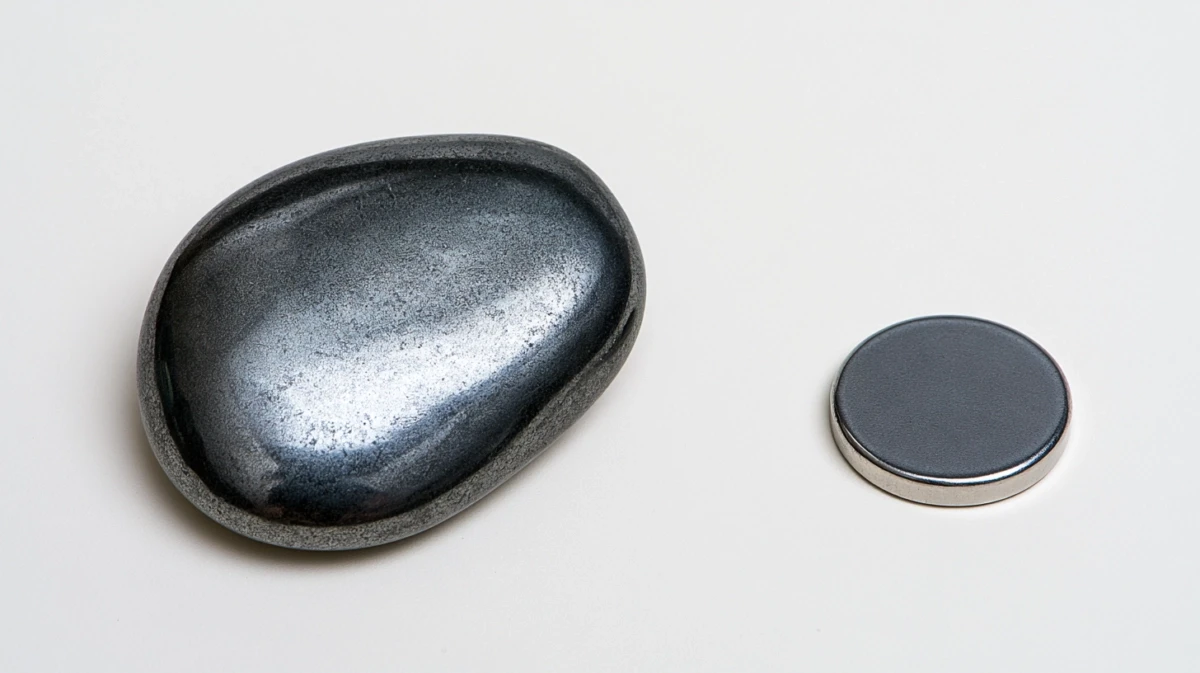
Most "magnetic hematite" sold online is barium-strontium ferrite, a ceramic compound manufactured to look like polished hematite. It has none of the iron oxide density that makes real hematite useful for grounding, and it costs a fraction to produce. The magnetic snap is actually the giveaway, not a feature.
You can identify synthetic ferrite using three methods:
1. The Magnet Test
Hold a refrigerator magnet against the stone. Natural hematite shows no noticeable magnetic pull. If the piece snaps to the magnet or clings on its own, it's synthetic ferrite. This takes about two seconds and catches roughly 90% of fakes sold as "healing hematite" on marketplace sites.
2. The Streak Test
Drag the stone across unglazed porcelain (the underside of a ceramic tile or mug works). Real hematite leaves a distinctive red-brown streak, which is where the Greek blood-name comes from. Synthetic ferrite leaves a dark gray or black mark. This is the most reliable single test because the iron oxide composition can't be faked in a ceramic substitute.
3. The Weight Test
Pick it up. A palm-sized piece of real hematite feels noticeably heavier than you'd expect from its size. Ferrite fakes are lighter, closer to 4.5 g/cm³. The difference is subtle with small beads but obvious with anything larger than a marble. If you've handled real hematite before, a fake feels hollow by comparison.
Buying Without Getting Burned
Skip any listing that uses the phrase "magnetic hematite" or shows the stones stacking on each other. That's ferrite, marketed under a mineral name it doesn't deserve. Sellers who photograph a red streak test or specify "natural hematite" with origin details (Brazil, Australia, Lake Superior region) are more trustworthy.
For pocket carry, a tumbled piece gives you enough mass to register when you reach for it. Small bead bracelets still work as background contact, but a single bead won't pass the weight test in any meaningful way, so buy from a seller who lets you verify at least one loose stone from the same batch.
Hematite FAQ: Care, Magnetism, and Pairings
Is hematite magnetic?
Natural hematite is not magnetic. Stones sold as "magnetic hematite" are synthetic ceramic made from barium-strontium ferrite, not iron oxide. If a stone snaps to a fridge magnet, it isn't real hematite.
Can hematite get wet?
Brief contact with water won't destroy it, but prolonged soaking or repeated exposure causes surface rust because of its iron content. Dry it immediately if it gets wet, and never use saltwater or ultrasonic cleaners.
This is especially important to remember if you wear a hematite bracelet daily. Remove it before showering or intense workouts, as trapped sweat against the skin will accelerate oxidation and leave faint rust marks on your wrist.
What does hematite do spiritually?
Most traditions treat hematite as a grounding and protective stone, valued for pulling scattered attention back into the body rather than amplifying energy outward. Its weight and density are central to that function, which is why physical contact matters more than passive display.
What crystals pair well with hematite?
Clear quartz adds a sharpening effect to hematite's heaviness, and smoky quartz shares the grounding quality without redundancy. Black tourmaline overlaps too much in function to be a useful pairing. Tiger's eye works if you want grounding with a more active, forward-facing edge.
Crystals for Men: The No-Nonsense Field Guide
If you want the full breakdown — the science, all ten stones, a daily carry practice, and a quiz that tells you exactly which stone to start with — the field guide has everything in one place.