Black Tourmaline Meaning: The Protection Stone Men Actually Use

This article contains affiliate links. If you purchase through our links, we may earn a small commission at no extra cost to you.
Black tourmaline is a sodium iron aluminum borosilicate mineral, and its black tourmaline meaning comes down to something physical: a dense, rough-textured stone with measurable piezoelectric properties that generates a small electric charge under pressure. Most men who carry crystals start here because it doubles as a tactile grounding tool, something heavy and striated enough to register in your hand without looking at it. Its reputation as a "protection stone" maps better onto boundary-setting and composure under stress than anything supernatural.
What Black Tourmaline Actually Is: the Mineral Behind the Reputation
Pick up a raw piece and the first thing you notice is the striations. Long, parallel grooves run the length of the crystal, visible without magnification, formed as the mineral crystallized in a trigonal system. No two pieces feel identical under your thumb, which is partly why raw tourmaline gets carried in pockets more often than polished stones. The texture gives your hand something to grip.
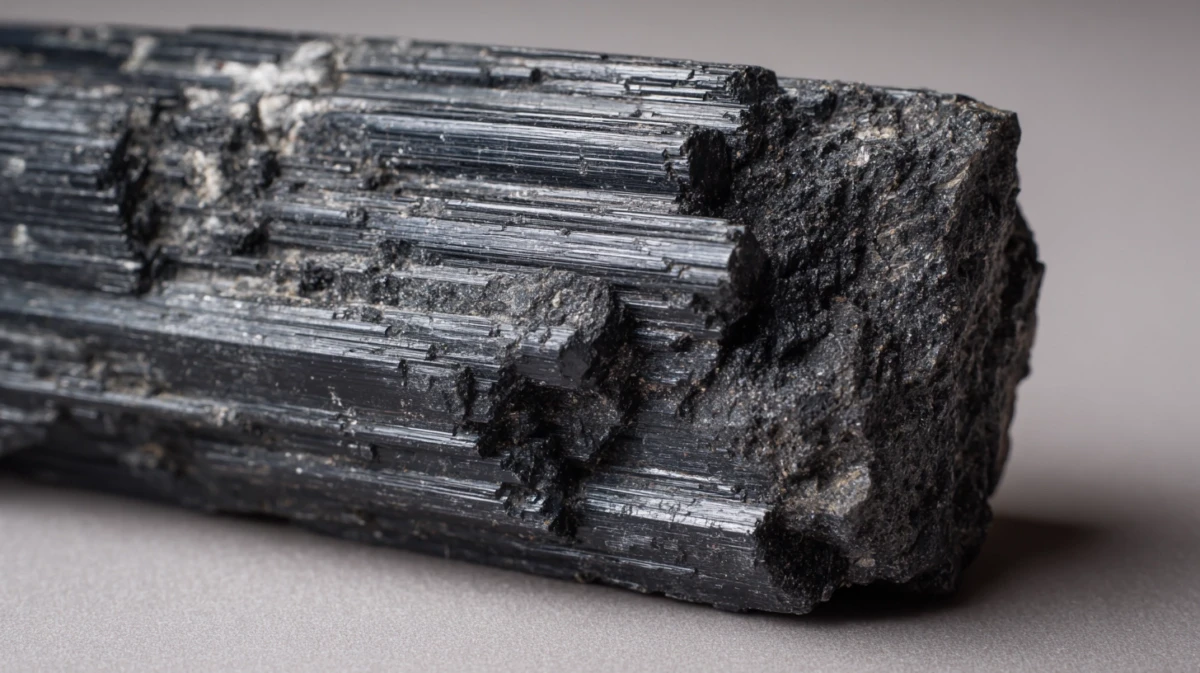
Chemically, it belongs to the tourmaline group as the iron-rich variety called schorl. The formula is a mouthful (sodium iron aluminum borosilicate with hydroxyl groups), but the practical takeaway is that it contains iron, which accounts for both the deep black color and the surprising weight. A palm-sized raw chunk feels noticeably heavier than obsidian or onyx of the same size.
The piezoelectric and pyroelectric properties are where things get interesting from a strictly scientific standpoint. Apply mechanical pressure or a temperature change, and the crystal produces a measurable electric charge across its surface. This was documented in laboratory settings long before anyone attached metaphysical language to it. It doesn't mean the stone "emits energy" in the way crystal shops sometimes imply. It means the mineral structure physically responds to pressure and heat, which is the same property used in some pressure sensors and electronic components.
Hardness sits at 7 to 7.5 on the Mohs scale, roughly the same as quartz. That matters for daily carry: it won't scratch easily in a pocket alongside keys or coins, and it won't crumble if you drop it on concrete. Softer stones like selenite or calcite can't survive that treatment. For a stone you plan to handle every day, durability isn't a bonus feature. It's a requirement.
This durability is one reason black tourmaline appears consistently in practical crystal guides for men who prioritize function over aesthetics.
What 'Protection' Means Without the Mysticism
Crystal shops describe black tourmaline meaning as "absorbing negative energy" and "shielding your aura." Strip that language away and you're left with three things the stone actually does in daily practice: it sets a physical boundary reminder, it interrupts stress responses through touch, and it anchors composure when pressure spikes. None of that requires belief in energy fields.
Boundary-setting as a tactile cue
Carrying a rough piece of tourmaline in your pocket creates a deliberate friction point. When a conversation starts draining you, or someone pushes past a line you've been too slow to enforce, reaching for that stone is a micro-decision. You're not casting a spell. You're giving yourself a two-second pause before you respond, and that pause is where boundaries actually get built. The stone doesn't protect you from the other person. It reminds you to protect yourself.
This boundary work overlaps with the internal shifts that happen during transformation-focused stone work, though tourmaline anchors you in present composure rather than future change.
Stress filtering through physical interruption
A raw tourmaline surface, with its parallel grooves and rough edges, pulls your attention into your hand. That shift from mental spiraling to physical sensation is a well-documented grounding technique in cognitive behavioral frameworks. Therapists call it sensory anchoring. The stone just happens to be a convenient, pocket-sized version of it. Rolling a striated piece between your fingers during a tense meeting does the same thing a stress ball does, except it doesn't broadcast to the room that you're struggling.
Composure under pressure
The weight of a palm-sized tourmaline piece (typically 40 to 80 grams for a raw chunk) sitting against your thigh registers as constant low-level input. That physical awareness works against the dissociative drift that hits during high-stakes moments: the presentation where your voice thins out, the confrontation you've been avoiding. Feeling the stone's mass keeps part of your attention rooted in your body rather than lost in your head.
That body-centered awareness becomes especially useful when working through patterns that pull you into rumination, the kind of mental loops addressed in structured self-examination practices.
The EMF claim, stated plainly
Black tourmaline's piezoelectric property, its ability to generate a small electric charge under mechanical pressure, is real and measurable. Some sellers extrapolate this into claims about blocking electromagnetic frequencies from phones and laptops. No peer-reviewed research supports that leap. The charge produced is minuscule, nowhere near sufficient to interfere with device emissions. Worth knowing the physical property exists, but buying tourmaline as an EMF shield means paying for a claim that hasn't cleared the evidence bar.
Black Tourmaline vs Obsidian, Hematite, and Onyx
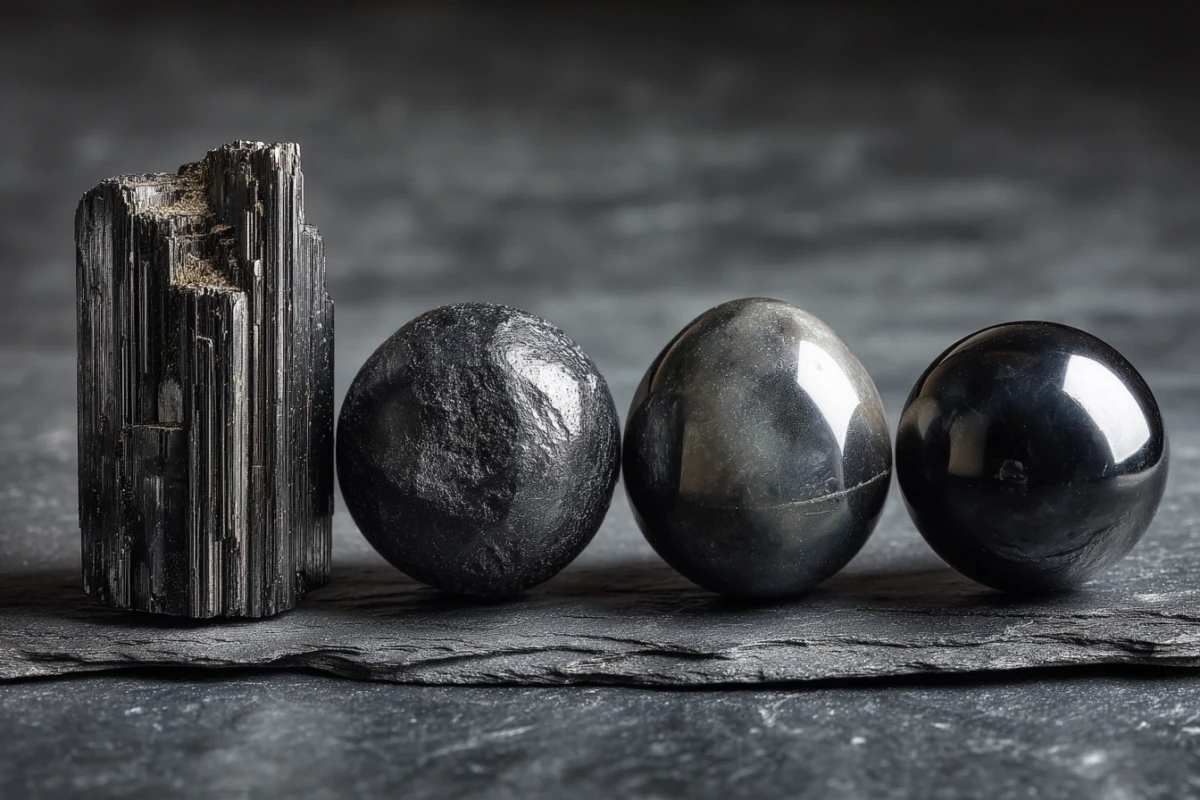
All four stones are black, heavy enough to notice in a pocket, and commonly recommended for grounding. That overlap is exactly why most men stall when picking one. The differences that matter sit in texture, hardness, and how each stone behaves during daily carry.
Black Tourmaline | Black Obsidian | Hematite | Black Onyx | |
|---|---|---|---|---|
Feel in hand | Rough, striated ridges | Glass-smooth, sharp edges | Cool, dense, metallic weight | Smooth, waxy surface |
Hardness (Mohs) | 7 to 7.5 | 5 to 5.5 | 5.5 to 6.5 | 6.5 to 7 |
Scratch risk with keys | Low | High (chips easily) | Moderate | Low |
Strongest practical use | Tactile grounding anchor | Confrontational self-reflection | Physical heaviness as calm cue | Quiet composure, formal wear |
Distinguishing property | Piezoelectric (generates charge under pressure) | Conchoidal fracture (razor-sharp edges) | Iron oxide core (unusually dense) | Microcrystalline quartz (uniform color) |
Tourmaline wins for daily pocket carry because its ridged surface doubles as a sensory cue and its hardness means keys and coins won't damage it. Obsidian is genuinely fragile by comparison. Drop a raw obsidian piece on tile and you'll likely chip it, plus those conchoidal fractures can produce edges sharp enough to cut skin. Hematite is tougher than obsidian but scratches more readily than tourmaline, and its main appeal is sheer density: it feels heavier than it looks, which some men prefer as a grounding signal. Onyx works best in jewelry rather than raw pocket carry because its smooth, uniform finish looks intentional on a wrist or ring.
If you want something you can grip, feel texture against your thumb, and forget about damaging, tourmaline is the obvious first pick. Choose hematite when weight matters more than texture. Skip obsidian for carry altogether unless you keep it wrapped or displayed at a desk.
How to Carry, Wear, and Place Black Tourmaline Day to Day
A raw piece roughly the size of your thumb fits in a front pocket without bulk and gives you the most tactile feedback of any option. The striated ridges catch your fingertip every time you reach in, which is the whole point: a physical texture that pulls your attention back to the present moment. Raw tourmaline sits comfortably alongside keys and coins because it scores 7 to 7.5 on the Mohs scale, hard enough that everyday metal won't scratch it. The trade-off is shedding. Raw pieces, especially freshly broken ones, can leave fine black dust on light-colored pocket linings for the first week or two. A tumbled piece solves that: same mineral, same weight, but polished smooth so nothing flakes off. You lose the rough texture that makes raw tourmaline distinctive as a grounding cue, though, which is why most men who start with tumbled eventually switch to raw anyway.
Wearing a Bracelet
A beaded tourmaline bracelet keeps the stone on your skin without occupying pocket space. It works well if you already wear a watch or other wrist accessories, since black beads blend in without drawing questions. The RTZN Black Tourmaline bracelet uses genuine stone beads on an elastic cord and is available on Amazon. Bracelets sacrifice the rough texture that makes pocket carry effective as a grounding anchor. Smooth, round beads feel more like any other accessory than a deliberate interruption. Where a bracelet does work is as a visual reminder: glancing at your wrist during a tense meeting can trigger the same pause that reaching into your pocket would.
If you go this route, take it off before showering or swimming. The chemicals in soap and chlorine degrade elastic cords quickly, and a snapped bracelet means scattering heavy stone beads everywhere.
Stationary Placement
Keeping a larger raw piece on your desk or nightstand turns it into a fixed anchor point for a specific environment rather than something you carry between contexts. A chunk weighing 100 to 200 grams sits heavy enough that it won't slide around, and the rough surface gives you something to grip during phone calls or before sleep. Desk placement pairs well with a short breathing reset: three slow breaths while holding the stone before starting focused work. The obvious limitation is that it stays put. If your stress shows up in transit, in conversations away from your desk, or during commutes, a stationary piece won't be there when you need it.
Picking a Starting Point
Pocket carry with a raw piece covers the widest range of situations. If shedding bothers you, wrap it in a small cloth for the first week or start with tumbled. Add a desk piece later if you want a fixed anchor for your workspace. A bracelet makes sense as a second option, not a first, because it trades the tactile sharpness that makes tourmaline useful for grounding in the first place.
Choosing Your First Piece: Raw, Tumbled, or Bracelet
Raw chunks with visible striations are the easiest way to confirm you're buying genuine black tourmaline — this ½ lb bulk pack on Amazon gives you several pieces to choose from at around €13. Those vertical ridges running along the surface are a signature of the mineral's crystal structure and almost impossible to fake convincingly. When selecting a raw piece, focus on finding one with clear, deep grooves rather than worrying about perfect shape, as these natural imperfections are the best indicator of genuine stone.
Because the polishing process removes the natural striations, verifying a tumbled stone requires checking its temperature and density instead of visual cues. The trade-off: you lose those striations, which makes it harder to verify authenticity at a glance. A genuine tumbled piece still feels noticeably heavy for its size and stays cool to the touch longer than glass imitations. If you're buying online, look for sellers who show unpolished stock photos rather than studio-lit glamour shots.
Bracelets are the most visible option, which is either an advantage or a dealbreaker depending on your preference. Bead size matters more than most listings suggest. Beads under 8 mm look subtle but feel flimsy and crack easier. Beads around 10 to 12 mm hold up better and give enough weight on the wrist to register as a tactile cue throughout the day. Watch for "black tourmaline" bracelets that are actually dyed howlite or obsidian. Genuine tourmaline beads have slight surface irregularities and aren't perfectly uniform in color.
If you want one piece that covers the most ground, a raw chunk for pocket carry remains the strongest starting point. A bracelet works as a second addition once you know you'll actually use it daily.
Black Tourmaline FAQ: Daily Use and Care
Can I wear black tourmaline every day?
Black tourmaline scores 7 to 7.5 on the Mohs hardness scale, so it handles daily wear without cracking or chipping under normal conditions. Tumbled pendants and properly strung bracelets with 10 mm or larger beads hold up well over months of continuous use.
Where should I put black tourmaline in my home?
A raw chunk near your front door or on your desk where you spend focused hours are the two most common placements. Nightstand placement works if you want a physical anchor for winding down, though some men find it more useful where they actually work.
How do I cleanse black tourmaline?
Run it under cool water for 30 seconds, then let it air dry. Salt water can degrade the surface over time, so plain tap water is the safer default. Some people leave it on soil or a windowsill overnight, but rinsing it regularly is the only step that matters practically.
Does black tourmaline actually block EMF?
Tourmaline does generate a weak electrical charge when heated or compressed, a property called pyroelectricity. No peer-reviewed study has shown this is strong enough to measurably shield against EMF from phones or routers. Treat EMF-blocking claims as marketing rather than established science.
By Jonatan Rajala, Founder of Inner Kingdom. About the author →
Crystals for Men: The No-Nonsense Field Guide
If you want the full breakdown — the science, all ten stones, a daily carry practice, and a quiz that tells you exactly which stone to start with — the field guide has everything in one place.