Tiger's Eye Meaning: The Stone of Focused Confidence

This article contains affiliate links. If you purchase through our links, we may earn a small commission at no extra cost to you.
Tiger's eye is a quartz stone where ancient blue asbestos fibers (crocidolite) were slowly replaced by silica, locking their parallel structure in place while iron oxide stained everything golden brown. That mineral swap is what gives tiger's eye its physical identity: not a dyed rock or a resin composite, but a fossil-level transformation preserved inside quartz. The shifting light band you see when you tilt it is called chatoyancy, and it works because those parallel fibers bounce light back along a single axis, like sunlight catching a spool of silk thread. Many who carry crystals for men reach for tiger's eye as a pocket stone or bracelet during stretches that demand steady thinking, not because of mystical claims, but because that moving band of light gives your eyes a concrete point to track when your mind wants to scatter.
What Tiger's Eye Actually Is: Geology in 90 Seconds
Tiger's eye starts as crocidolite, a fibrous form of blue asbestos embedded in rock. Over millions of years, silica-rich groundwater dissolves the crocidolite and deposits quartz in its place, fiber by fiber, preserving the original structure down to the microscopic level. Geologists call this pseudomorphism. Iron oxide seeps in during the process, which is what produces the golden-brown to reddish banding rather than the original blue.
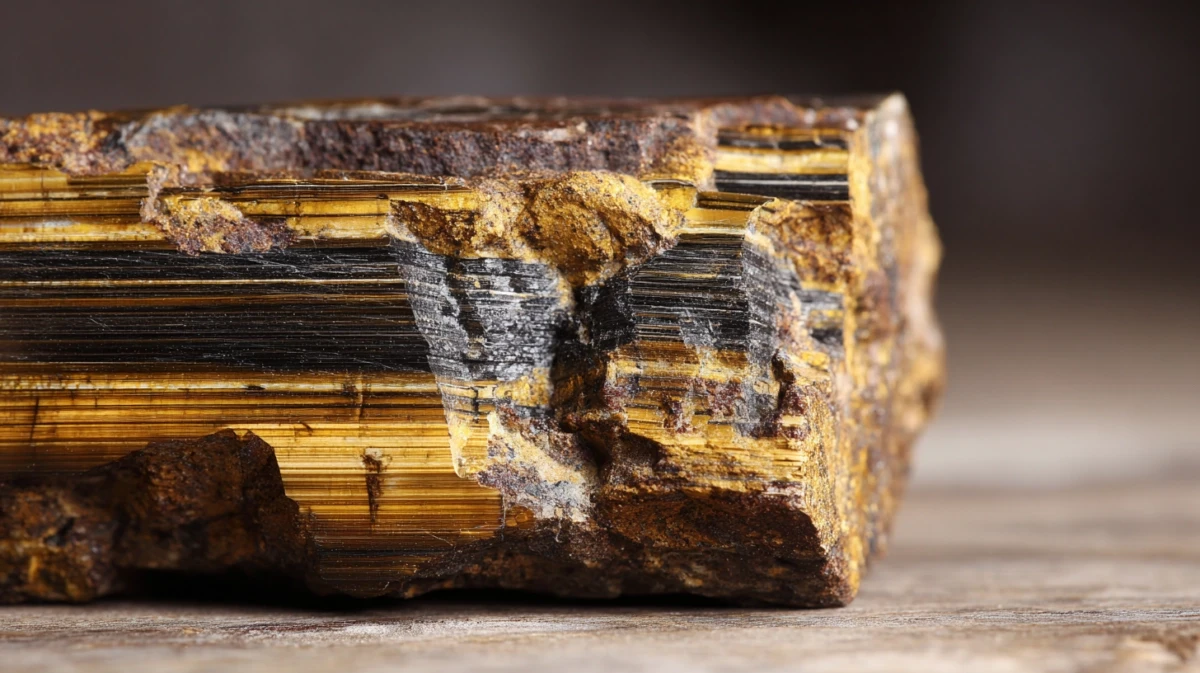
Chatoyancy is simpler than it sounds. Those preserved parallel fibers act like thousands of tiny mirrors aligned in the same direction. When light hits them, it reflects back as a single bright band that slides across the surface as you rotate the stone. The effect only works when the stone is cut perpendicular to the fiber direction, which is why a poorly oriented cabochon or bead looks flat and dull even if the mineral composition is identical.
At 7 on the Mohs hardness scale, tiger's eye sits just below topaz. That makes it hard enough to survive daily pocket carry, key scratches, and regular bracelet wear without losing its polish.
South Africa produces the majority of gem-quality tiger's eye on the market. Smaller deposits turn up in Western Australia, parts of India, and Brazil, though South African material tends to show the sharpest chatoyancy due to tighter fiber alignment in those geological formations.
Tiger's Eye Meaning and Properties: Focus, Composure, Grounded Confidence
Tiger's eye is often described as a list of abstract virtues: courage, strength, willpower. That tells you almost nothing about when to actually reach for it. The stone's reported effects land in a few specific pressure situations, and understanding those matters more than memorizing a property chart.
None of the claims about its effects are scientifically proven. They come from crystal healing traditions and consistent user reports. What makes tiger's eye worth examining isn't mystical energy but the practical mechanics of how people use it.
Decision paralysis under time pressure
The scenario where tiger's eye gets the most traction is the moment you freeze between options. A negotiation, a confrontation you've been avoiding, a career fork with no clear winner. Users describe holding or wearing the stone as a grounding cue that interrupts the spiral. The chatoyancy band gives your eyes a single moving point to track, which pulls scattered attention into one channel. That visual narrowing reportedly makes the next step feel less overwhelming. It doesn't choose for you. It shortens the gap between knowing and acting.
Low-confidence stretches
Weeks where nothing lands and self-doubt compounds. Tiger's eye sits in the solar plexus chakra tradition, which maps to personal authority and self-trust—the same grounding mechanism that makes it relevant in broader grounding practices focused on steadying scattered attention. Practically, the stone works as a physical reminder you chose to carry. Reaching into a pocket and feeling its weight and warmth re-anchors identity to something deliberate rather than reactive. The limitation here is obvious: a stone won't fix a skills gap or a toxic environment. It functions as a reset button for your internal narrative, not a substitute for changing external conditions.
Composure when you're being watched
Job interviews, public speaking, high-stakes meetings where scrutiny is constant. Tiger's eye wearers describe it as a stillness anchor. The golden-brown color and shifting light band sit at the edge of peripheral vision on a wrist, which some find steadying without being distracting. Where it falls short is situations requiring genuine emotional processing. Grief, deep conflict, relational rupture: those need different tools entirely. Tiger's eye is a composure stone, not a healing stone.
Boundary-setting conversations
Saying no to someone who expects yes. Confronting a pattern you've tolerated too long. The stone's traditional association with protection isn't about deflecting external threats. It maps better to internal firmness: holding a position without escalating. Pocket carry before these conversations is the most common use case, treated as a pre-commitment device. You decided something mattered enough to prepare for it physically, and that preparation itself shifts how you show up.
Across these situations, tiger's eye functions as a tactile and visual anchor that pulls diffuse pressure into a single point of focus. Whether that mechanism is energetic, psychological, or purely ritualistic depends on your framework. The reported outcome is consistent regardless.
How Chatoyancy Works as a Focus Tool
A polished tiger's eye bead held under a desk lamp produces a single bright line that slides across the surface when you rotate the stone even two or three degrees. That line is the chatoyancy band, created by light reflecting off thousands of parallel crocidolite fibers locked inside the quartz. Unlike a static pattern, this band moves in real time with your hand, which is what makes it functionally different from carrying any smooth worry stone or piece of obsidian.
Your eyes are wired to track moving light. When you tilt the stone slowly, the band shifts, and your gaze follows it without effort. That involuntary tracking pulls visual attention to a single moving point, narrowing your focus the same way a fixed spot on the wall steadies your balance during a one-legged stance. The difference is that the chatoyancy band rewards micro-adjustments: tilt a fraction more, the band responds. Your hands stay busy, your eyes stay locked, and for a few seconds the mental chatter around an upcoming meeting or difficult conversation loses its grip.
This is why tiger's eye keeps circling back to composure rather than relaxation. The stone doesn't calm you down the way deep breathing does. It redirects attention. That redirection creates a gap between stimulus and reaction, which is where steadier decisions tend to happen.
60-Second Chatoyancy Reset
Hold the stone between thumb and forefinger under any direct light source. Tilt it slowly left, then right, keeping your eyes on the bright line as it travels across the surface. Match each tilt to one slow exhale. After four or five tilts you'll notice your breathing has deepened on its own, not because you forced it but because sustained visual tracking tends to down-regulate shallow chest breathing. The whole thing takes under a minute and works in a parked car, at a desk, or standing in a hallway before walking into a room.
Stones with weak or patchy chatoyancy don't produce a clean enough band to make this work. If the line barely moves or looks smeared, the fibers weren't oriented well during cutting. A stone that flashes a sharp, continuous band under ordinary indoor light is what you want for this kind of deliberate use.
Tiger's Eye vs Carnelian vs Black Tourmaline: Choosing by Situation
Each of these three stones addresses a different internal problem. Tiger's eye anchors composure when you need to stay sharp under scrutiny. Carnelian pushes activation and forward momentum when motivation stalls. Black tourmaline acts as a boundary stone, creating a sense of separation between your energy and whatever chaos surrounds you.
The confusion usually starts because all three get labeled "confidence stones" in crystal shops. They're not interchangeable. Someone walking into a salary negotiation needs a different anchor than someone trying to start a difficult creative project or someone draining themselves in a toxic open-plan office.
They split across specific situations:
Tiger's Eye | Carnelian | Black Tourmaline | |
|---|---|---|---|
Core function | Composure and focused clarity | Drive, initiative, physical energy | Energetic shielding and grounding |
Best situation | High-stakes conversations, presentations, decisions under pressure | Starting projects, breaking procrastination, physical performance | Draining environments, boundary-setting, sensory overwhelm |
Typical carry | Bracelet on dominant hand or pocket stone | Pocket carry or worn near the lower torso | Left pocket, desk placement, or worn as pendant |
Where it falls short | Won't generate motivation if you're stuck in inertia | Can feel agitating if you're already overstimulated or anxious | Doesn't sharpen focus or push you to act |
Combining two makes sense in specific cases. Tiger's eye paired with black tourmaline works well for someone who faces both high-pressure decisions and an environment that drains them between those moments. Carnelian and tiger's eye together suit a scenario where you need to start something difficult and then present it under scrutiny, though wearing both when you're already anxious can feel like too much activation.
Skip carnelian if your problem is overthinking, not under-doing. Skip tiger's eye if you already think clearly but can't get yourself moving.
How to Use Tiger's Eye Before High-Stakes Moments
A tiger's eye bracelet worn on your dominant hand stays in your peripheral vision every time you gesture, write, or shake someone's hand. That repeated visual contact with the chatoyancy band acts as a passive reset during conversations where your attention might otherwise scatter. Wear it on the wrist you use most, not your off-hand, because the stone needs to catch your eye without you reaching for it. The RTZN Tiger's Eye bracelet on Amazon is a solid starting option since the bead size produces a visible light band under indoor lighting, which is the part that matters. Where this falls short: if your workplace or meeting context reads jewelry as distracting or unprofessional, a bracelet becomes a liability instead of a tool.
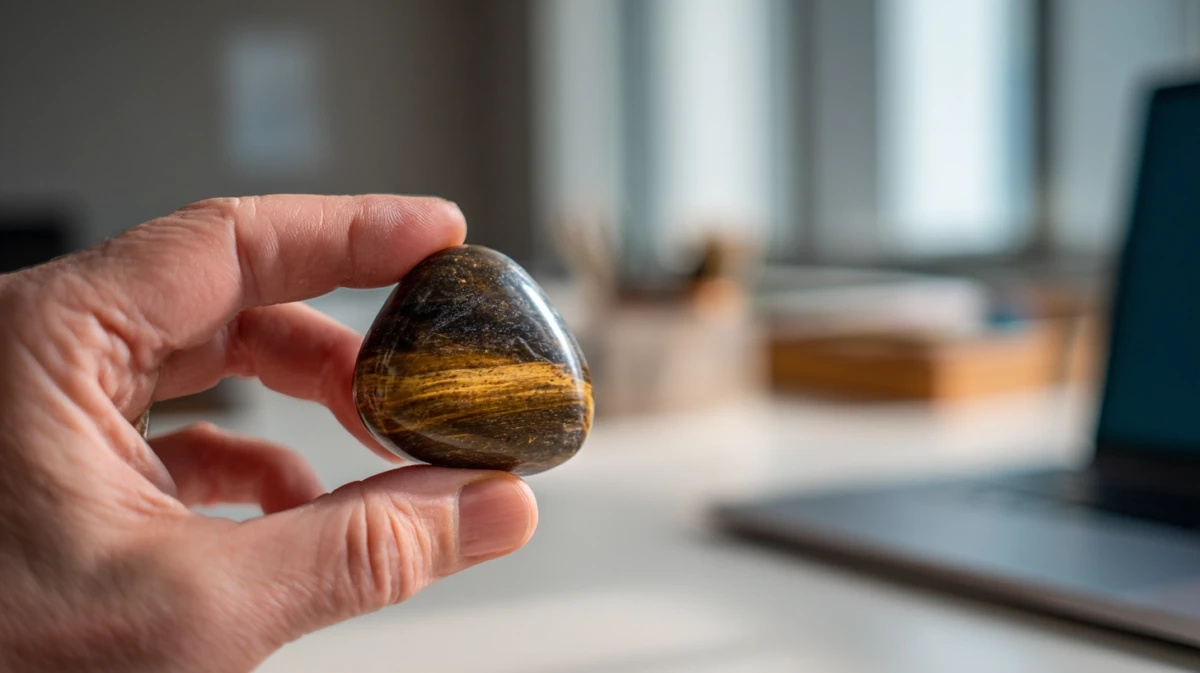
Pocket carry works when a bracelet draws the wrong kind of attention. A single polished palm stone in your front pocket gives you a tactile check-in you can use without anyone noticing. The move is simple: press your thumb across the surface of the stone for two or three seconds, feel the warmth and the smooth ridges of the banding, then release. That brief physical contact pulls your awareness out of spiraling thoughts and back into your body. It works best right before walking into a room, during a pause in a negotiation, or in the hallway before a difficult one-on-one. The stone itself does nothing magical here. The deliberate act of touching something tied to composure interrupts the mental loop, which is the actual mechanism.
The 60-second chatoyancy practice fits the two-minute window before you walk into a high-stakes meeting, pitch, or confrontation. Using the tilt-and-exhale method narrows your visual focus and quiets peripheral noise when your chest tightens and your thinking starts to compress.
Golden, Red, and Blue Tiger's Eye: Which Variant Fits
Golden tiger's eye is the standard. It's the most widely available, the least expensive, and the variant where chatoyancy tends to show most clearly because the golden-brown banding creates strong contrast with the light band. If you read the sections above and thought "that's what I want," golden is what you're searching for. No special sourcing required.
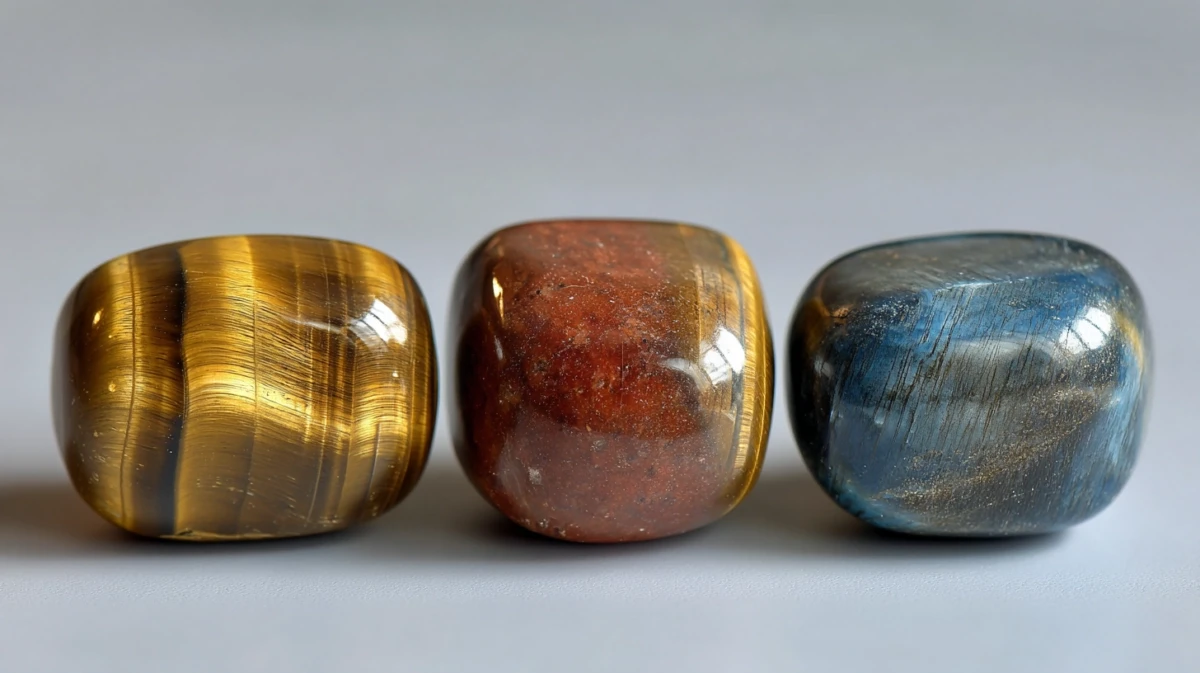
Red tiger's eye (sometimes called ox eye or bull's eye) gets its deeper reddish-brown color from heat treatment, though some pieces oxidize naturally over time. Its core function stays rooted in focus and composure, but practitioners often associate the red variant with added drive and forward momentum. Think of it as golden's slightly more aggressive sibling. Availability is good since most red pieces are heat-treated golden stock, so pricing stays comparable. The darker base color can reduce chatoyancy contrast slightly, making the light band harder to track in dim rooms.
Blue tiger's eye (hawk's eye) is the rarest of the three. It retains the original blue crocidolite fibers that haven't fully converted to iron oxide, giving it a cooler, steel-blue shimmer. Where golden and red lean toward activation and confidence, hawk's eye gets recommended for situations requiring calm observation rather than assertive presence. Listening-heavy meetings, conflict de-escalation, moments where you need to read the room before acting. Expect to pay roughly 30 to 50% more than golden for comparable quality, and check chatoyancy carefully before buying. Some blue pieces look striking in photos but show almost no light movement in person.
Pick golden if you want the strongest chatoyancy effect and a general-purpose focus stone. Go red if your pattern is more about hesitation than composure. Go blue if your pressure moments demand restraint more than confidence.
Tiger's Eye FAQ: Wear, Care, and Authenticity
Can you wear tiger's eye every day?
Tiger's eye sits at 7 on the Mohs scale, so it handles daily wear without scratching easily. Bracelets and rings hold up well through normal activity, though removing them before heavy lifting or chemical exposure keeps the polish intact longer.
What chakra is tiger's eye connected to?
Tiger's eye ties most directly to the solar plexus chakra (personal power, confidence) and the root chakra (grounding, stability). Golden and red variants lean toward solar plexus activation, while blue tiger's eye pulls closer to the throat chakra.
How do you cleanse and charge tiger's eye?
Running it under cool water for 30 seconds and placing it in moonlight overnight is the most common method. Brief sunlight works too, but prolonged UV exposure can fade the golden bands over time, so keep sun charging under an hour.
If you are handling raw, unpolished tiger's eye, avoid water cleansing entirely. Because the stone's original structure contains asbestos, it should never be soaked in drinking water to make crystal elixirs, even when fully polished.
How can you tell if tiger's eye is real?
Genuine tiger's eye feels noticeably cool and heavier than glass or resin imitations. Tilt it under a single light source: authentic chatoyancy produces a sharp, moving light band across natural color variation, not a uniform glow. Perfectly even stripes with no irregularity usually signal a dyed synthetic.
Another common imitation is fiber-optic glass, often sold simply as 'cat's eye.' While this glass produces a bright, highly uniform light band, it lacks the natural micro-fractures and earthy color variations found in genuine quartz.
Does tiger's eye contain asbestos?
Tiger's eye was formed from crocidolite asbestos through a geological process called pseudomorphism — the asbestos fibres were replaced by quartz while retaining their shape. The finished stone contains no free asbestos fibres and is considered safe to handle and wear. Concerns about asbestos in tiger's eye are based on its geological origin, not its composition as a finished gemstone.
Crystals for Men: The No-Nonsense Field Guide
If you want the full breakdown — the science, all ten stones, a daily carry practice, and a quiz that tells you exactly which stone to start with — the field guide has everything in one place.