Smoky Quartz Meaning: The Stone for Men Who Carry Too
This article contains affiliate links. If you purchase through our links, we may earn a small commission at no extra cost to you.
Smoky quartz meaning comes down to its geological origin: silicon dioxide tinted brown-to-black by natural radiation acting on trace aluminum inside the crystal lattice. Unlike tourmaline, which blocks incoming negativity, or obsidian, which forces buried tension to the surface, smoky quartz absorbs the low-grade stress you've already accumulated. Carry a tumble stone in your pocket, wear it as a bracelet, or set one on your desk for steady, passive grounding throughout the day.
What Smoky Quartz Actually Is (Geology, Not Lore)
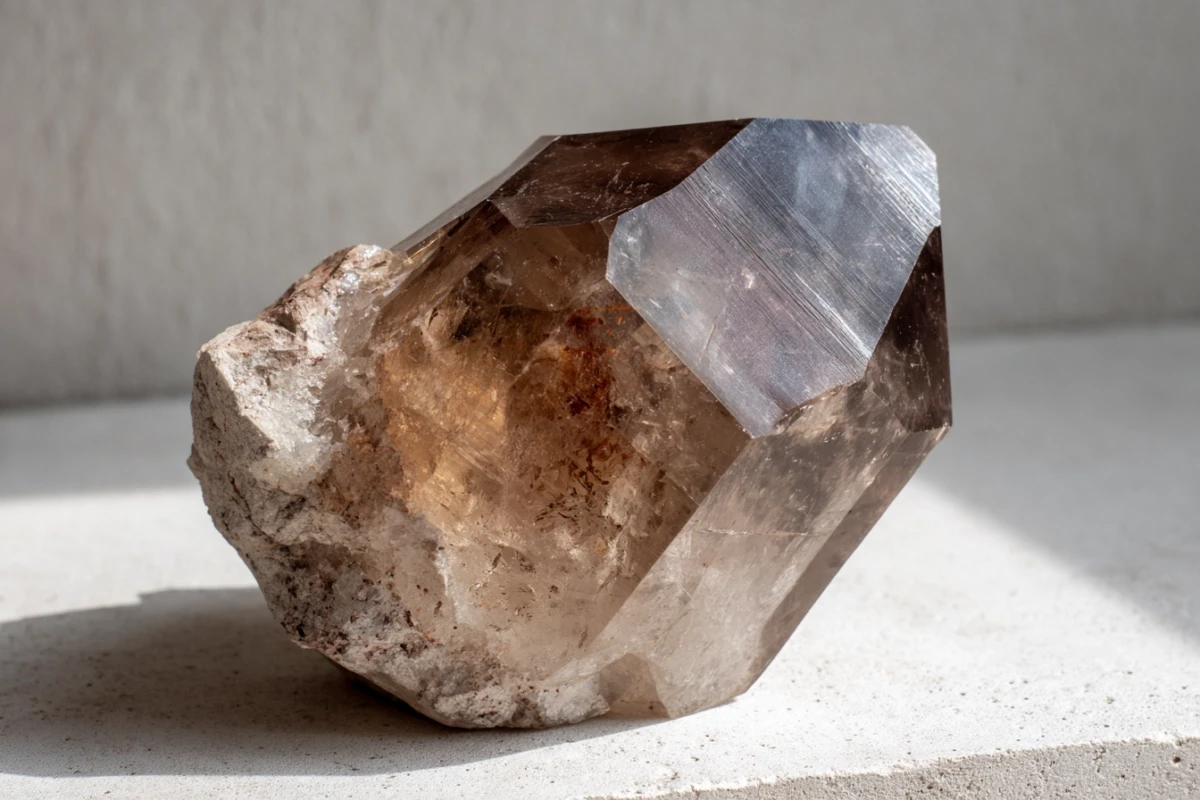
Smoky quartz forms when ordinary clear quartz (SiO₂) sits inside granite for millions of years. The granite emits low-level natural radiation, which interacts with tiny aluminum impurities trapped in the crystal structure. That interaction shifts how the crystal absorbs light, producing the characteristic brown, grey, or near-black color. No dye, no coating. The color is baked in at the atomic level by the same rocks surrounding it.
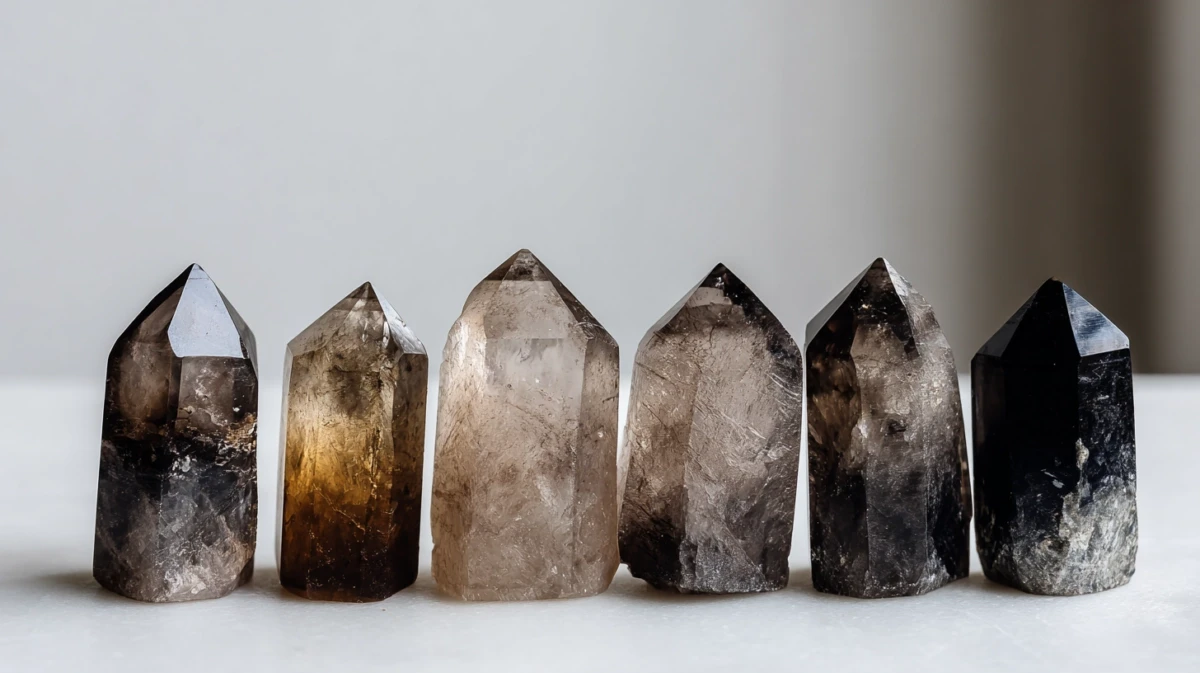
Physically, it scores 7 on the Mohs scale, hard enough to shrug off daily wear without scratching. The surface has a glassy (vitreous) luster, and the crystal system is hexagonal, meaning the raw points grow in six-sided columns when left undisturbed. Specimens range from fully transparent pale grey to completely opaque jet black, depending on how much radiation exposure and aluminum content they received.
The color spectrum has a few named varieties worth knowing. Morion is the darkest end: opaque, almost black, and often confused with black tourmaline at first glance. Cairngorm sits at the other end, a warm yellowish-brown named after Scotland's Cairngorm Mountains, where it's been collected for centuries. Between those two poles you'll find every shade of smoky brown and grey, which is part of why two smoky quartz pieces rarely look identical.
One detail that anchors the stone's history outside crystal circles: in 12th-century China, thin slices of smoky quartz were fitted into frames and worn as the earliest known sunglasses—a practical application that predates the modern use of crystals for men by centuries. Judges used them to hide their facial expressions during court proceedings. The stone's practical usefulness predates any metaphysical association by a wide margin.
Smoky Quartz Meaning and Properties in Practice
Three properties dominate how practitioners describe smoky quartz meaning: tension absorption, mental clarity, and grounding. None of these carry scientific backing, but each maps onto a physical experience most men recognize without needing metaphysical vocabulary.
Tension absorption, not stress blocking
Smoky quartz is consistently described as a stone that draws out accumulated tension rather than deflecting incoming pressure. This difference dictates how the stone is used. black tourmaline gets credited with shielding you from external negativity. Smoky quartz, by contrast, is said to work on what's already lodged in your body: the jaw you've been clenching since noon, the tight shoulders you stopped noticing two hours into a workday. Practitioners treat it as a slow drain for background stress that never peaked enough to register as a crisis but sat in your muscles anyway. That framing resonates with men who'd never call themselves stressed yet carry visible physical tightness through every waking hour.
Mental clarity under load
The second attributed property is sharper focus, specifically when your attention has been fragmented by task-switching or consecutive meetings. Crystal practitioners describe smoky quartz as cutting through mental fog by settling scattered energy downward. Translated into plain language: holding or wearing the stone becomes a tactile reset, a physical cue to stop cycling through unfinished tasks and narrow your attention to one thing. Whether the stone itself does anything or the ritual of reaching for it interrupts a distraction loop is an open question. The practical outcome reported by consistent users is the same.
Grounding without heaviness
Smoky quartz sits firmly in the root chakra tradition, alongside hematite and black tourmaline, meaning practitioners associate it with stability and physical presence. Where it differs from hematite's dense, almost metallic grounding is in texture: smoky quartz is described as grounding that still lets you move. You feel anchored but not sluggish. That makes it a common recommendation for men who travel frequently or shift between environments and notice they feel slightly unmoored without knowing why. The stone becomes a fixed reference point you carry with you, a consistent object in inconsistent surroundings.
These descriptions rely on practitioner frameworks rather than clinical claims. The value, for men who use smoky quartz consistently, tends to come from the physical ritual attached to the stone rather than from any measurable energy transfer.
Smoky Quartz vs Black Tourmaline vs Obsidian vs Clear Quartz
These four stones are often compared, but they serve different purposes. The confusion makes sense because they all get filed under "grounding" or "protection," but picking the wrong one means you're solving a problem you don't actually have.
Stone | Primary function | Best for | Not ideal when |
|---|---|---|---|
Smoky quartz | Absorbs accumulated tension | Background stress you've stopped noticing: jaw clenching, shallow breathing, low-grade fatigue that builds over weeks | You need to block specific external pressure from a person or environment |
Black tourmaline | Blocks incoming negativity | Acute situations where outside energy feels draining: difficult colleagues, crowded spaces, confrontational dynamics | The stress is internal and self-generated rather than coming from outside |
Black obsidian | Surfaces buried material | Forcing honest confrontation with patterns you've been avoiding: denial, suppression, unprocessed grief | You're already overwhelmed and need stabilization, not more excavation |
Clear quartz | Amplifies existing energy | Pairing with another stone to strengthen its effect, or when you need general mental sharpness without a specific emotional load | You're carrying heavy tension, because amplification makes that worse |
Amethyst | Calms overactive thinking | Racing thoughts at night, decision fatigue, emotional reactivity that spikes fast | The issue is physical tension or body-held stress rather than mental noise |
While smoky quartz and black tourmaline are both considered "grounding stones," they handle stress from different directions. Tourmaline works like a shield, deflecting what's coming at you. Smoky quartz works like a sponge, drawing out what's already settled into your body. If you're not sure which one fits, ask yourself whether the tension started outside you or built up quietly from within. Most men carrying chronic low-level stress without a clear source land on smoky quartz. If there's a specific person or environment making things worse, tourmaline is the sharper pick.
You can also combine the two if you are dealing with both internal burnout and a toxic workplace. Keeping a tourmaline on your desk to manage the room's energy while carrying a smoky quartz in your pocket for personal tension is a common, highly effective pairing.
Obsidian deserves a warning: it's not a comfort stone. Practitioners who work with it consistently describe it as confrontational, pulling suppressed material to the surface whether you're ready or not. Reaching for obsidian during an already difficult stretch can feel like pouring fuel on a fire rather than settling anything down.
How to Use Smoky Quartz Throughout Your Day
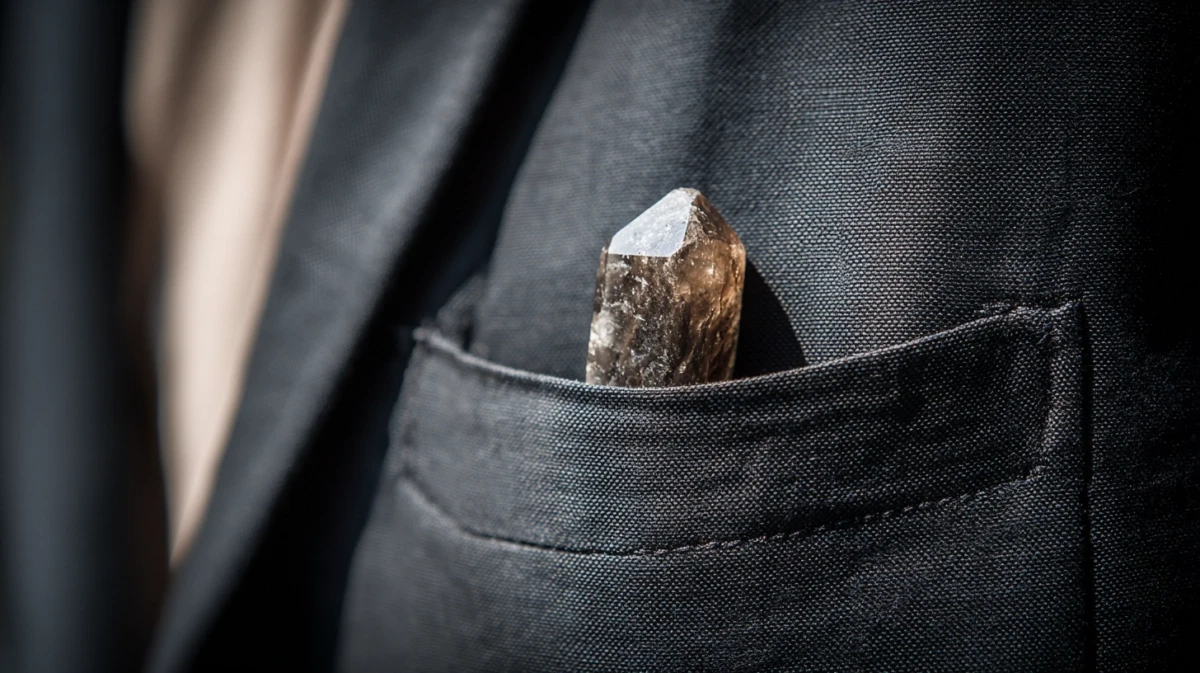
A tumbled smoky quartz in your front pocket sits against your thigh, which means you notice it every time you stand up, shift weight, or reach for your phone. This physical interruption serves as a deliberate cue to check your posture or breathing. When you feel the stone, take one slow breath and unclench whatever you're holding tight: jaw, shoulders, fists. The pocket carry works best during commutes or meetings where tension builds without a clear trigger. Keep it in the same pocket each day so the gesture becomes automatic rather than something you have to think about.
Wrist Carry for Sustained Contact
A smoky quartz bracelet stays in your peripheral vision all day, which changes how it functions compared to a pocket stone. You don't reach for it; you glance at it. That passive reminder tends to catch tension earlier, before it compounds into the 2pm jaw-clench. The trade-off is that bracelets with smaller beads (6mm or 8mm) feel less intrusive but also give less tactile feedback. A smoky quartz bracelet in 8mm keeps the stone in contact throughout the day without drawing attention. If you want something you actually feel on your wrist, go with 10mm beads and accept that it looks like jewelry. Rotating the bracelet with your opposite hand during a stressful call gives your hands something deliberate to do instead of fidgeting.
Desk Placement During Focused Work
Place the stone next to your monitor, not behind it. If you have to lean to see it, it loses its value as a visual cue. A polished point or small tower works better here than a tumbled stone because it stays put and catches light, which pulls your eye toward it during screen fatigue. When you notice it, treat that as a cue to drop your shoulders and take a single deep exhale. Some people rotate their desk stone weekly with a pocket stone to keep the visual cue from becoming invisible through familiarity.
Aim for a piece that is at least three to four inches tall. Anything smaller tends to blend into the background clutter of coffee mugs and sticky notes, defeating its purpose as a visual pattern interrupt.
Bedside Placement
Set a piece of smoky quartz on your nightstand, close enough to touch from your pillow. A practical approach is to hold the stone for 30 seconds while doing slow nasal breathing before putting your phone down for the night. The stone becomes the physical boundary between screen time and sleep. If you wake at 3am with a racing mind, reaching for the stone instead of your phone gives you a tactile anchor that doesn't blast blue light into your eyes.
Pairing any of these placements with a structured breathwork practice sharpens the effect. The stone gives you the physical cue; the breath practice gives your nervous system something concrete to do with that cue.
How to Spot Fake or Artificially Irradiated Smoky Quartz
A significant portion of smoky quartz on the market started life as clear quartz, then got blasted with x-rays in a lab to force the brown-black color. The result looks like smoky quartz at first glance, but the stone never developed its color through the slow geological process of natural radiation acting on aluminum impurities inside granite. Knowing what to look for saves you from paying for a stone that carries none of the qualities you're after.
Visual Signs of Natural vs. Irradiated Smoky Quartz
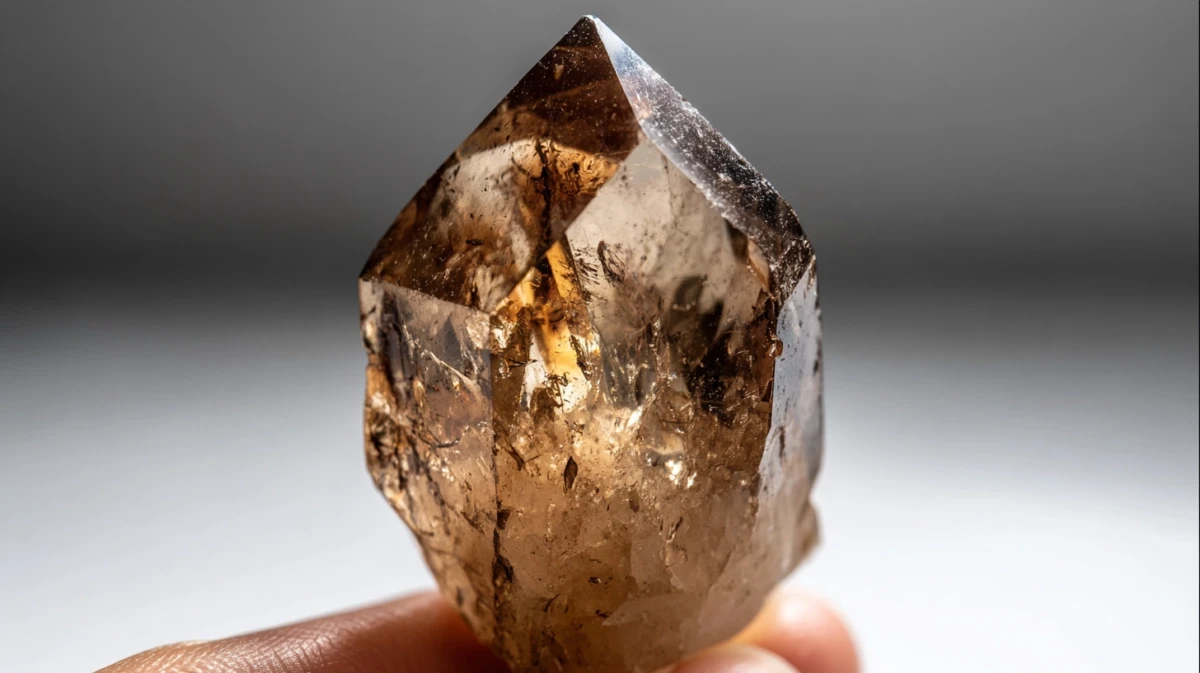
Genuine smoky quartz almost always shows uneven color distribution. The brown or gray tone shifts across the crystal, darker near the base and lighter toward the tip, or with visible bands and zones where the radiation exposure varied over thousands of years. You'll often see small inclusions, tiny internal fractures, or wispy veils inside the stone. That imperfection is the signature of a real specimen.
Artificially irradiated pieces tend to look completely uniform. The color sits at the same intensity throughout, often an extremely dark brown or near-black that lacks any gradient. If the stone is opaque, perfectly even in tone, and completely free of internal character, treat that as a warning sign rather than a mark of quality. Suspiciously low prices compound the problem: a large, flawless, deeply colored smoky quartz point selling for a few dollars almost certainly didn't form naturally.
How to Source Untreated Smoky Quartz
A reputable mineral dealer will disclose whether a stone has been treated or enhanced. Ask directly about origin and treatment. Sellers who can name the mine or region (Minas Gerais, the Swiss Alps, Madagascar) and confirm the specimen is untreated are worth the slightly higher price. Local rock and mineral shops let you hold the stone, check the color gradient under different light, and inspect for natural inclusions before buying. Online, look for sellers who photograph each individual piece rather than using a single stock image for dozens of listings.
Skip any vendor who lists smoky quartz in bulk at identical sizes and colors without treatment disclosure. That uniformity points to a batch of irradiated clear quartz, not stones pulled individually from the earth.
Common Questions About Smoky Quartz Care and Usage
Is smoky quartz good for anxiety?
Many people use smoky quartz as a grounding anchor during anxious moments, holding it to shift focus from racing thoughts to physical sensation. It won't replace professional support, but as a tactile reset tool it's one of the more commonly reached-for stones for stress.
Can you wear smoky quartz every day?
With a Mohs hardness of 7, smoky quartz handles daily wear well in rings, pendants, and bracelets without scratching easily. Avoid exposing jewelry to harsh chemicals or prolonged direct sunlight, which can gradually lighten the stone's color over months.
How do I cleanse smoky quartz?
Lukewarm water with mild soap and a soft brush is the simplest method. Some practitioners prefer moonlight overnight or smudging with sage. Skip prolonged soaking. Ultrasonic cleaners work fine given the stone's hardness, though they're rarely necessary for routine care.
If your piece has raw, unpolished clusters or sits on a fragile matrix, avoid submerging it entirely. Instead, use a damp microfiber cloth to wipe away dust without risking damage to the delicate secondary minerals.
Will smoky quartz fade in sunlight?
Prolonged UV exposure can lighten smoky quartz over time, shifting deep browns toward pale gray. A few hours of indirect light won't cause damage, but storing or displaying your stone away from windowsills that catch direct afternoon sun keeps the color stable long-term.
What chakra is smoky quartz associated with?
Smoky quartz is consistently linked to the root chakra at the base of the spine, the energy center tied to stability, security, and physical grounding. This association is why it appears so often in grounding-focused practices alongside garnet and black tourmaline.
Crystals for Men: The No-Nonsense Field Guide
If you want the full breakdown — the science, all ten stones, a daily carry practice, and a quiz that tells you exactly which stone to start with — the field guide has everything in one place.