Crystals for Stress Relief: The Stones That Actually Help Under Pressure
This article contains affiliate links. If you purchase through our links, we may earn a small commission at no extra cost to you.
Smoky Quartz is the most practical starting stone for crystals for stress relief when the pressure is constant rather than triggered by a single event. Amethyst suits racing thoughts and disrupted sleep, Black Tourmaline works as a pattern interrupt during acute spikes, and Labradorite tends to steady people navigating major life transitions. Matching the stone to the specific type of pressure matters more than picking one all-purpose crystal.
Chronic Background Pressure: Smoky Quartz and Lepidolite
Most stress isn't dramatic. It's the low-grade hum of a workload that never fully clears, the ambient tension you carry in your jaw or shoulders without noticing until someone points it out. That sustained cognitive load is the pattern where Smoky Quartz and Lepidolite get mentioned most often by consistent users.
If you're new to using stones for stress management, starting with a practical framework helps cut through the noise. Our crystals for men guide covers the fundamentals of choosing, carrying, and integrating stones into daily routines without the ceremonial overhead.
Smoky Quartz
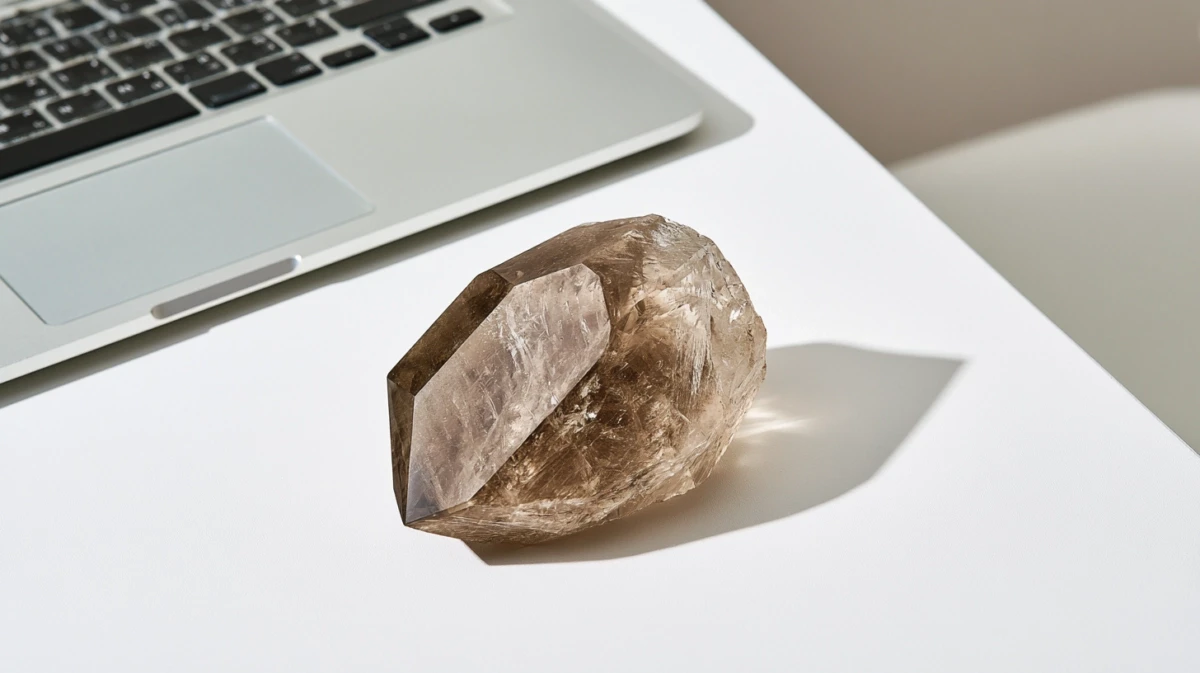
Smoky Quartz is silicon dioxide with natural irradiation that gives it a translucent brown-to-gray color. Users who carry it for background stress describe a grounding effect without sedation: less mental fog, not less energy. The typical use case is pocket carry during a long work stretch or placed on a desk where you can reach it during calls. People who report the strongest response tend to hold it briefly when they notice tension building rather than treating it as passive decoration. Where it falls short: if your stress manifests as racing thoughts at night, Smoky Quartz alone rarely addresses that. It's a daytime, load-bearing stone.
Lepidolite
Lepidolite is a lithium-bearing mica mineral, and that lithium content is the reason it keeps appearing in stress conversations. Nobody is absorbing therapeutic doses of lithium through skin contact, but users consistently report a softening of ambient anxiety when carrying Lepidolite during high-tension periods. It suits the kind of stress that sits in your chest rather than your head. A flat lepidolite piece works well for this. Desk placement or keeping a flat piece in a jacket pocket are the most common approaches. Lepidolite is softer than most carry stones (2.5 to 3 on the Mohs scale), so it scratches easily if tossed in with keys or coins.
Racing Thoughts and Sleep Disruption: Amethyst vs Howlite
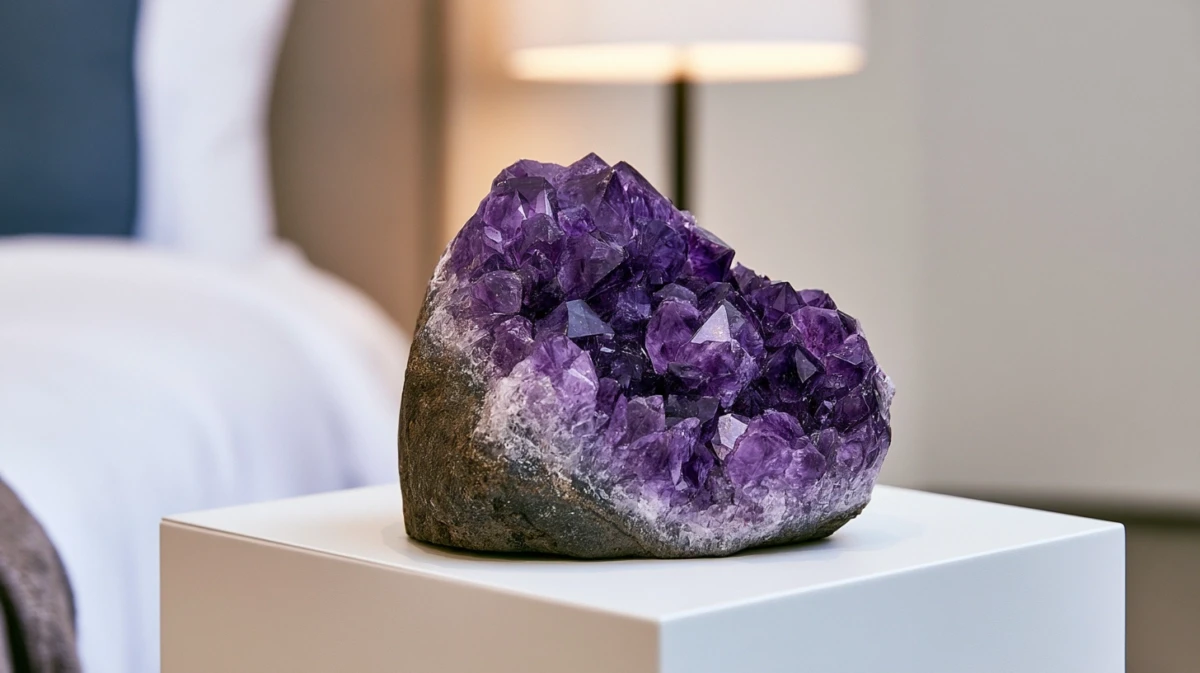
Amethyst targets the loop where your mind replays conversations, deadlines, or worst-case scenarios the moment your head hits the pillow. Howlite works differently: it suits the kind of stress that sits in your jaw, your shoulders, or the back of your neck, the physical tension that keeps you from settling even when your thoughts aren't particularly loud.
Amethyst | Howlite | |
|---|---|---|
Best stress pattern | Analytical overthinking, mental replay loops | Physical restlessness, clenched jaw, tension headaches |
Typical placement | Nightstand or under the pillow | Held in the palm or placed on the forehead before sleep |
Reported effect | Quiets mental chatter, eases the transition to sleep | Softens muscular tension, slows the urge to toss and turn |
Cost and availability | Widely available; a small amethyst cluster is widely available on Amazon | Inexpensive and easy to find; tumbled howlite stones are widely available on Amazon |
It is common to experience both mental and physical tension at night, but one usually dominates. If you lie awake constructing tomorrow's argument with your boss, amethyst is the more direct match. If you notice your fists are balled up and your breathing is shallow before you've even had a single anxious thought, start with howlite.
Pairing either stone with a short breathwork routine before bed sharpens the effect. Two to three minutes of slow exhale-dominant breathing while holding the stone creates a physical cue your nervous system starts to associate with winding down. The stone alone won't override a racing mind, but anchoring it to a breath pattern gives it a functional role instead of just sitting on your nightstand collecting dust.
Acute Stress Spikes: Black Tourmaline as an Interrupt Tool
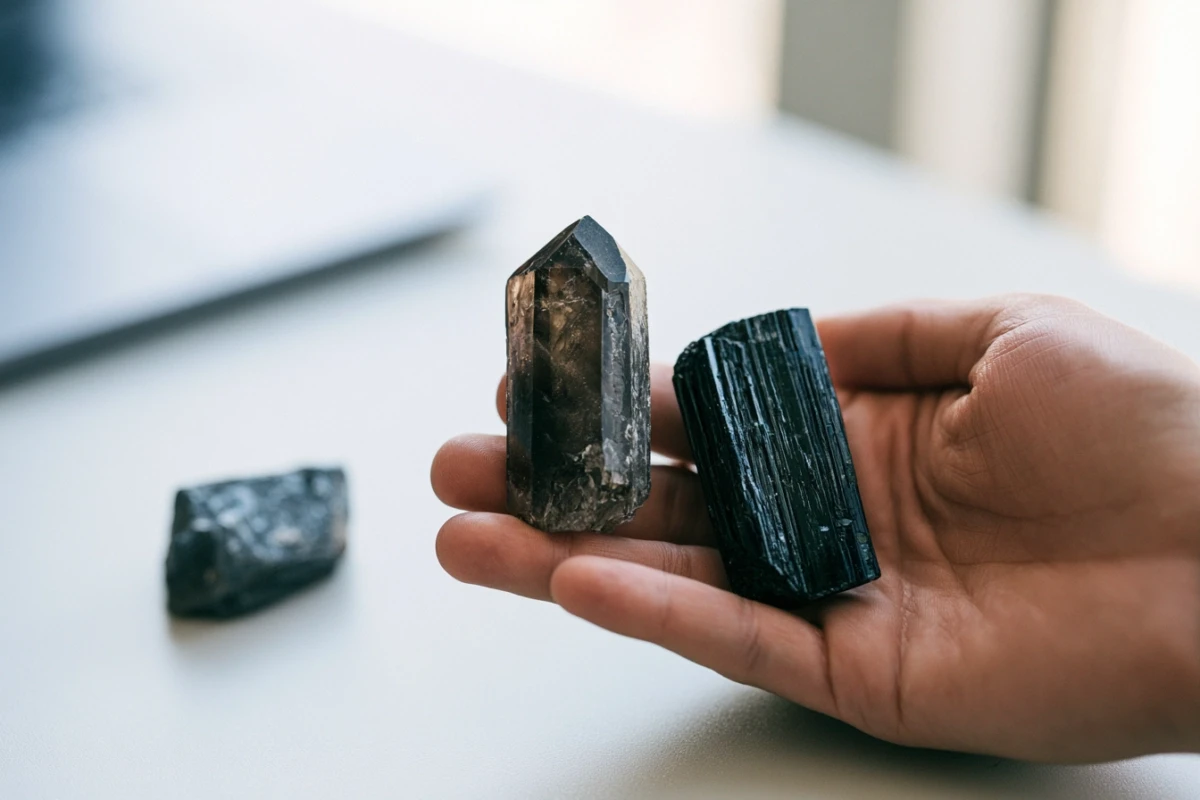
Black Tourmaline's protective properties stem from its dense, opaque structure and surprising weight for its size. That weight matters when stress hits fast, because the physical sensation of gripping something solid in your pocket creates a tactile interrupt before your thinking brain catches up to the adrenaline.
The mechanism is simple. A difficult conversation starts escalating, or you walk into a room where the stakes just doubled. Your hand finds the stone. The texture of raw Black Tourmaline is ridged and striated, almost rough enough to scratch, which forces sensory attention away from the mental spiral and into your fingertips. That shift from abstract threat to physical contact is enough to break the first seconds of a fight-or-flight loop, which is when most reactive decisions get made.
A piece like this one gives you the raw texture that makes tourmaline effective as an interrupt tool. Front trouser pocket, dominant hand side. You want access without reaching across your body or fumbling. A tumbled piece works if you prefer smooth contact, but the raw form gives a stronger sensory signal. It is usually easy to keep a hand resting near a pocket unnoticed during a meeting.
Keep in mind that Black Tourmaline does nothing for the slow, cumulative pressure covered earlier. It's a circuit breaker, not a load-bearing stone. If your stress pattern involves feeling disconnected from your body rather than overwhelmed by it, Hematite is a better fit. Its iron-heavy weight pulls attention downward, back into physical sensation, which counters dissociation more directly than Tourmaline's sharp texture does.
For men who need a wearable option that maintains that grounding effect throughout the day, a hematite bracelet provides constant tactile weight without requiring pocket access.
Pick Black Tourmaline when the stress is sudden and your body knows before your mind does.
Stress from Transition and Uncertainty: Where Labradorite Fits
Career changes, divorce, relocating to a new city, questioning your purpose at 35 or 45: these situations don't spike your cortisol the way a confrontation does, and they don't grind you down the same way a brutal workload does. Transitional stress sits in a different register. It's the low hum of not knowing who you're becoming, and most crystals for stress relief aren't really aimed at that feeling.
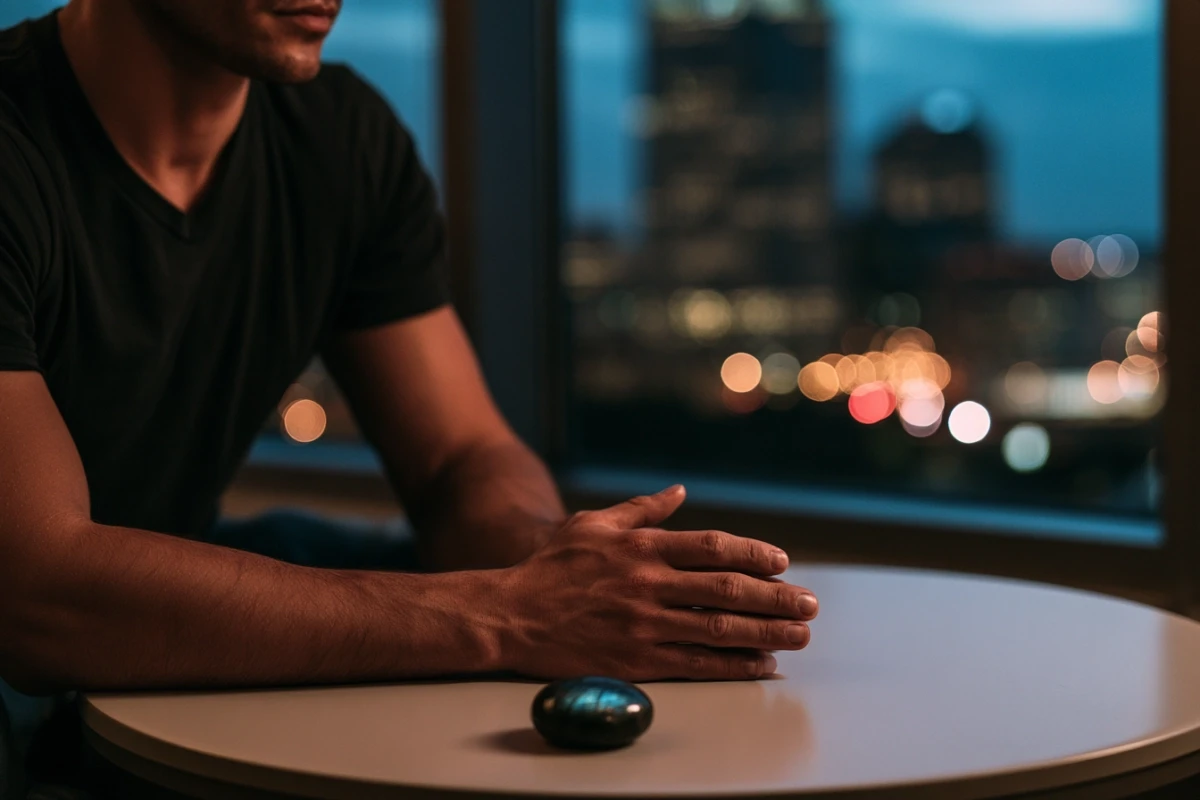
Labradorite shows up in crystal communities as the stone people reach for during identity-level shifts. Users consistently describe it as steadying when the ground beneath a major life decision feels unstable, not calming in the way amethyst quiets mental chatter, but more like a reminder that disorientation is part of the process rather than proof that something is wrong.
It is important to note that labradorite won't resolve the actual uncertainty. A man leaving a 15-year career still needs to sit with the discomfort of not having answers. The stone works best as a tactile anchor alongside practices that process the deeper material, whether that's structured journaling, breathwork, or honest conversation with someone who won't just tell you what you want to hear. Treating any single stone as a solution for existential pressure is a mistake. Labradorite earns its place in a carry kit for transition periods, but it belongs next to real inner work, not instead of it.
Building a Three-Layer Stress Relief Carry
Three stones, three locations, each tied to a routine you already have. That's the entire system.
Pocket stone: daytime interrupts
Smoky quartz or black tourmaline in your front pocket, dominant-hand side. You reach for it when pressure spikes during a meeting, a commute, or a conversation that starts going sideways. Tie the placement to your morning routine: keys, wallet, stone. If you skip the anchor to an existing habit, the stone often ends up forgotten on your dresser within a few days.
Desk stone: sustained work pressure
A piece of smoky quartz sits where you can see it without reaching. The point isn't to hold it constantly but to break the tunnel vision that builds over hours of screen work. When you notice the stone in your peripheral vision, it functions as a micro-pause cue. Placing it next to your water glass works because you already glance there. Labradorite earns this spot instead if your current work stress is rooted in a role change or an uncertain project outcome.
Nightstand stone: sleep transition
Amethyst on the nightstand, placed during your last deliberate act before lights out. Not scrolled past, not buried under a phone charger. The placement ritual matters more than the stone's proximity to your head. One deliberate moment of setting it down signals the shift from processing the day to releasing it.
Cleanse all three stones once a week under cool running water for about thirty seconds each. Full-moon rituals and sage bundles are optional; consistency matters more than ceremony.
However, be careful with softer minerals like lepidolite or howlite, which can degrade or lose their polish if exposed to water frequently. For these porous stones, resting them on a piece of selenite or simply leaving them on a windowsill overnight is a safer maintenance method.
Inner Kingdom's Grounding Ritual Kit (€27) packages breathwork and grounding practices that slot directly into this three-layer structure, particularly the morning pocket check and the nightstand wind-down.
Frequently Asked Questions About Stress Relief Crystals
Do crystals actually help with stress?
No clinical evidence supports crystals directly reducing cortisol or anxiety biomarkers. Their value sits in the ritual layer: holding a cool stone during a stress spike creates a tactile interrupt that redirects attention, which is a grounding technique with real psychological backing regardless of the object used.
What is the best crystal for stress and anxiety?
Amethyst is the most versatile starting point because it covers both daytime tension and sleep disruption. For chronic, low-grade pressure that builds over weeks, smoky quartz or lepidolite tend to suit the pattern better than amethyst does.
If your anxiety manifests as sudden, overwhelming panic rather than just background worry, black tourmaline is often the better choice. Its heavy, grounding nature provides a much stronger sensory interrupt when you need to quickly pull your focus back to the present moment.
Should I carry a crystal or wear it for stress relief?
A pocket stone gives you something to grip during acute moments, which makes the physical contact deliberate rather than passive. Wearing a crystal as jewelry keeps it present but removes the conscious act of reaching for it, so the grounding effect is weaker for most people.
How do you cleanse stress relief crystals?
Cool running water is the most practical method. While moonlight and sage smoke are popular alternatives, a quick rinse doesn't require timing around lunar cycles or sourcing specific materials.
Can you combine multiple crystals for stress?
Combining works best when each stone covers a different stress pattern rather than doubling up on the same one. For example, you might pair a daytime pocket stone with a different crystal on your nightstand for sleep.
Crystals for Men: The No-Nonsense Field Guide
If you want the full breakdown — the science, all ten stones, a daily carry practice, and a quiz that tells you exactly which stone to start with — the field guide has everything in one place.
The Grounding Ritual Kit
If you want a structured 7-day grounding practice to use alongside these stones, The Grounding Ritual Kit gives you the full system — breath, stillness, and returning to your center under pressure.
Not ready to buy? Start here instead:
Five short sessions to train calm under pressure — the perfect companion to whatever stone you start with.