Amethyst Meaning: The Stone for Men Who Need to Switch Off

This article contains affiliate links. If you purchase through our links, we may earn a small commission at no extra cost to you.
Amethyst is purple quartz with a chemical formula of SiO₂, colored by trace iron and natural gamma irradiation trapped inside the crystal lattice. The amethyst stone meaning for men comes down to one thing: it's the stone you reach for when your brain won't stop running after the day is done. Most guys who carry crystals for grounding during pressure reach for black tourmaline or hematite. Amethyst solves the opposite problem: switching off once the pressure is gone.
What Amethyst Actually Is: Geology, Not Mysticism
Amethyst belongs to the quartz family, sharing the same silicon dioxide backbone as smoky quartz and citrine. What separates it is color. Iron atoms (Fe³⁺ and Fe⁴⁺) substitute into the crystal structure during formation, and natural gamma irradiation from surrounding rock alters their charge state. That interaction produces the purple. No iron, no purple. No irradiation, no purple. Both have to be present.
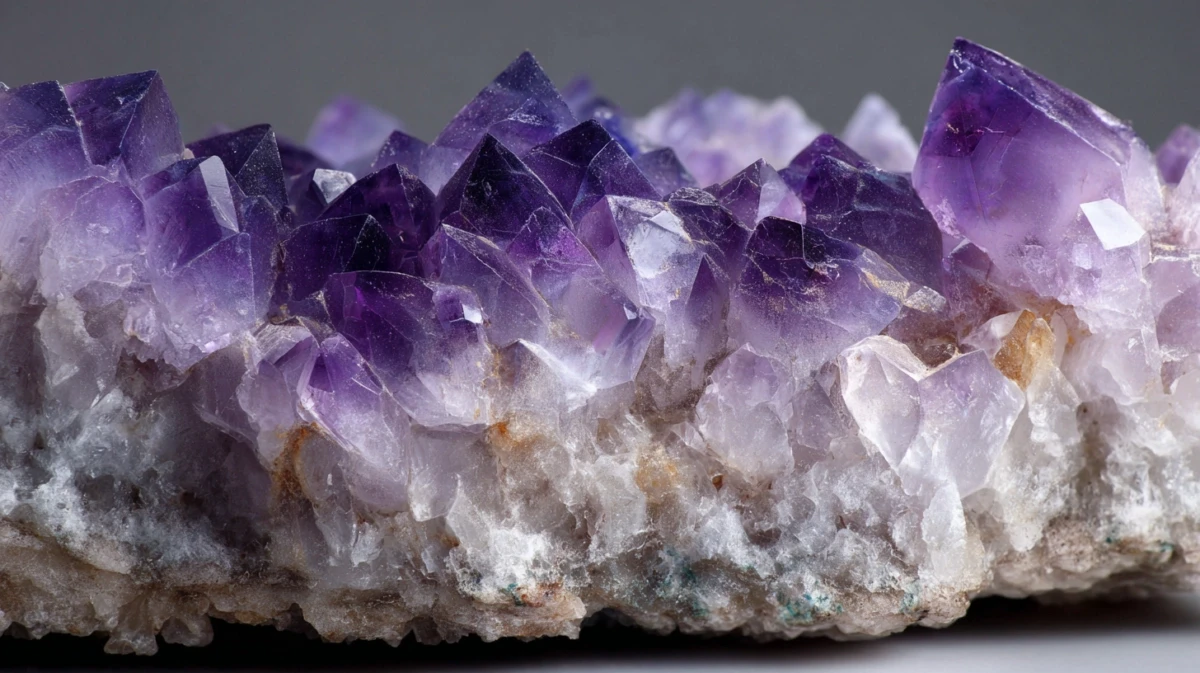
The crystal system is hexagonal (trigonal), the same six-sided geometry you see in all macrocrystalline quartz. Hardness sits at 7 on the Mohs scale, which makes it harder than steel and durable enough for daily handling without scratching.
Color runs from barely-there lavender to saturated violet so deep it looks almost black in low light. The shade gem dealers prize most is called "Deep Siberian," a rich purple with red and blue flashes that originally came from Russian deposits. Today, most commercial amethyst is mined in Brazil and Uruguay, with significant deposits in Zambia and parts of India. Brazilian geodes can weigh hundreds of kilograms, which is why amethyst clusters remain relatively affordable compared to other semiprecious stones.
This affordability makes it an accessible starting point for most people. Color depth drives price more than size, and knowing the geology keeps you from paying premium for dyed glass.
Amethyst Properties: What It Does to Your Nervous System After a Long Day
Three reported effects show up consistently among men who keep amethyst on a nightstand or hold a piece during an evening wind-down: reduced thought-looping, faster sleep onset, and a noticeable drop in the emotional residue that follows high-pressure work.
Mental quieting after cognitive overload
You close the laptop at nine, but your brain keeps replaying the conversation you should have handled differently. That loop, where the same three thoughts cycle without resolution, is the pattern men describe amethyst interrupting. Holding a cool cluster or placing one within arm's reach during a deliberate pause seems to give the mind a physical anchor point, something to land on instead of spinning.
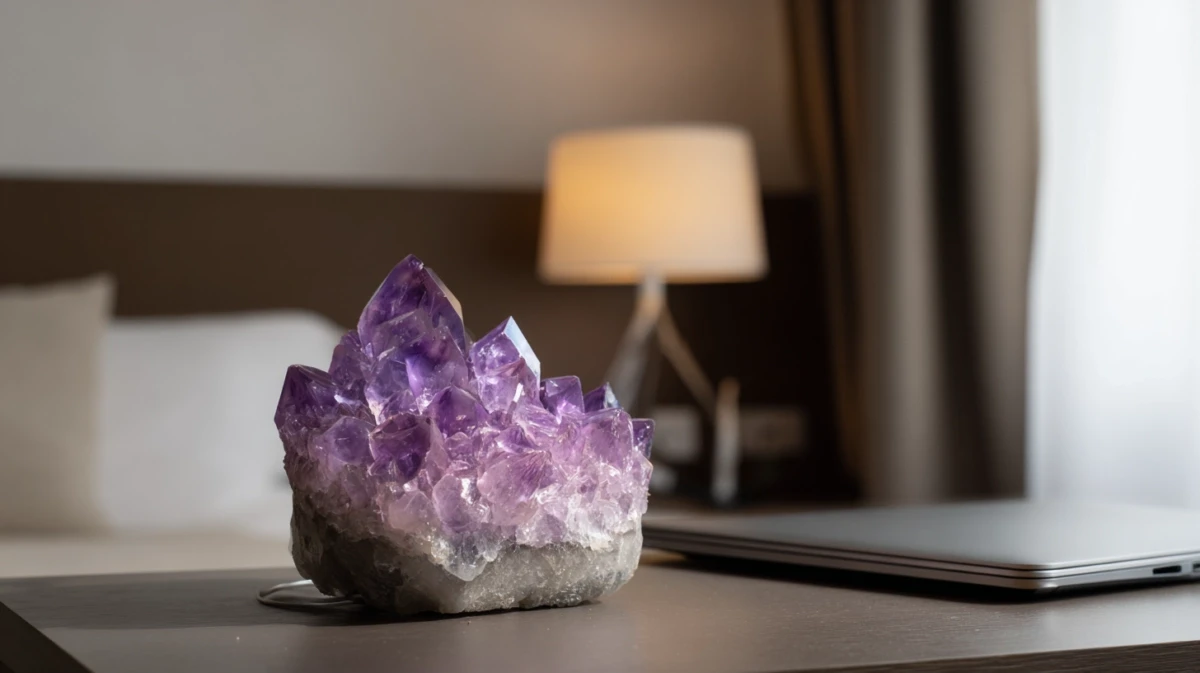
Sleep that actually arrives
Lying in bed while your body is exhausted but your head still runs tomorrow's schedule is a specific kind of insomnia. Men who place an amethyst cluster on the nightstand report that the transition from "awake and wired" to drowsy shortens. Not by hours, but enough to notice across a week. The stone itself doesn't sedate you. It marks the boundary between work-mode and rest-mode, which matters when your environment otherwise gives no signal to stop.
For men who need active tension management during the day rather than evening decompression, grounding stones serve a different function in the daily routine.
Emotional decompression without talking it out
After a day of managing people, absorbing tension, or making decisions under pressure, there's a residual weight that doesn't have a name. Most men won't journal about it or call a friend. Sitting with an amethyst piece for five quiet minutes, paired with slow breathing, gives that pressure somewhere to go without requiring language.
One thing worth stating plainly: none of these effects are clinically proven. They come from traditional use and personal reports, not peer-reviewed trials. Amethyst won't replace therapy, medication, or professional help for chronic insomnia or anxiety. What it can do is serve as a physical cue inside a wind-down routine, and for many men, that cue alone changes the pattern.
Why Men Specifically Struggle to Switch Off: and Where Amethyst Fits
A twelve-hour day ends, but the mental loop keeps running. You replay a conversation with a client. You rehearse tomorrow's meeting. You scan for problems that don't exist yet. The body sits on the couch, the mind stays at the desk. This pattern hits men who tie their identity to output especially hard, because "doing nothing" feels like falling behind.
Three situations where this shows up most clearly:
Post-work rumination, where the commute home changes nothing internally. The environment shifts but the cognitive gear stays locked. Stress-driven insomnia, where the body is exhausted but the brain treats 11 p.m. like a strategy session. And the inability to be present at home, where a partner or kid gets a man who is physically there but mentally still solving work problems.
The amethyst stone meaning for men in this context is blunt: it works as a transition object. Not because purple quartz rewires your prefrontal cortex, but because a physical object used consistently at the same point in your evening creates a behavioral cue. Pick it up when you sit down after work, hold it during five minutes of slow breathing, place it on the nightstand before sleep. Over weeks, the brain starts associating that object with "pressure ends here." The stone becomes a boundary marker you can actually touch.
Where it falls short: if the racing thoughts come from unresolved anxiety or chronic insomnia, a crystal won't fix the root cause. A ritual object supports a wind-down habit. It doesn't replace one that needs clinical attention.
Amethyst vs. Smoky Quartz vs. Clear Quartz: Picking the Right One
All three are quartz, same mineral family, same 7 on the Mohs scale. The difference is timing and what you need the stone to do.
Amethyst is the evening stone. Its role in a routine is decompression: slowing racing thoughts, marking the shift from output mode to rest. Smoky quartz works the opposite end of the day. It absorbs tension during high-pressure hours, acting as a grounding anchor when stress builds in real time. Clear quartz sharpens rather than softens. It amplifies focus and mental clarity, which makes it useful for deep work but counterproductive when the goal is switching off.
Amethyst | Smoky Quartz | Clear Quartz | |
|---|---|---|---|
Primary use | Wind-down, sleep | Daytime grounding | Focus, amplification |
Best timing | Evening, before bed | During work or commute | Morning, deep-work blocks |
Placement | Nightstand, held during breathwork | Pocket carry, desk | Desk, workspace |
Look | Purple, pale lavender to deep violet | Translucent brown-grey | Colorless, transparent |
Pairs with | Evening ritual, breathwork | Black tourmaline, hematite | Tiger's eye, obsidian |
If you only buy one, the deciding question is simple: does your problem hit hardest during the day or after it ends? Daytime tension that you can feel building in your chest and jaw points toward smoky quartz. A mind that won't stop replaying the day once you sit down at home points toward amethyst. Clear quartz is the wrong first pick for either problem because it intensifies mental activity rather than reducing it.
Most men who carry smoky quartz during the day and keep an amethyst cluster on the nightstand end up covering both scenarios without overlap.
How to Actually Use Amethyst: Placement, Timing, and Routine
Nightstand Cluster for Sleep
Place a small amethyst cluster within arm's reach on your nightstand, not across the room where it becomes decoration you forget about. The stone works as a behavioral anchor: seeing it when you get into bed signals the shift from doing to done. Kill overhead lights and screens before you settle in. Dim light and the cluster in your peripheral vision create a consistent pre-sleep environment your brain starts associating with shutdown. A cluster rather than a single point catches low light in a way that draws brief attention without stimulating you.
Because clusters have dozens of tiny crevices, they collect dust quickly when left out on a nightstand. Rinse the stone under lukewarm tap water every few weeks and let it air dry on a towel to keep the crystal faces reflective and clean.
Holding a Point During Evening Breathwork
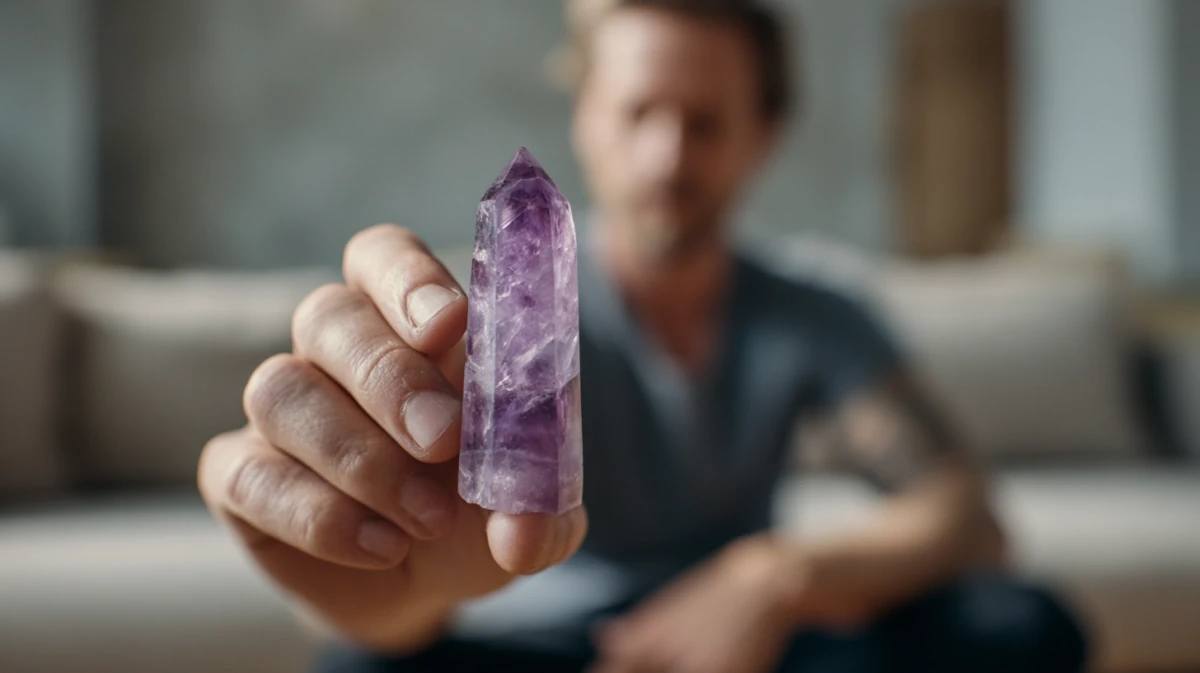
Grip a single amethyst point in your non-dominant hand, tip facing away from your wrist, during five minutes of box breathing (four counts in, four hold, four out, four hold). The slight pressure of the point against your palm gives your attention somewhere physical to land when your mind tries to drift back to the inbox. Inner Kingdom runs a free 5-Day Breathwork Challenge that pairs well with this if you want a structured starting point rather than winging it. Keep sessions short. Ten minutes of genuine focus beats thirty minutes of half-present breathing every time.
Desk Placement as a Wind-Down Cue
Set a small amethyst piece at the edge of your monitor or beside your keyboard during the last hour of your workday. This isn't about the stone doing something to you while you type. It's a visual interrupt: every time you glance at it, you're reminded that the day has an endpoint and you're approaching it. When you leave the desk, leave the stone there. The separation reinforces the boundary between work mode and everything after.
Buying Amethyst Without Getting Burned
Color depth matters, but not the way most sellers frame it. Deep purple amethyst with strong saturation is generally considered higher quality, yet pale lavender pieces are still genuine quartz colored by the same iron and irradiation process. A lighter stone works just as well on your nightstand. Where color becomes a red flag is uniformity: natural amethyst shifts in tone across the crystal, with lighter and darker zones. If every square millimeter is the exact same vivid purple with zero variation, you're likely looking at dyed glass or a synthetic.
Other tells for fakes: too-perfect clarity with no inclusions at all, and pricing that seems absurdly low for the size. Genuine amethyst at 7 on the Mohs scale has natural imperfections. A flawless, deeply saturated piece selling for a few dollars should raise questions.
Choosing Between Clusters, Points, and Tumbled Stones
A cluster with multiple points works best as a nightstand or desk piece because it sits stable and catches low light. A single terminated point suits breathwork sessions where you want something to hold with a defined shape pressing into your palm. Tumbled stones are the most portable option, small enough for a pocket, but they lack the visual presence that makes a desk or bedside piece function as a behavioral anchor.
Palm-sized clusters tend to be the most common entry point and the easiest to find well-reviewed.
Preventing Sun Damage and Color Fading
Amethyst loses color when exposed to prolonged UV light. A windowsill that gets direct sun for hours each day will bleach a deep purple stone to washed-out grey over months. Keep it on a nightstand, a shelf away from the window, or inside a desk drawer during daytime. This is the single most common way people ruin a good piece without realizing it until the damage is done.
Frequently Asked Questions About Amethyst
Can amethyst help with sleep?
Many men report falling asleep faster with amethyst on the nightstand, likely because it anchors a wind-down ritual rather than doing anything pharmacological. The stone itself doesn't sedate you, but a consistent pre-sleep routine built around it can train your nervous system to downshift.
Where should I put amethyst in my room?
A cluster on your nightstand or desk works well, away from windowsills and direct sunlight. The placement matters less than the consistency: pick one spot where you already pause during your day, and let the stone mark that transition point.
Is amethyst a good stone for men?
Amethyst suits men who run hot mentally and struggle to decompress. Its traditional association with sobriety and clarity maps well onto the specific challenge most men face: not lacking drive, but lacking an off switch. No stone is gendered, but this one fits that pattern.
Does amethyst fade in sunlight?
UV exposure gradually bleaches the purple pigment caused by iron impurities in the quartz. A few hours of indirect light won't ruin it, but leaving a piece on a sunny windowsill for weeks or months will noticeably wash out the color, sometimes permanently.
Can you wear amethyst every day?
At 7 on the Mohs scale, amethyst handles daily wear without scratching easily. A ring takes more abuse than a pendant, so expect minor surface wear over years if you wear it on your hands. Avoid exposing it to harsh chemicals or prolonged heat.
Take off amethyst rings before lifting weights, as the pressure against knurled steel bars can easily chip the stone. It is also best to remove jewelry before showering to prevent soap scum from dulling the crystal's natural polish.
Crystals for Men: The No-Nonsense Field Guide
If you want the full breakdown — the science, all ten stones, a daily carry practice, and a quiz that tells you exactly which stone to start with — the field guide has everything in one place.