Labradorite Meaning: The Stone for Men Who Are Ready to Change
This article contains affiliate links. If you purchase through our links, we may earn a small commission at no extra cost to you.
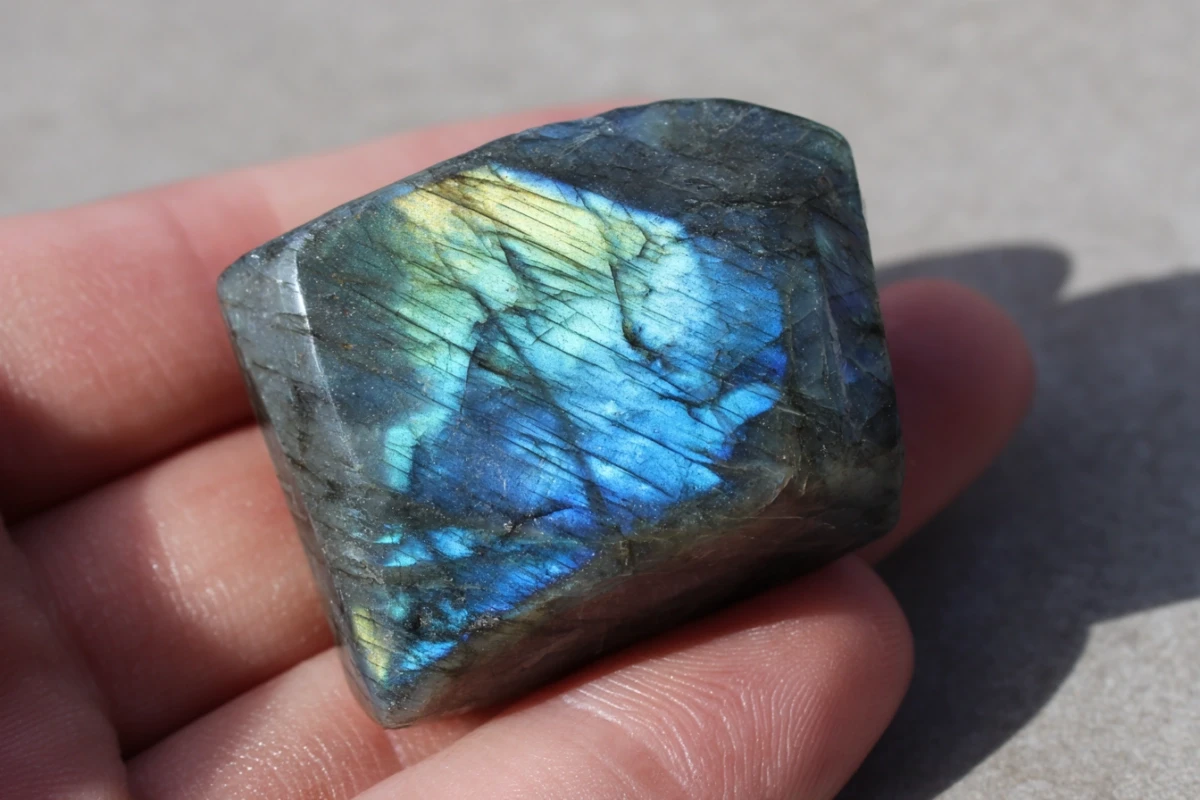
Labradorite is a feldspar mineral that refracts light between its internal layers, producing flashes of blue and green known as labradorescence. The meaning men tend to connect with when using labradorite has less to do with mysticism and more to do with what the stone physically does: it looks unremarkable until you turn it, and then something shifts underneath. That optical trick maps onto the kind of inner work where surface behavior hides deeper patterns worth examining.
What Labradorite Actually Is: and Why It Flashes
Labradorite belongs to the plagioclase series within the feldspar mineral family, sitting at roughly 6 to 6.5 on the Mohs hardness scale. Moravian missionaries first documented it on the Labrador Peninsula in Canada during the late 1700s, though deposits have since turned up in Madagascar, Finland, and parts of Mexico.
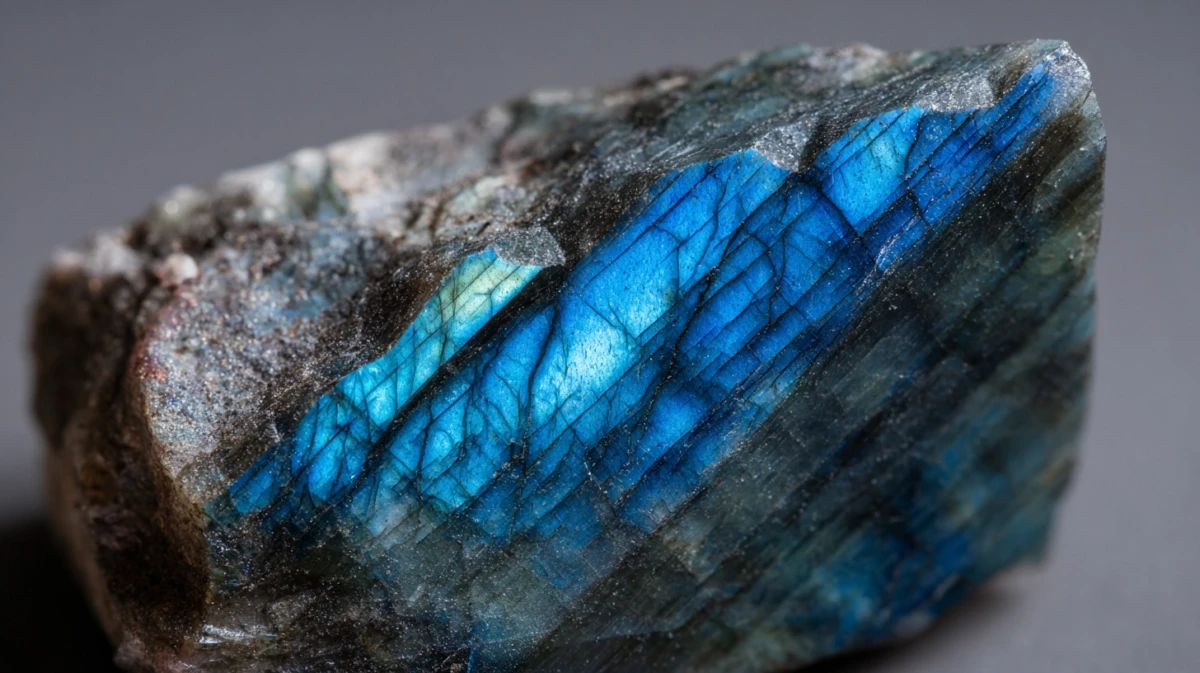
The flash that makes labradorite distinctive is not a surface coating or dye. Inside the stone, thin lamellar layers formed during cooling create internal boundaries. When light enters and hits those boundaries, it refracts and scatters back at specific wavelengths. In higher quality pieces, that means a strong blue-green flash that appears and disappears depending on the angle you hold it. Cheaper specimens might show a dull grey with barely any color play at all, which is worth knowing before you spend money on one.
That hidden-then-revealed quality is the reason labradorite keeps showing up in conversations about personal change and shadow work among men who use crystals as physical anchors. Approaching the stone this way treats it not as a magical object, but as a practical tool with a built-in metaphor worth paying attention to.
Why Men in Transition Keep Reaching for This Stone
Grounding stones anchor you where you are. Confidence stones reinforce what you already believe about yourself. Labradorite fills a different gap: it sits with you in the space between who you were and who you haven't become yet. That's why its significance for men keeps circling back to transition, not stability.
Walking Away from a Career
A man leaving a long career rarely needs more confidence. He needs to sit with the discomfort of not knowing what comes next. Carrying a labradorite palm stone during that period works as a physical prompt to stay honest about why he left, not just rehearse the polished version he tells other people.
After a Relationship Ends
A common impulse after a breakup or divorce is to harden. Black onyx or hematite would support that instinct. Labradorite pushes the other direction: toward noticing the patterns that contributed to the collapse. Holding it during journaling or quiet reflection keeps the focus on self-examination rather than blame.
Starting Shadow Work
Working with the shadow self requires looking at parts of yourself you've been avoiding. A labradorite stone on the desk or in the hand during that process acts as a physical reminder of the intention: stay present with what surfaces, even when it's uncomfortable. The stone doesn't do the work. It marks the commitment to doing it.
Breaking a Generational Pattern
Recognizing that you're repeating your father's anger, withdrawal, or avoidance is one thing. Interrupting it daily is harder. Labradorite's role here is the simplest: a pocket stone you touch when you catch yourself falling into the old groove. Not magic. A physical pause between stimulus and reaction.
Labradorite vs. Black Onyx, Tiger's Eye, and Carnelian
Each of these four stones solves a different problem. Picking the wrong one wastes the moment you actually need it.
Stone | Primary use case | Reach for it when… | What it won't do |
|---|---|---|---|
Labradorite | Pattern recognition during change | You're mid-transition and need honest self-examination | Stabilize you when you just need to feel solid |
Black Onyx | Emotional shielding | External pressure is high and you need to hold your line | Push you toward growth or self-questioning |
Tiger's Eye | Focused decision-making | A specific choice sits in front of you and doubt is circling | Address deeper emotional layers underneath the decision |
Carnelian | Drive and forward momentum | Energy is flat and you need activation, not reflection | Slow you down enough to notice what you're avoiding |
If you already feel stable but sense something underneath that needs examining, labradorite fits better than onyx. If the issue is paralysis rather than avoidance, tiger's eye or carnelian cuts closer to the problem. A deeper breakdown of all four stones and how men use them sits in our crystals for men guide.
How to Use Labradorite Day to Day
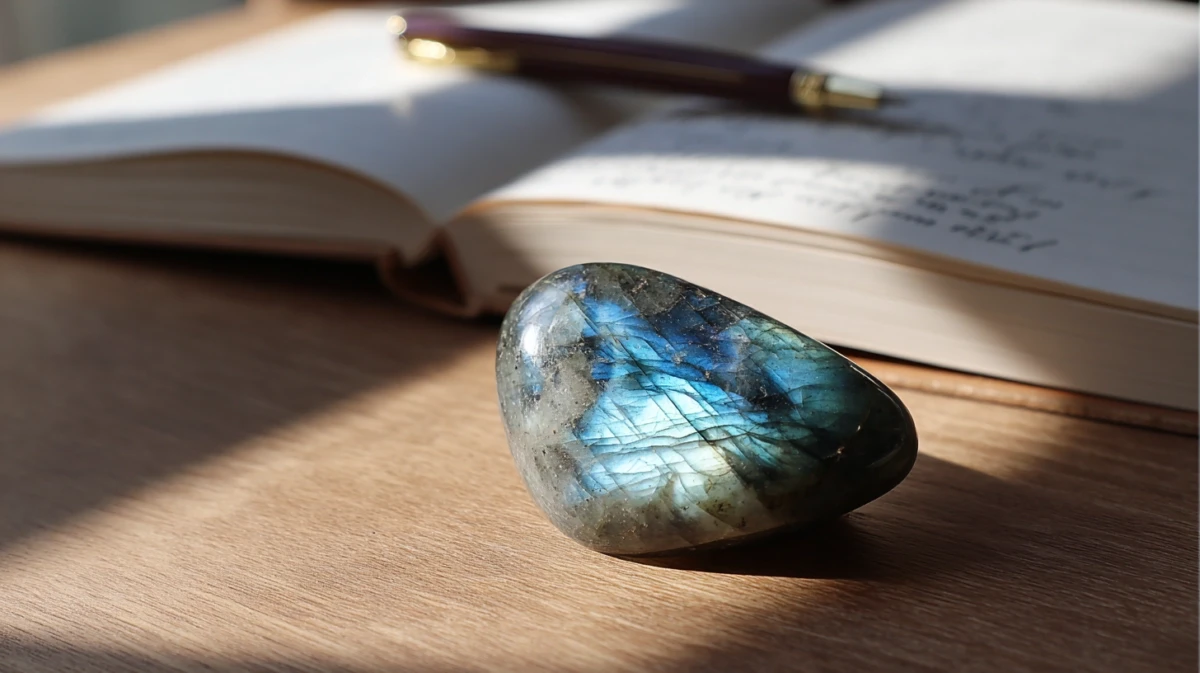
A palm stone held in your non-dominant hand while journaling forces you to slow down. The weight and cool surface act as a physical anchor when you're writing about patterns you'd rather not look at. This pairs well with shadow work: the stone becomes part of the ritual rather than a decoration on your desk. Keep it in the same spot where you write so the association builds over weeks, not days.
Pocket carry works differently. A tumbled labradorite stone, roughly thumb-sized, sits in your front pocket during situations where old reactions tend to surface. A tense meeting, a conversation you've been avoiding, a day when irritability runs the show. The point isn't to squeeze it like a stress ball. Reaching for it creates a two-second gap between the trigger and whatever you'd normally do next. That gap is where the actual work happens, and it only takes a few days of consistent carry before the gesture becomes automatic.
Because labradorite is relatively soft, keeping it in the same pocket as your keys or loose change can quickly scratch the polished surface and ruin the flash. Dedicate a separate space, like the small coin pocket on your jeans, to protect the stone while keeping it accessible.
A pendant worn under your shirt keeps labradorite against your chest during longer stretches of transition: the first months at a new job, the weeks after ending a relationship, a period where your identity feels unstable. The stone resting on your sternum is a quiet, constant reminder that you chose to stay in the discomfort rather than numb it. Pendants on longer chains (about 24 inches) stay hidden under a crew neck, which matters if visibility is a concern. The limitation here is durability: labradorite can chip if it swings into hard surfaces, so tuck it in before physical work.
What to Look for When Buying Labradorite
Strong labradorescence should be visible without tilting the stone back and forth under a spotlight. If you have to hunt for the flash, the piece will look dead in normal light. Pick it up, rotate it once under overhead lighting, and the color play should hit you immediately. Blues and golds are most common; full-spectrum pieces with purple or green cost more and are harder to find.
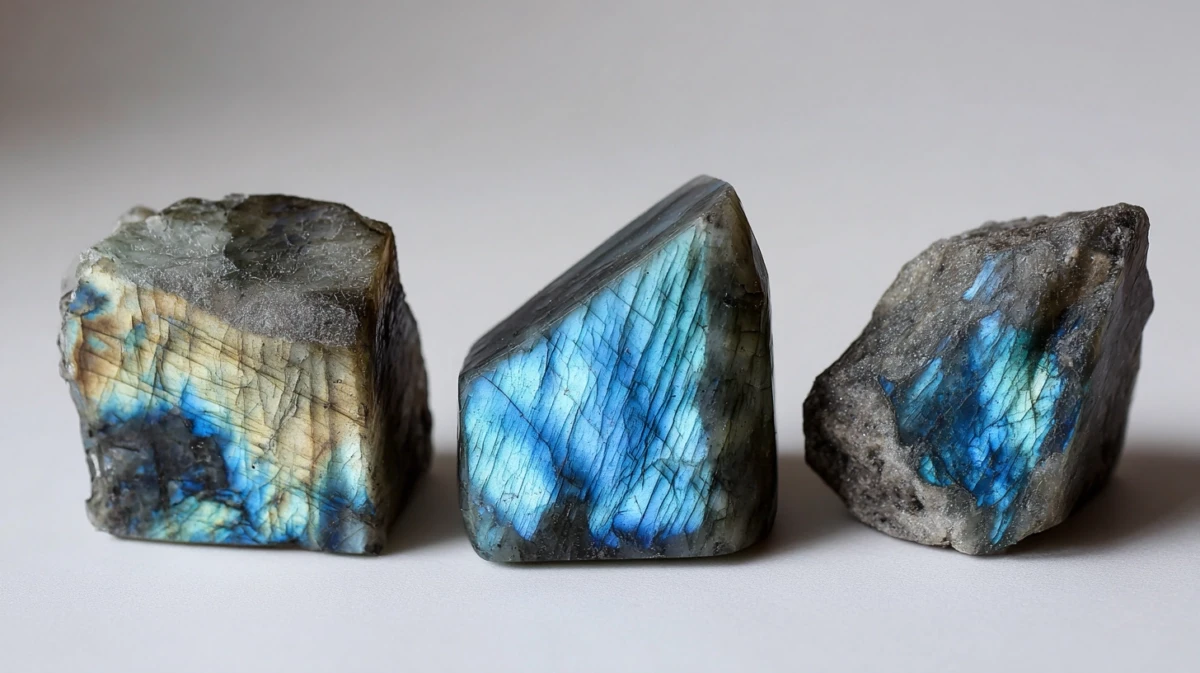
Palm stones (flat, oval, roughly thumb-width) sit best in the hand during journaling or stillness work. Tumbled stones are smaller, cheaper, and fine for pocket carry. Raw specimens look striking but their uneven surfaces make them less practical as daily tools.
Dyed or resin-coated fakes show unnaturally uniform color that doesn't shift with the angle. Real labradorescence moves across the surface as you turn the stone. If the flash stays perfectly static or covers every square millimeter identically, walk away.
Budget tumbled pieces run a few dollars each. A quality palm stone with strong flash typically costs somewhere between ten and thirty dollars. Collector specimens with full-spectrum color jump well above that.
Buy from an independent lapidary or mineral shop where you can hold the stone first. Mass-market online listings often use angled photography that exaggerates the flash, and returns on cheap marketplace stones are rarely worth the hassle.
Frequently Asked Questions About Labradorite for Men
What does labradorite actually do?
In crystal-healing traditions, labradorite is considered a stone of transformation and energetic protection. It's used to support clarity during periods of personal change, not as a cure but as a tactile anchor for intention and self-reflection.
Where should I keep my labradorite when I'm not using it?
A nightstand drawer or a small cloth pouch works well. Keeping it somewhere you see daily reinforces the habit of picking it up, which matters more than any specific placement rule.
How do I cleanse or recharge labradorite?
Run it under cool water for 30 seconds, then let it air dry on a windowsill with indirect light. Moonlight overnight is a common alternative. Avoid salt soaks, which can dull the surface and weaken labradorescence over time.
Can I combine labradorite with other stones?
Pairing it with black tourmaline or clear quartz is common in practice. Avoid stacking three or four stones at once, though. The point is focused attention, and spreading that across too many objects dilutes the ritual rather than strengthening it.
Crystals for Men: The No-Nonsense Field Guide
If you want the full breakdown — the science, all ten stones, a daily carry practice, and a quiz that tells you exactly which stone to start with — the field guide has everything in one place.
Want a free grounding practice to go alongside your crystals?
The free 5-Day Breathwork Challenge gives you five short sessions to settle your nervous system — the perfect companion to carry alongside the stones.