Crystals for Sleep: The Stones That Help Men Switch Off
This article contains affiliate links. If you purchase through our links, we may earn a small commission at no extra cost to you.
Amethyst is the most widely used crystal for sleep, particularly for men whose minds keep replaying conversations, decisions, and unfinished tasks long after the lights go out. Howlite targets the physical side: jaw tension, restless legs, shoulders that won't drop. Smoky quartz works as a cognitive drain, pulling accumulated mental load from the day so it doesn't follow you into bed. Place one stone on your nightstand and keep it bedroom-only. That single-location rule turns the stone into a wind-down cue your brain starts to recognize.
Why Men's Sleep Problems Need Different Stones
Most men who struggle with sleep aren't dealing with a single problem. The guy lying awake at 11 PM mentally re-editing an email he sent six hours ago has a different blocker than the one whose shoulders are still braced like he's mid-deadline. Cognitive replay is the most common pattern, and amethyst addresses it directly: a palm stone on the nightstand becomes a signal that the thinking part of the day is done.
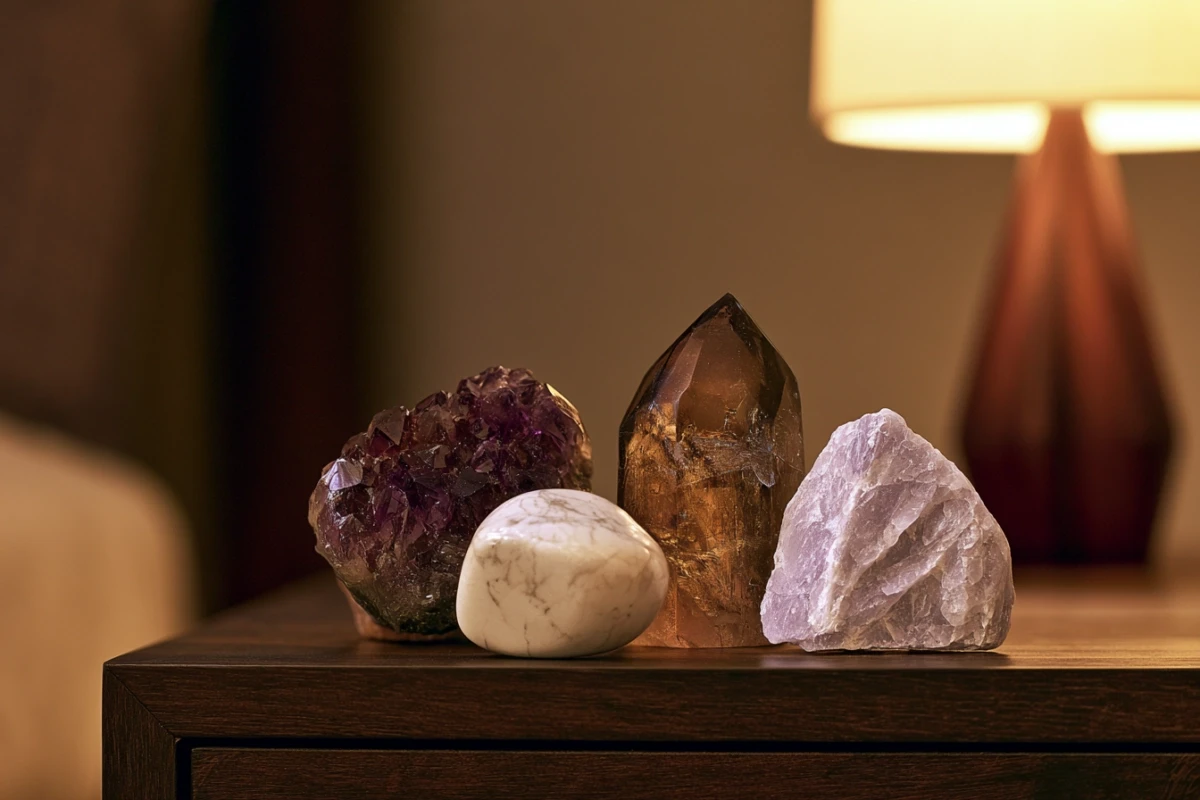
Then there's somatic tension, the kind where your body holds the day even after your mind lets go. Howlite is the match here, a stone associated with releasing physical grip, particularly useful if you catch yourself clenching your jaw in bed.
Stress carryover is subtler. You're not anxious about anything specific, but the sheer volume of the day's input sits on you like dead weight. Smoky quartz acts as a release valve for that accumulated load. And when the problem is a low-grade tightness in your chest that you can't name or trace to a cause, lepidolite tends to be the stone people reach for. It addresses that ambient, diffuse anxiety that doesn't attach to a thought but still blocks settling.
Matching the stone to the pattern matters more than picking whichever crystal ranks highest on a generic sleep list.
The broader guide to crystals for men covers how different stones address different masculine challenges, but sleep specifically requires matching the stone to your dominant blocker rather than collecting a full set.
Amethyst: When Your Brain Replays the Entire Day at 11 PM
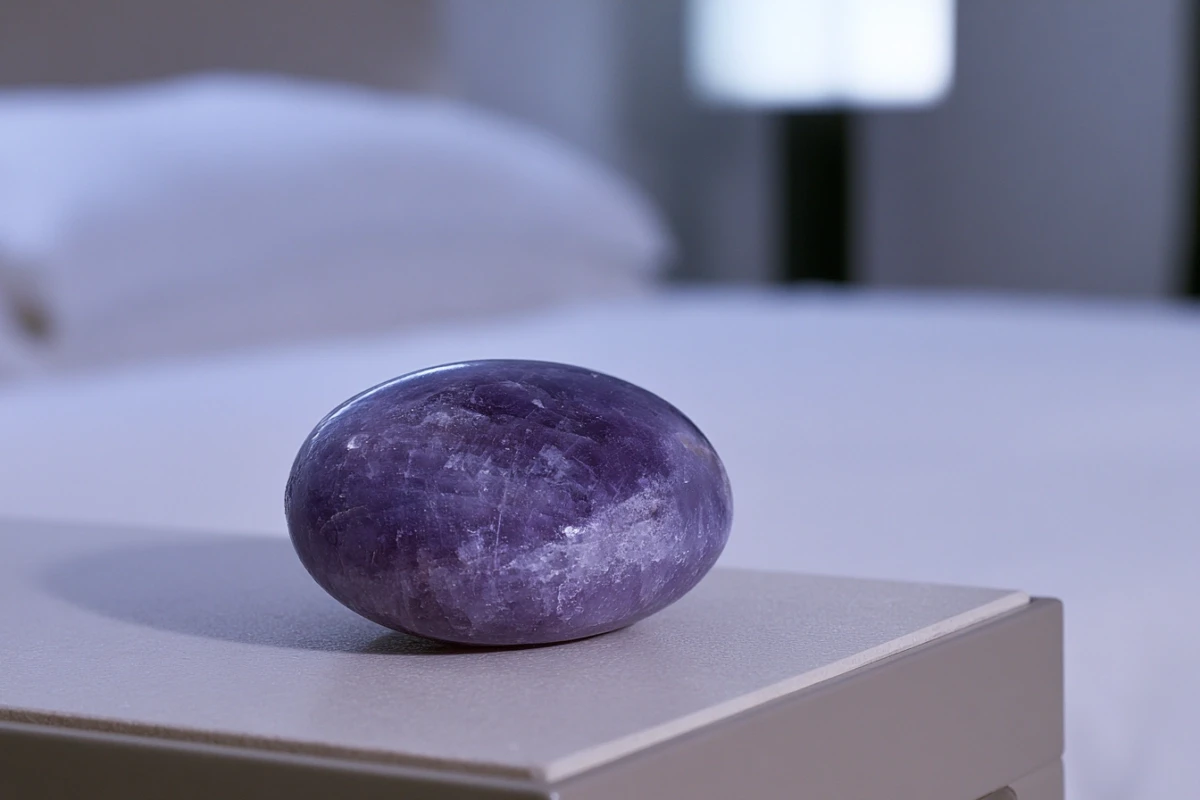
A palm-sized amethyst on the nightstand works as a visual full stop for the day. The man who needs this stone knows the pattern: lights off, eyes closed, and the brain immediately starts replaying a conversation from 2 PM or rehearsing tomorrow's first meeting. That loop isn't insomnia in the clinical sense. It's a cognitive habit where the mind treats bedtime as unscheduled processing time.
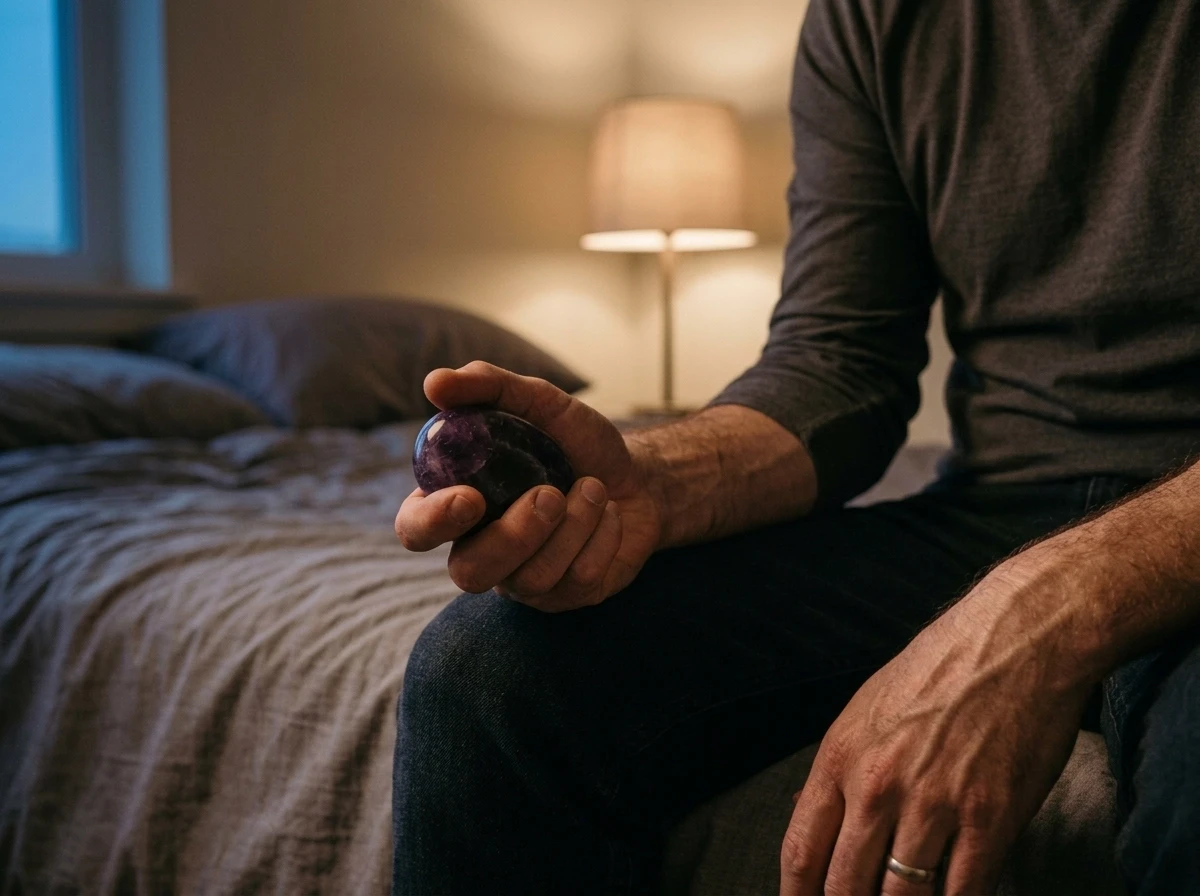
Amethyst interrupts that cycle not through any mystical frequency but as a tactile and visual anchor. Picking up a cool, heavy stone and holding it for 30 seconds forces a sensory shift. Your attention moves from abstract thought to physical weight, surface texture, temperature. That redirection is the entire mechanism. The stone becomes a behavioral cue: when you see it on the nightstand, the association is wind-down, not work.
Form factor is a practical detail that makes a noticeable difference. A tumbled thumb-sized piece disappears under a pillow and you forget it's there, which defeats the purpose of a deliberate ritual object. A cluster looks impressive but the points are sharp and fragile. A smooth palm stone, roughly 5 to 7 cm across, sits well in the hand and stays visible on a nightstand without cluttering it. That visibility is what builds the nightly association over time.
Skip wearing amethyst during the day if sleep is your goal. Constant contact dilutes its effectiveness as a specific nighttime cue. The amethyst meaning article covers broader uses, but for sleep specifically, single-location placement is what makes the habit stick.
Howlite: For the Man Whose Body Won't Release
Clenched jaw, tight traps, hands curled into loose fists under the covers. The mind might actually be quiet, but the body never got the memo. This is where howlite earns its place among crystals for sleep, because it solves a different problem than amethyst. Amethyst quiets the mental replay loop. Howlite targets the physical grip that won't let go.
A smooth howlite tumble stone has a surface that stays noticeably cool against the palm, even after a few seconds of contact. That coolness works as a sensory interrupt. Hold it in one hand while lying down, then run your attention slowly from your jaw down through your shoulders, forearms, and into your legs. Wherever you find tension, the stone in your hand gives you something concrete to release toward. Two to three minutes of this body scan, and the stone becomes the off-switch your muscles were waiting for.
Once the scan is done, place the howlite on the nightstand. Keep it strictly in the bedroom to maintain its association with physical release at night.
Where howlite falls short is with men whose tension is emotional rather than muscular. If the tightness sits in your chest and feels more like dread than soreness, that points toward lepidolite or smoky quartz instead. Howlite works best when you can actually locate the tension in a specific muscle group and consciously let it soften.
Smoky Quartz vs Lepidolite: Accumulated Stress or Unnamed Anxiety
Smoky quartz works best when you can point to exactly what's keeping you up. A brutal deadline, a conversation that went sideways, three back-to-back meetings that left your nervous system buzzing. The stress has a source. Hold the stone in your dominant hand, take five or six slow exhales, and mentally assign each exhale to a specific thing you're releasing. Think of it as a deliberate "day dump." Smoky quartz is dense, slightly heavy for its size, and that physical weight gives the exhale something to push against. Once you've run through the list, place it on the nightstand and leave it there.
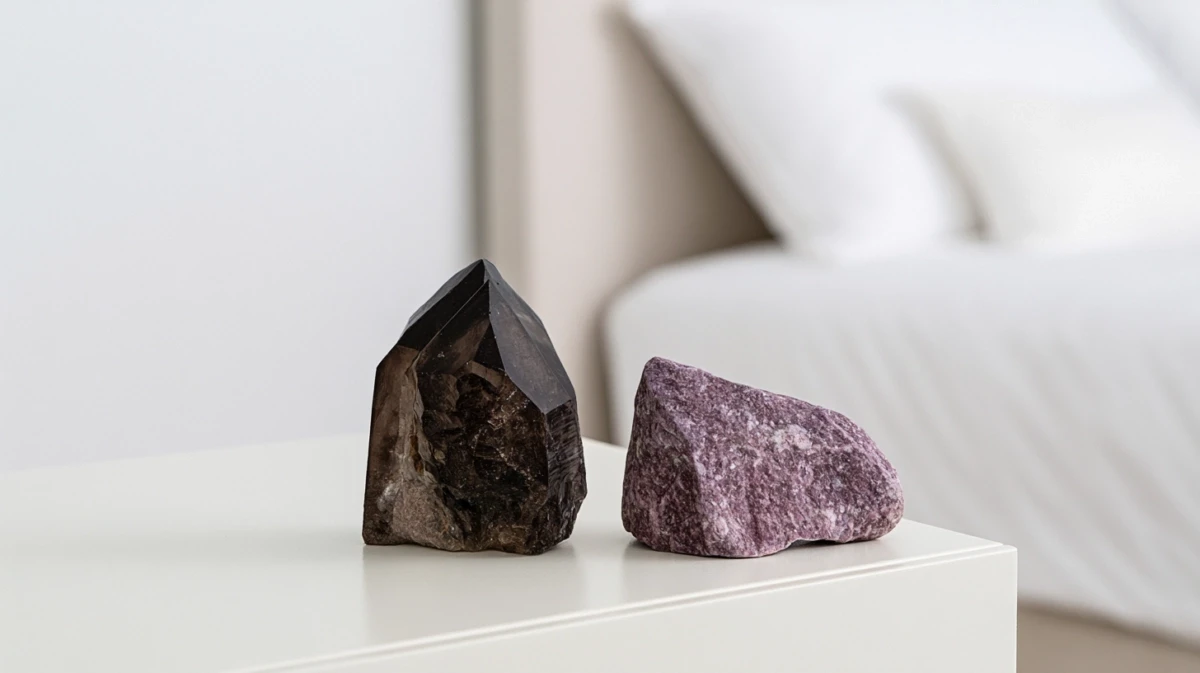
The smoky quartz meaning article explores how this stone functions as a cognitive drain across different contexts, but the bedtime exhale sequence remains its most direct sleep application.
Lepidolite solves a different problem. Some nights the tension sits behind your sternum and you genuinely can't say why. No single event, no obvious trigger, just a low-grade tightness that won't settle. Lepidolite is a lithium-bearing mineral, which is part of why crystal practitioners associate it with calming ambient anxiety rather than situational stress. Place it flat against your chest while lying down, let the slight pressure and coolness register, and breathe normally for a minute or two. You're not trying to process anything specific. You're giving the body a focal point that isn't the tightness itself.
For men whose baseline tension runs high throughout the day, crystals for grounding used during waking hours create the foundation that makes lepidolite effective at night rather than fighting accumulated charge from morning through bedtime.
If you're unsure which one fits your night, ask yourself: "Can I name it?" Yes means smoky quartz. No means lepidolite.
One complementary piece worth keeping nearby is a selenite wand or plate on the nightstand. Selenite doesn't target a specific feeling the way these two do, but many users treat it as a "reset surface," placing their other crystals for sleep on it between uses to clear residual energy. Two to three inches of selenite tucked behind your main stone is enough.
Building a Sleep Crystal Routine That Sticks
Pick one specific stone based on your dominant sleep problem. One. Stacking amethyst, howlite, and lepidolite on your nightstand turns the setup into décor rather than a cue. The behavioral logic is simple: a single stone tied to a single context trains your nervous system the same way dimming lights does. It becomes a conditioned signal that the day is over.
Keep that stone in the bedroom permanently. Using it outside of your sleep environment weakens its impact. When you only touch it at night, picking it up starts to trigger wind-down automatically, usually within two weeks of consistent use.
The routine itself takes three to five minutes. Pick up the stone, hold it in your palm, and run a short breathwork sequence: four-count inhale, six-count exhale, five or six rounds. If you want structure for the breathing portion, the free 5-Day Breathwork Challenge from Inner Kingdom pairs well here since it builds the exhale-dominant pattern that actually slows heart rate before sleep. When the breathing rounds are done, place the stone back on the nightstand. That placement is the full stop. Screen stays off, conversation stops, the day is closed.
Give this at least fourteen consecutive nights before deciding whether it works. Skipping three days in the first week and calling it useless is the most common failure pattern. The stone itself isn't doing the heavy lifting. The consistency of the ritual is. If your daytime stress is high enough to bleed into evenings regardless, a separate grounding or stress-relief practice during the day makes a bigger difference than adding a second crystal at night.
What Makes Sleep Stones Stop Working
Crystals for sleep lose their effect when the bedroom-only association breaks down. Handling your chosen stone throughout the day trains your nervous system to treat it as background noise rather than a wind-down signal. The stone stops marking the transition between waking life and rest.
Keeping citrine or carnelian on the nightstand creates a similar problem from the opposite direction. Those stones carry an activating quality that works against the settling you spent five minutes building with breathwork.
Switching between different stones every few nights prevents the conditioning from taking hold. The fourteen-night minimum exists because your body needs repetition to link a specific object with a specific state. Rotating stones restarts that clock each time.
The subtlest mistake: treating the stone as a standalone fix while scrolling a phone until midnight or drinking coffee past 3 PM. No crystal overrides a disrupted circadian rhythm. The stone anchors a routine, but only when the routine itself supports sleep.
Physical maintenance matters too, as dust and skin oils accumulate on stones handled nightly. Wipe smooth stones like amethyst or quartz with a damp cloth weekly, but keep porous stones like howlite away from soaking to prevent surface degradation.
Frequently Asked Questions About Crystals for Sleep
What is the best crystal for sleep?
Amethyst remains the most widely used sleep stone because it targets the racing-mind pattern that keeps most men awake. Howlite works better when the problem sits in physical tension rather than mental loops.
Where should I place crystals for sleep?
A nightstand within arm's reach works for most people. Under the pillow is fine with smaller tumbled stones, though some find the physical awareness of it distracting enough to backfire.
If you share a bed, place the stone strictly on your side of the nightstand to maintain your personal visual cue. Keeping it in your own immediate tactile field ensures the wind-down association remains yours alone.
Can crystals help with insomnia?
Crystals can support a wind-down routine, but they don't replace sleep hygiene fundamentals. The stone acts as a tactile anchor for the nervous system, not a medical intervention. Persistent insomnia warrants a conversation with a doctor.
How many crystals should I put on my nightstand?
One is enough to start, and often enough long-term. Adding a second stone makes sense only after you know what the first one does for you. Cluttering the nightstand with five or six stones turns a focused ritual into decoration.
Should I sleep with crystals under my pillow?
Small, smooth stones like tumbled howlite or lepidolite work under a pillow without disrupting comfort. Larger or rough-cut pieces tend to shift during the night and wake you up, which defeats the purpose entirely.
Crystals for Men: The No-Nonsense Field Guide
If you want the full breakdown — the science, all ten stones, a daily carry practice, and a quiz that tells you exactly which stone to start with — the field guide has everything in one place.
Not ready to buy? Start here instead:
Five short sessions to train calm under pressure — including the exhale-dominant breathwork that actually slows your heart rate before sleep.