Crystals for Grounding: The Stones That Bring You Back to Earth

This article contains affiliate links. If you purchase through our links, we may earn a small commission at no extra cost to you.
Black Tourmaline, Hematite, and Smoky Quartz are the three crystals for grounding that show up in nearly every serious recommendation. Black Tourmaline acts as a dense energetic anchor, Hematite pulls your attention into the body through sheer physical weight, and Smoky Quartz absorbs accumulated stress while keeping you rooted. Which one actually fits depends on your specific problem: an overactive mind, a disconnected body, or tension that needs to decompress rather than just be held down.
Why Men Lose Their Ground: and What a Crystal Actually Does About It
Twelve hours of screen time, shallow chest breathing locked in place by a desk chair, and a mind still replaying a conversation from 3 PM at 11 PM. That cycle is what losing ground actually looks like. It's not abstract. Your nervous system stays in a low-grade fight-or-flight loop because nothing in your environment signals "stop." Notifications keep the sympathetic nervous system firing. Shallow breathing starves the vagus nerve of the input it needs to downshift. The result is a man who's physically present but mentally scattered across six tabs and yesterday's argument.
A grounding crystal doesn't fix that by radiating mystical energy. It works as a tactile interrupt. A piece of Hematite in your pocket weighs enough that you notice it when you shift position. That noticing is the mechanism: it pulls attention out of the mental loop and into a physical sensation. You feel the cold, the weight, the edges. For a few seconds, your brain registers something real and immediate instead of recycling the same thought. Pair that with one slow exhale and you've just activated a parasympathetic response without any ritual. The stone acts as a physical cue. Knowing which stone matches your pattern is what makes it useful rather than decorative.
This approach fits into a broader framework of using crystals as practical tools rather than mystical objects, where each stone serves a specific function tied to observable patterns in your nervous system.
Black Tourmaline and Hematite: The Heavy Anchors for an Overactive Mind
Both stones are dark, dense, and iron-rich, which is why they are frequently grouped together. The difference that matters sits in your hand.
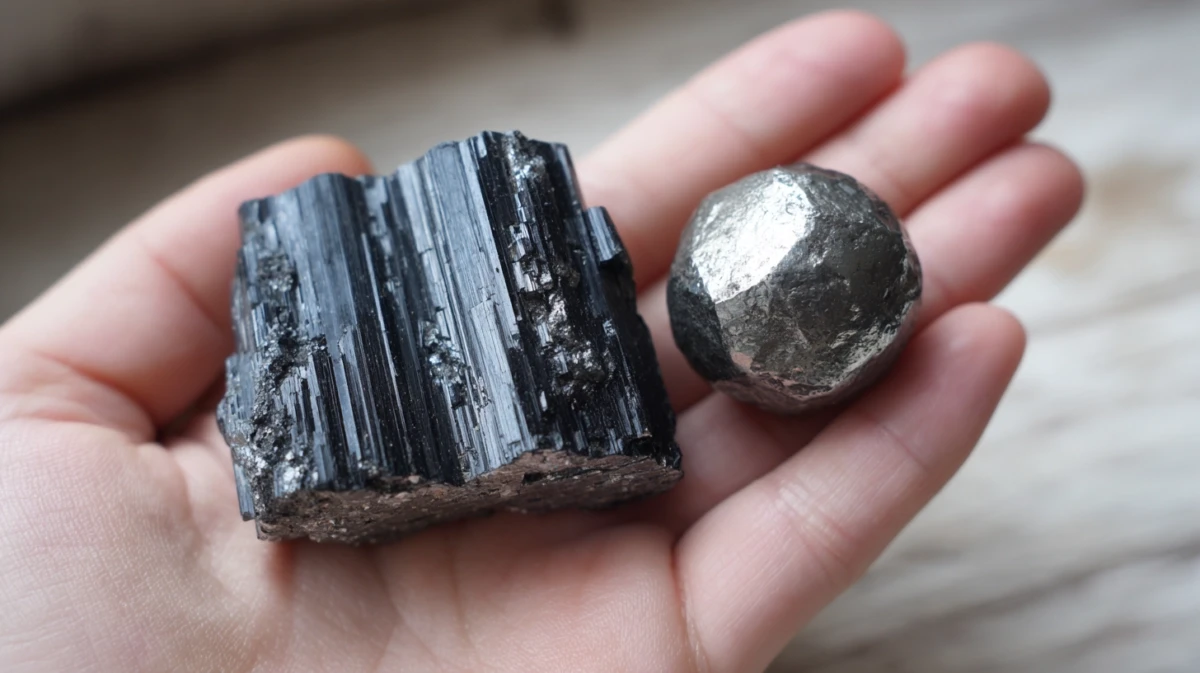
Black Tourmaline feels rough, striated, almost jagged against the skin. That texture creates a sharper tactile interrupt, the kind that cuts through when your nervous system is reacting to external noise like too many notifications or a tense room. If the problem is boundary-related, if you lose your center around other people or in chaotic environments, Tourmaline's raw surface pulls attention back to your palm faster than a smooth stone would. A black tourmaline bracelet keeps that tactile interrupt on your wrist through the day's most demanding moments.
Hematite fits the opposite scenario. It's polished, cold, and surprisingly heavy for its size. When the overwhelm is internal, when you're trapped three layers deep in your own head running the same argument or deadline on repeat, Hematite's metallic weight registers as a blunt physical fact. You notice gravity. That shift from mental loop to body sensation is what makes it effective for men who overthink rather than over-absorb. A hematite bracelet keeps that weight in constant contact with your wrist throughout the day.
The practical verdict: reach for Black Tourmaline when the chaos is coming at you from outside. Pick up Hematite when the chaos is self-generated. If you genuinely can't tell which pattern fits, Hematite is the safer first purchase because internal rumination is the more common issue for most men who seek out crystals for grounding. Tourmaline earns its place once you've identified that your instability tracks to environments and people rather than your own thought patterns.
Smoky Quartz: When You Need to Decompress, Not Just Anchor
Smoky Quartz sits lighter in the hand than Hematite or Black Tourmaline, and that difference matters more than it sounds. Where those two stones interrupt a racing mind through sheer density, Smoky Quartz works better when the problem isn't speed but accumulation. It helps lift the fog after a long week. The dull tension you can't quite name. That scattered, low-grade heaviness that doesn't feel like chaos but still keeps you from thinking clearly.
Within the crystal community, Smoky Quartz is traditionally described as absorbing stress rather than blocking it. Think of it as a slow drain instead of a wall. Its translucent, smoke-colored body even looks the part. For men who feel more depleted than overstimulated, reaching for a heavy anchor stone can actually feel counterproductive, like adding weight to something that already feels sluggish.
The scenario where Smoky Quartz earns its place: end-of-day decompression or any stretch where your energy has been running low for days and you need release. Hold it during a few minutes of slow breathing and the lighter tactile feedback gives your attention something to settle on without pressing down harder. A smoky quartz bracelet worn in the evening is the easiest way to keep the stone close during decompression.
It pairs well with the heavier stones rather than replacing them. Use Black Tourmaline or Hematite during the workday when you need to stay sharp, and Smoky Quartz in the evening when you need to let the day go. Treating them as separate tools for separate states gets more out of both.
Black Obsidian and Carnelian: Two Unconventional Grounding Approaches
Black Obsidian: grounding through confrontation
Black Obsidian doesn't calm you down. It forces you to look at whatever you've been avoiding, whether that's a conversation you keep postponing, anger you've buried under productivity, or a decision you already know the answer to. That confrontation is what grounds you: the evasion itself was the source of the drift.
This stone suits men who feel ungrounded because something unresolved keeps pulling their attention sideways. The intensity is real, though. Obsidian can surface uncomfortable material fast, which is why pairing it with a journaling or shadow-work practice matters. Without a container for what comes up, the stone creates more turbulence than stability. Skip it as a first grounding crystal. Reach for it when you're ready to stop running from something specific.
Carnelian: grounding through movement
Where every other stone on this list works through stillness or weight, Carnelian grounds through forward motion. It's warmer, lighter, and almost counterintuitive as a grounding crystal, which is exactly the point when your problem is stagnation rather than overstimulation.
Procrastination and dissociation through inaction are their own forms of losing ground. Sitting still with a heavy stone won't fix that. Carnelian pushes toward the first step, whether that means sending a message or starting a workout. If you've been stuck for days and the dense, dark stones feel like they're just helping you sit more comfortably in your paralysis, swap to Carnelian until momentum returns. Once you're moving again, the heavier crystals for grounding become useful tools rather than comfortable hiding spots.
How to Use a Grounding Stone in a Daily Practice That Actually Sticks
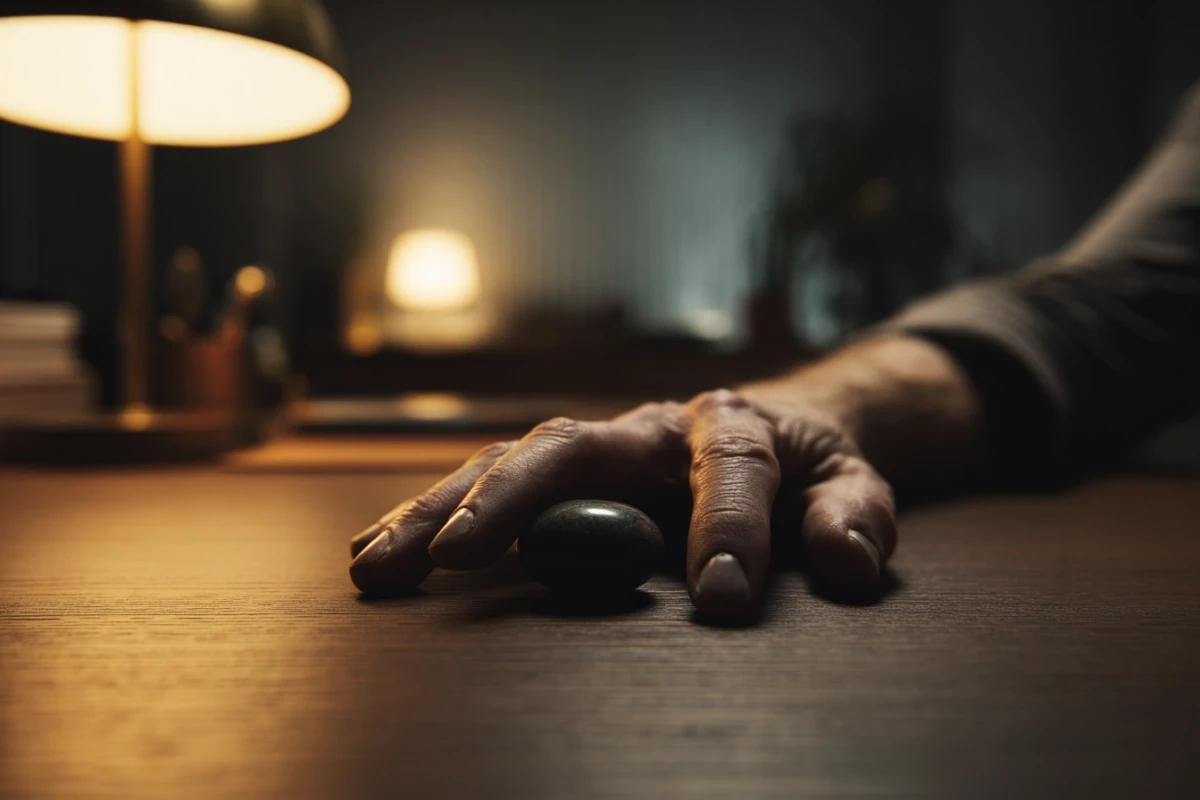
Place the stone on your desk before you open your laptop. Not beside the keyboard where it disappears into clutter, but directly in your line of sight, between you and the screen. When your attention fragments mid-task, pick it up with your non-dominant hand, squeeze once, and take three slow breaths through the nose. The weight and temperature shift pull your nervous system out of the scroll-and-react loop faster than willpower alone.
Morning Anchor
Hold your chosen crystal in a closed fist during the first two minutes after waking, before you check anything. Stand barefoot if possible. The stone turns a vague intention to "be present today" into a physical act your body registers. Hematite or Black Tourmaline work well here because their density gives immediate tactile feedback.
Pairing Stones with Breathwork
During a breathwork session, rest the crystal on your sternum or hold it against your lower belly. Smoky Quartz sits well here because it absorbs tension as your breathing deepens. If you want a structured container for this, the Grounding Ritual Kit runs a seven-day system that pairs directly with stone work, giving each session a specific focus instead of improvised breathing.
Pocket Carry During High-Pressure Moments
Slip a smaller tumbled stone into your front pocket before meetings or conversations where you tend to lose composure. Touch it once before you speak. That single-second pause creates a gap between stimulus and reaction, which is where grounding actually lives. Carnelian works if the pressure comes from passivity. Black Tourmaline if it comes from overstimulation.
Make sure to choose a polished, tumbled stone rather than a raw piece for this specific habit. Raw Black Tourmaline, for instance, is brittle and can easily splinter or tear the fabric of your pants when you sit down. A smooth stone also provides a more consistent tactile surface for your thumb to trace when you need that physical interrupt.
The free five-day breathwork challenge pairs well with any of these methods as a low-commitment starting point for building the habit.
Frequently Asked Questions About Grounding Crystals
Can you use multiple grounding crystals at the same time?
Combining two stones works well when they serve different functions, like pairing Hematite for mental stillness with Smoky Quartz for emotional release. Stacking three or more dense stones at once tends to feel heavy rather than stabilizing, so start with one and add a second only if the first leaves a gap.
How do you cleanse and recharge grounding crystals?
Running water for 30 seconds works for most grounding stones, though Hematite can rust with prolonged exposure. Burying a stone in soil overnight is particularly fitting for earth-heavy crystals. Moonlight and smoke from sage or incense are safe options for any stone you're unsure about.
If you choose the soil method, wrap the crystal in a thin natural cloth first. This prevents dirt from getting lodged in the microscopic crevices of rough stones like raw Tourmaline, which can be frustrating to clean out later without damaging the crystal.
What is the best grounding crystal for beginners?
Smoky Quartz is the easiest entry point. It grounds without the confrontational edge of Obsidian or the density of Hematite, and it doubles as a stress buffer. Red Jasper is another gentle option with a slower, more nurturing quality that suits people who feel overwhelmed by intense energy work.
Is Red Jasper good for grounding?
Red Jasper connects strongly to the root chakra and grounds through steady, sustained warmth rather than the sharp pull of iron-based stones. It suits men who need consistent low-level anchoring throughout the day more than a single intense reset. Carry it in a pocket rather than using it in focused meditation for best results.
Crystals for Men: The No-Nonsense Field Guide
If you want the full breakdown — the science, all ten stones, a daily carry practice, and a quiz that tells you exactly which stone to start with — the field guide has everything in one place.
The Grounding Ritual Kit
If you want a structured 7-day grounding practice to use alongside these stones, The Grounding Ritual Kit gives you the full system — breath, stillness, and returning to your center under pressure.