Carnelian Stone Meaning: The Drive Stone for Men Who Need to Move
This article contains affiliate links. If you purchase through our links, we may earn a small commission at no extra cost to you.
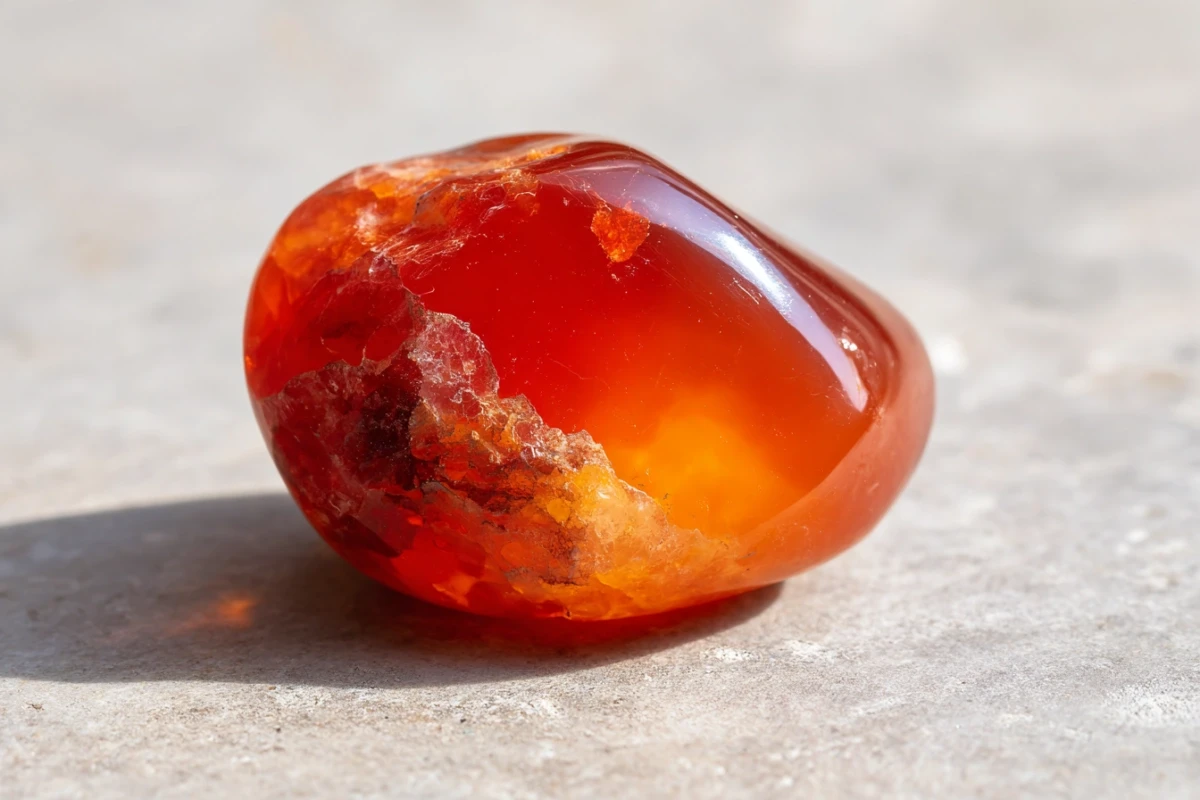
Carnelian stone meaning for men comes down to one word: movement. It's a chalcedony quartz colored by iron oxide, ranging from pale orange to deep reddish-brown, and it rates 6 to 7 on the Mohs hardness scale. Men in self-development circles carry it as a tactile anchor before difficult conversations, hold it during focused morning rituals, or wear it to break through the gap between knowing what to do and actually doing it.
What Carnelian Actually Is (And Why the Color Matters)
Carnelian belongs to the chalcedony family, a microcrystalline form of quartz with a density around 2.6 g/cm³. That puts it in the same mineral group as agate, but without the banding. Where agate shows visible layers, carnelian runs a continuous color from translucent pale orange through saturated reddish-brown.
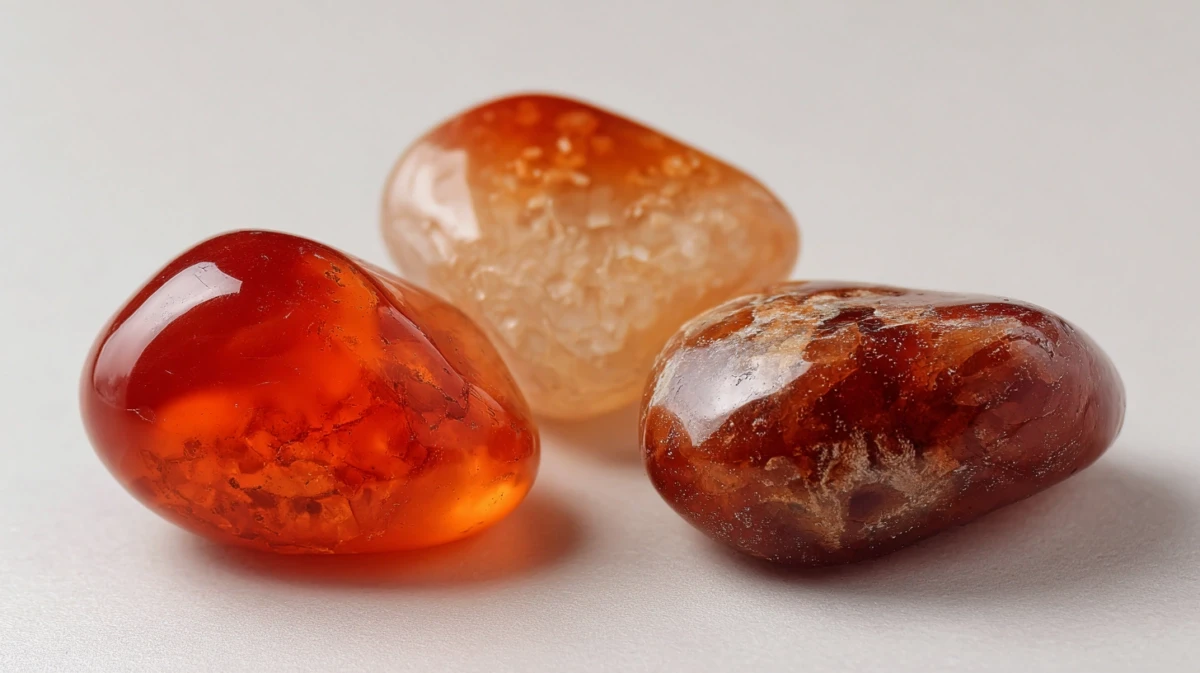
That color comes entirely from iron oxide trapped in the silica structure, which is why carnelian appears consistently in crystals for men focused on action and momentum rather than passive reflection. Low iron concentration produces a washed-out, almost peachy tone. Higher concentration pushes the stone into deep burnt orange and dark red. When you're selecting a piece, that saturation matters more than size. A small stone with rich, even color typically signals better mineral quality than a large pale one. Deeper saturation is also harder to fake, which becomes relevant when you're trying to avoid dyed agates passed off as carnelian.
Carnelian forms inside cavities in volcanic rock, where silica-rich fluids cool slowly enough to crystallize. Brazil, India, and Madagascar produce most of what reaches the market today. Brazilian stones tend toward warmer orange tones, while Indian carnelian often skews darker and redder. Neither origin is inherently better. The iron oxide content of the specific deposit determines the color you get.
Carnelian's Core Properties: Motivation, Vitality, and Breaking the Freeze
Roman soldiers wore carnelian signet rings into battle, not for decoration but because they believed the stone pushed hesitation out of the body. That association with forward movement has followed carnelian through every culture that adopted it, and it remains the core of what the stone means for men today.
Courage as a Daily Muscle
Most carnelian content frames courage as some dramatic, battlefield quality. The practical version is quieter. It shows up when you need to make the phone call you've been avoiding, set a boundary you keep rehearsing in your head, or say the honest thing in a conversation where silence feels safer. Carnelian's traditional link to confidence and self-trust maps directly onto those small, unglamorous moments where action costs something. The stone doesn't remove fear. It sits in the space between knowing and doing, which is where most men get stuck.
Vitality Without the Hype
Carnelian connects to the sacral chakra (lower abdomen) and, in some traditions, the solar plexus. Placing it on or near the lower belly during breathwork or stillness practice targets the body's energy center associated with drive and physical stamina. The solar plexus connection adds a layer of willpower and gut-level decisiveness. If you carry carnelian in a front pocket, you're already keeping it close to both points without any elaborate ritual.
Worth noting: most online sources also tie carnelian to fertility, sexuality, and romantic passion. Those associations exist in historical traditions, particularly in ancient Egyptian and Hindu contexts. For men working on momentum and self-mastery, those historical angles are less relevant.
The Freeze Pattern
The most underrated property of carnelian for men doing inner work is its connection to breaking the freeze response. Not the fight-or-flight kind of freeze, but the subtler version: you've done the journaling, you see the pattern clearly, you know what needs to change, and you still don't move. That gap between insight and action is where carnelian earns its reputation as a motivation stone. It's traditionally associated with initiating movement, both physical and emotional, which is why it keeps showing up in practices built around overcoming stagnation.
None of this replaces the actual work of sitting with discomfort and choosing to act anyway. A stone sitting on your desk won't send the email for you. But as a tactile anchor for the decision to move, carnelian carries a few thousand years of consistent use behind it.
Why Men Doing Inner Work Keep Reaching for Carnelian
A man journals every morning, names the pattern he's been avoiding, writes down exactly what conversation he needs to have, then closes the notebook and does nothing. The insight is real. The resistance is also real. This specific stall point is why carnelian resonates with men who have already done the reflective part.
Shadow work strips away denial. It surfaces the fear behind procrastination, the anger underneath compliance, the grief that masquerades as numbness. That process is necessary and often brutal. But it doesn't automatically produce action. Plenty of men get stuck in a loop of increasingly precise self-awareness without any corresponding change in behavior. They can articulate exactly why they avoid conflict, yet they still avoid it. The journal fills up. The situation stays the same.
Carnelian works as a physical interrupt in that loop. Not because the stone transmits some mystical force, but because a tactile object carried with intention functions as a cue. Reaching into a pocket before a difficult phone call, feeling the weight and warmth of a piece of carnelian, creates a micro-pause that bridges reflection and movement. It's the same principle behind any physical anchor: the object doesn't do the work, but it marks the threshold between thinking and doing.
Where Shadow Work and Carnelian Overlap
The overlap between working with the shadow self and carnelian's action-oriented properties isn't accidental. Shadow work targets the exact emotional material that causes freeze: shame, fear of rejection, old stories about inadequacy. Carnelian's traditional associations with courage and decisive action map directly onto the output side of that process. A man who's identified his pattern through shadow work and then holds a carnelian stone before acting on what he's learned is using two tools that address different halves of the same problem.
While no object can override deep-seated avoidance on its own, carnelian serves as a transition marker for men who know that more reflection isn't what they need.
Carnelian vs Tiger's Eye vs Pyrite: Choosing Your Action Stone
All three stones show up constantly in content about crystals for men, and for good reason. Each one addresses a different version of being stuck. A common misstep is treating them as interchangeable motivation stones, since they often solve different problems at different stages.
Carnelian breaks the initial freeze. When you know what needs doing but your body won't cooperate, that reddish-orange stone in your pocket works as a physical cue to start. Tiger's Eye picks up where carnelian leaves off: it sharpens focus and steadies your pace once you're already in motion. Pyrite does something neither of the others does well. It builds outward-facing composure for moments when other people are watching, like a difficult conversation, a pitch, or a negotiation where your presence matters as much as your words.
Stone | Best for | When to reach for it | Pairs well with |
|---|---|---|---|
Carnelian | Breaking hesitation, initiating action | Before starting something you've been avoiding | Shadow work, breathwork, morning rituals |
Tiger's Eye | Sustained focus, follow-through | During long projects or when distraction pulls you off course | Structured journaling, deep work blocks |
Pyrite | External confidence, composure under scrutiny | Before presentations, negotiations, or high-stakes social situations | Preparation rituals, grounding practices |
Carrying carnelian and Tiger's Eye together makes sense when a project demands both the courage to begin and the discipline to finish. A man launching something new, where the first week requires overcoming resistance and the following months require consistency, gets genuine use from both.
Pairing carnelian with pyrite is less useful. Carnelian already generates forward momentum, and pyrite's outward confidence becomes redundant if the real obstacle is internal hesitation rather than external pressure. If you find yourself reaching for three stones at once, that's usually a sign the issue isn't which crystal to carry. It's that the underlying avoidance pattern needs more direct work, the kind that shadow work and structured practice address better than any stone combination.
Pick based on where you're actually stuck, not on which stone sounds most appealing.
How to Use Carnelian in Your Daily Practice
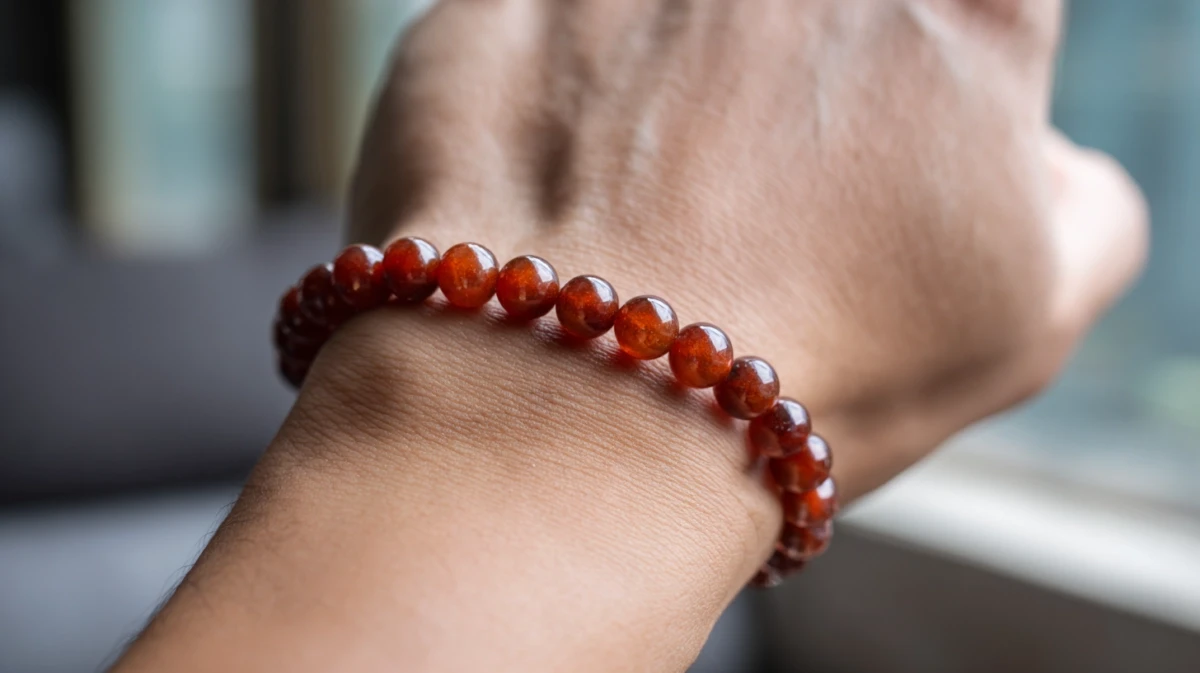
A bracelet on your dominant hand is the most common daily-carry method for carnelian, and for good reason: it stays in your peripheral awareness without requiring any ritual at all. But if you want the stone to function as more than jewelry, tie it to moments where you actually need forward momentum.
Signet rings offer a more traditional alternative that keeps the stone in direct contact with your skin while remaining discreet in professional settings. Because a ring sits on your hand, it acts as a constant visual anchor every time you reach for your phone or type an email, reinforcing the cue to act.
Morning intention-setting
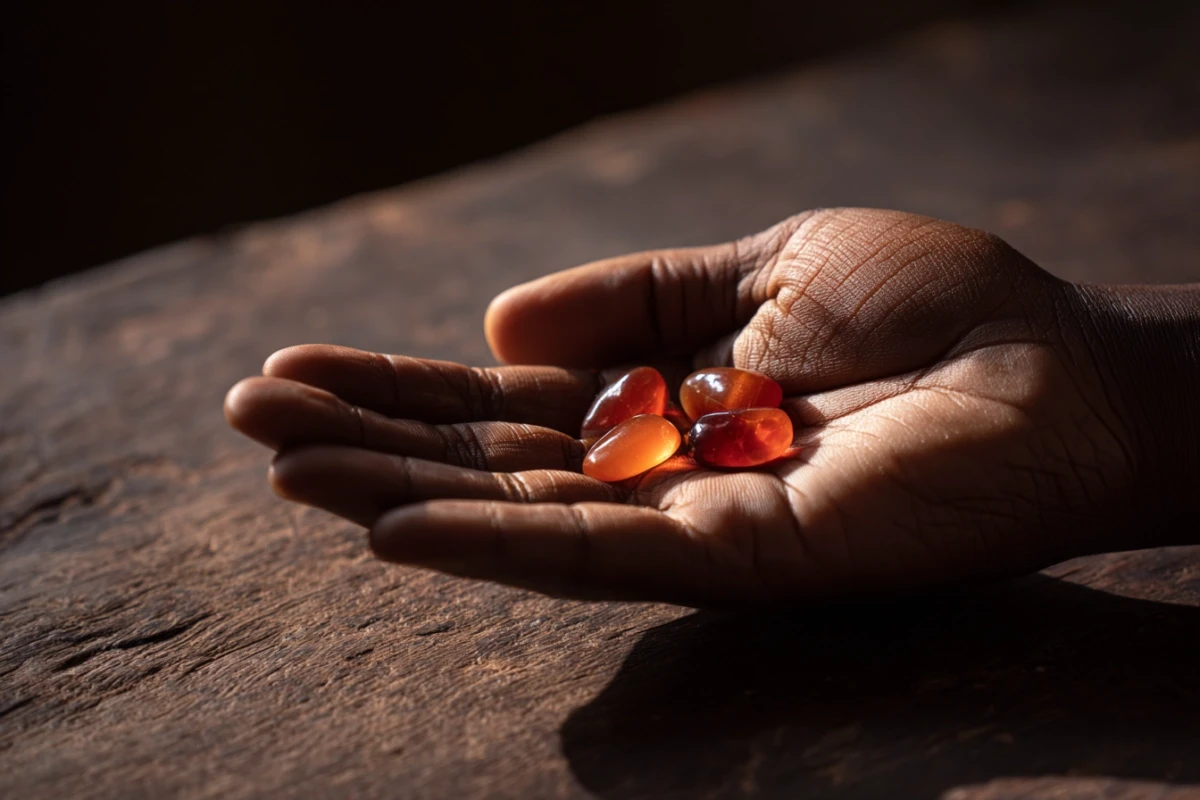
Hold a carnelian palm stone in your closed fist during your first two minutes of breathwork or intention-setting. The weight and warmth register faster than an abstract goal. Place it on your lower belly if you sit for the practice. The point isn't duration. Two focused minutes with physical contact beats twenty minutes of scattered meditation where the stone sits on a shelf across the room.
Before a high-stakes conversation
Drop a tumbled carnelian into your front pocket 15 to 20 minutes before the meeting, call, or confrontation you've been avoiding. Touch it once when you notice the hesitation rising. That single contact point interrupts the loop between "I should say something" and "I'll bring it up next time." It works because the physical cue is faster than self-talk.
Focused work blocks
Wearing a carnelian bracelet during deep work sessions keeps the stone passive but present. Where it falls short: if you're already in flow, carnelian won't add much. It earns its place on days when starting feels heavy, when the blank page or the first email sits untouched for too long. Slip it on before you sit down, not after you've already stalled for an hour.
Creative sessions at your desk
Place a raw or polished piece next to your keyboard or sketchpad. Not as decoration. Position it where your non-dominant hand naturally rests, so contact happens without thinking. Some men rotate it between their fingers while drafting. The tactile motion keeps the body engaged when the mind wants to drift toward distraction. If you find yourself reaching for your phone, pick up the stone instead.
Physical training warm-up
Hold carnelian in your palm during your first set of mobility work or stretching. This one sounds odd until you try it. The stone anchors attention in the body before exertion, which matters most on days when you showed up to the gym but your head is still in yesterday's argument. Set it down once the warm-up ends and your body has taken over.
The common thread across all five scenarios: carnelian works best as a transition tool, placed at the exact friction point between inaction and movement. Wearing it all day dilutes that signal. Reaching for it at the moment you'd normally hesitate sharpens it.
How to Tell Real Carnelian from Dyed or Fake Stones
Genuine carnelian has a waxy, slightly matte surface. Glass imitations look glassy and too polished. That visual difference often catches fakes before you even pick the stone up.
Four checks you can do without equipment
Hold it against your cheek. Real carnelian feels noticeably cool and has weight to it. Plastic and resin feel warm almost immediately and sit too light in the hand for their size.
Look at the color in natural light. Natural carnelian rarely shows perfectly uniform orange. You'll see subtle gradations, slight cloudiness, or soft shifts from pale orange into deeper reddish tones. Dyed agate, by contrast, tends toward an unnaturally bright, even orange, and dye often pools visibly in surface cracks or fracture lines.
Check for banding. If the stone shows clear parallel bands, it's technically red agate rather than carnelian. Sellers frequently market banded pieces as carnelian anyway. This isn't a quality problem on its own, but it does mean you're not getting what the label says.
Question the price relative to size. Carnelian isn't an expensive stone, but a palm-sized piece for a couple of dollars almost certainly started life as a cheaper agate that was heat-treated or dyed. Tumbled stones and small cabochons are affordable, though if the price feels absurdly low for the size, the color probably isn't natural.
The dyed agate issue
Most "fake" carnelian on the market isn't glass or plastic. It's agate soaked in iron nitrate solution and then heated to produce a reddish-orange color. The result can look convincing, but the color distribution gives it away: natural carnelian shifts gradually across the stone, while dyed pieces often show sharp color boundaries or concentrations where the dye absorbed unevenly. Holding the stone up to a strong light source sometimes reveals this, since dyed agate tends to show a more opaque, blocky color rather than the soft translucency of natural carnelian.
None of these checks require a loupe or a gemology degree. If a stone passes all four, you're almost certainly holding the real thing.
Frequently Asked Questions About Carnelian
Can I wear carnelian every day?
Carnelian sits at 6 to 7 on the Mohs scale, so it handles daily wear without damage. The question is whether constant contact keeps you responsive to it or just turns it into background noise. Most men get more from wearing it selectively, tied to specific moments of hesitation or decision-making.
How do I cleanse and recharge carnelian?
Warm water with a drop of mild soap handles surface buildup. For energetic recharging, moonlight overnight is the safest method. Sunlight works for short periods, but prolonged exposure fades the orange-red color over time, especially in lighter specimens.
Avoid ultrasonic cleaners or harsh chemical dips, as these can widen microscopic fractures in the stone or strip the polish. If you wear the stone during intense workouts, a quick rinse is usually enough to remove sweat and oils without risking damage.
What is the difference between carnelian and red agate?
Both belong to the chalcedony family, but carnelian is unbanded with a warm, translucent orange-red body. Red agate shows clear parallel banding through the stone. Retailers sometimes label banded pieces as "carnelian agate," which blurs the line. If you see distinct stripes, you're holding agate.
Does carnelian work for anxiety?
Carnelian is traditionally associated with forward momentum and action, not calm or sedation. For men whose anxiety stems from indecision or avoidance, that push toward doing can reduce the spiral. If the anxiety is more about overstimulation or racing thoughts, a grounding stone like black tourmaline or a structured breathwork practice tends to be a better fit.
Crystals for Men: The No-Nonsense Field Guide
If you want the full breakdown — the science, all ten stones, a daily carry practice, and a quiz that tells you exactly which stone to start with — the field guide has everything in one place.