Rose Quartz for Men: What It Actually Does (No Fluff)
This article contains affiliate links. If you purchase through our links, we may earn a small commission at no extra cost to you.
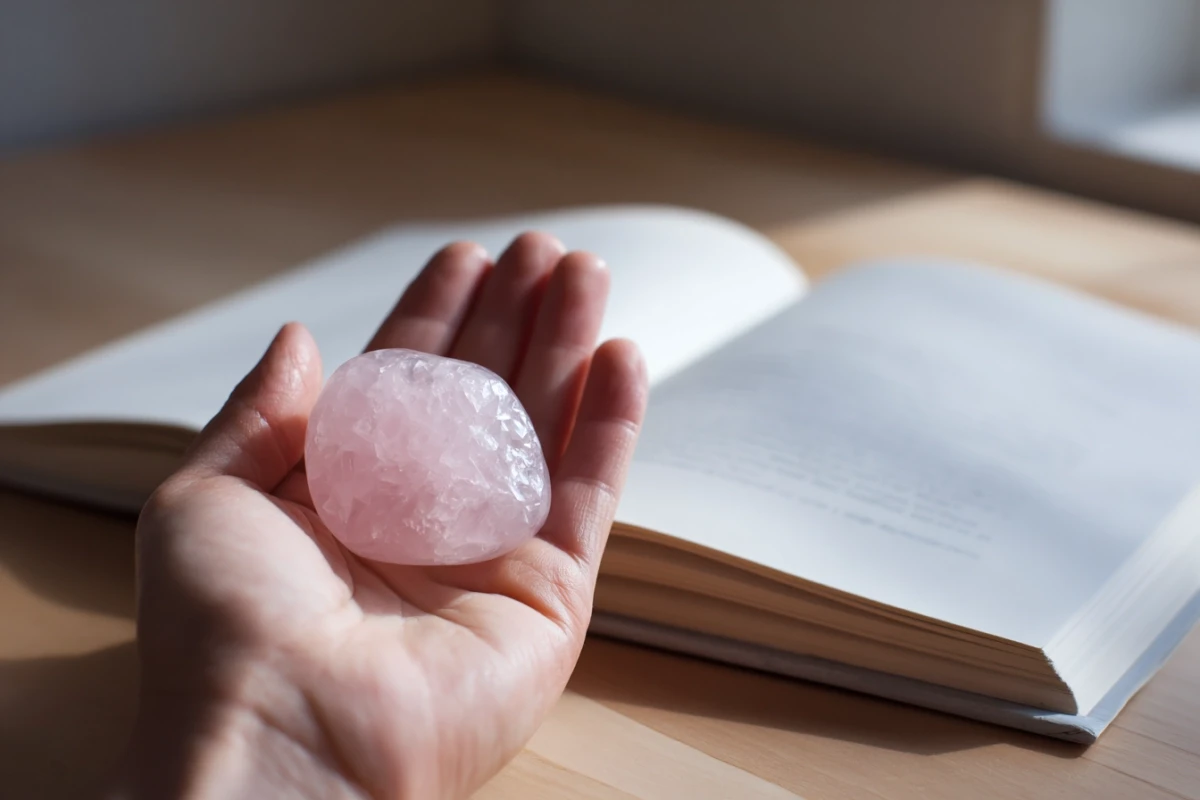
Rose quartz is silicon dioxide with a Mohs hardness of 7, the same mineral family as clear quartz and amethyst. For men doing inner work, it functions as a self-compassion tool: held during journaling or kept on a nightstand, it anchors attention on softening a harsh inner critic rather than pushing through emotional reactivity. Most of the benefits men report from rose quartz come from pairing the stone with an existing reflective practice, not from passive carry.
What Rose Quartz Actually Is (the Mineral, Not the Marketing)
Silicon dioxide, trigonal crystal system, hardness 7 on the Mohs scale. That puts rose quartz in the same durability range as steel files and well above glass. It won't scratch, chip, or degrade sitting on a desk for years.
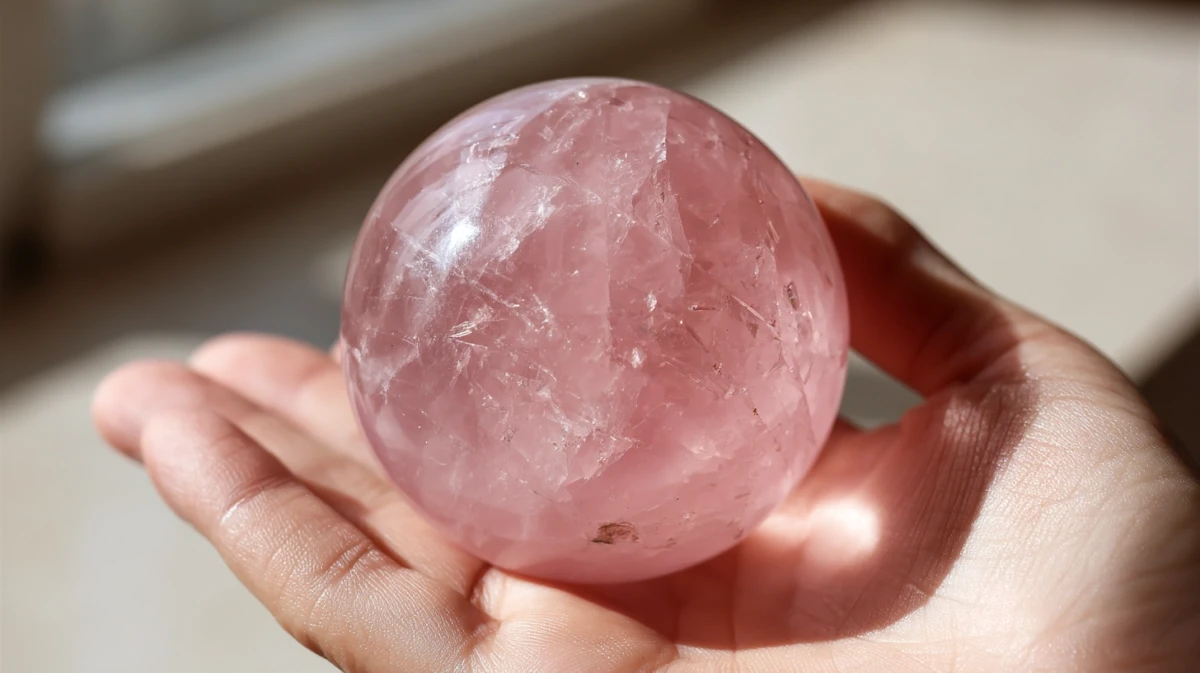
The pink color traditionally gets attributed to trace amounts of titanium, iron, or manganese in the crystal lattice. Research from the late 1990s complicated that story: the tint more likely comes from microscopic fibrous inclusions similar to dumortierite. Both explanations circulate, and neither changes how the stone is used. What matters is that the color is structural, not a coating or dye.
In practice, this means you should avoid vendors selling "hyper-charged" or unnaturally bright pink stones at a massive markup. A genuine, high-quality palm stone for daily use should cost between $10 and $25; anything priced significantly higher is usually just aggressive marketing.
Most commercial rose quartz comes from Brazil, Madagascar, and South Dakota. Brazilian material dominates the market and tends toward a milky, translucent pink. Madagascan pieces often run slightly deeper in hue and are sometimes sold at a premium for that reason alone.
The "love stone" label is tradition, not geology. It traces back thousands of years through Greek and Egyptian lore. Separating that cultural layer from the mineral itself helps frame the stone as a practical object rather than just a symbol.
Rose quartz is one of several stones men use for inner work, each addressing a different aspect of self-examination. For a broader look at which stones match specific challenges, this guide to crystals for men breaks down the practical differences.
Who Actually Benefits from Rose Quartz (and Who Can Skip It)
Rose quartz benefits men who already notice a specific internal pattern: relentless self-criticism that runs on a loop. The guy who finishes a solid week and still fixates on the one conversation he fumbled. If that sounds familiar, a tactile anchor tied to self-compassion gives the inner work something concrete to land on. None of this is scientifically validated. The value is experiential, reported consistently by men doing reflective practices like journaling or breathwork, not proven in a lab.
The harsh inner monologue
Men who run a punishing internal narrative tend to get the most from rose quartz. The stone becomes a physical cue during shadow work or evening reflection: pick it up, and the practice of softening toward yourself has a starting signal. Without an existing reflective habit, though, it just sits on a shelf.
Post-conflict emotional shutdown
Some men go quiet after arguments or confrontations, not out of calm but because the emotional system locks up. Rose quartz paired with a breathing exercise or a journal prompt can serve as a re-entry point, a way to sit with discomfort instead of sealing it off.
Men who recognize this shutdown pattern often find it tied to deeper issues around emotional unavailability, where the instinct to close off becomes automatic rather than chosen.
Who should skip it
If your current challenge is scattered focus, low motivation, or weak boundaries, rose quartz misses the mark. Labradorite works better for men building self-trust and navigating transition. Amethyst suits the guy who needs to quiet mental noise before sleep. Rose quartz solves a narrow problem: it anchors the practice of treating yourself with less hostility. If that isn't your pattern right now, spend your attention on a stone that matches what is.
Additionally, men dealing with clinical depression or severe relationship toxicity should not rely on rose quartz as a substitute for professional therapy. It is a supplementary tool for self-reflection, not a standalone cure for deep-rooted psychological distress.
What Rose Quartz Does for Men in Practice
Holding a rose quartz palm stone while writing in a journal changes the texture of the session. Men who pair it with reflective writing often notice they soften the language they use about themselves mid-entry. The stone doesn't cause that shift. It marks the moment you chose to sit down and stop performing.
After a hard conversation with a partner
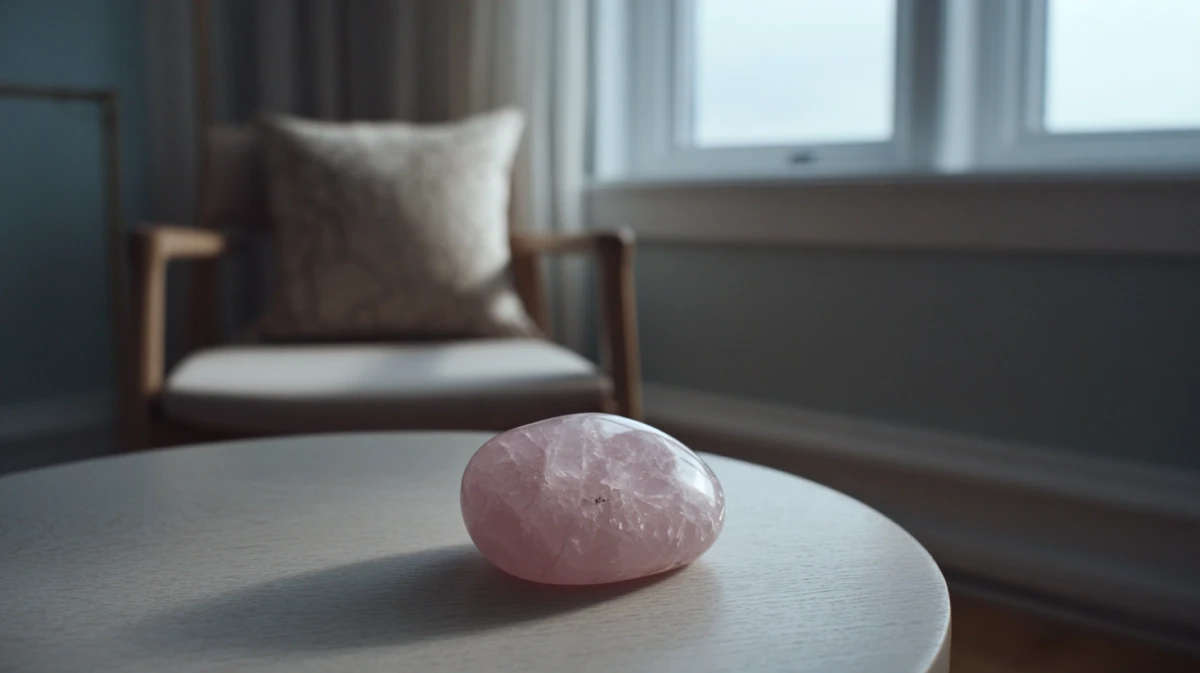
The instinct after conflict is to go quiet, replay what you should have said, and build a case. Keeping a rose quartz piece on the table where you decompress interrupts that loop. Picking it up becomes a physical decision to stop litigating and start noticing what you actually feel underneath the frustration. Men who do this regularly describe shorter recovery windows between the argument and genuine re-engagement.
During a period of professional failure
Losing a contract, getting passed over, botching a project. The internal monologue turns brutal fast. Holding the stone during a five-minute sit after the workday acts as a speed bump between the event and the story you build around it. The stone helps here not through any energy transfer, but because the object is tied to one intention: stop punishing yourself long enough to see what happened clearly.
When grief surfaces without warning
A song, a date on the calendar, a smell. Grief doesn't schedule itself. Men who keep rose quartz on a nightstand report that reaching for it in those moments gives the emotion somewhere to land physically. The hand closes around something cool and smooth instead of clenching or reaching for a phone. That pause, even ten seconds of it, changes whether the feeling gets processed or buried again.
Rose Quartz vs Labradorite vs Amethyst for Inner Work
All three stones show up in inner-work conversations, but they solve different problems. Choosing a stone that doesn't align with your current focus often leads to it just sitting unused in a drawer.
Dimension | Rose Quartz | Labradorite | Amethyst |
|---|---|---|---|
Primary emotional function | Softens self-directed harshness | Strengthens self-trust during uncertainty | Quiets looping mental noise |
Best-fit phase | Active shadow work with a loud inner critic | Transitions, identity shifts, rebuilding after loss of direction | Overthinking, pre-sleep anxiety, mental fatigue |
Typical use | Held during journaling or kept where you decompress | Pocket carry during high-stakes days | Nightstand or held during evening wind-down |
Where it falls short | Won't sharpen focus or build motivation | Does little for self-compassion or emotional softening | Not useful when the issue is self-judgment rather than mental chatter |
Pick this if... | You catch yourself punishing yourself after mistakes | You're in a chapter where nothing feels solid yet | Your mind won't stop replaying the day at 11 p.m. |
How to Choose Based on Where You Are
The distinction that matters most: rose quartz addresses how you talk to yourself, labradorite addresses whether you trust yourself, and amethyst addresses whether you can stop thinking long enough to rest. These rarely overlap in the same moment.
If your current pattern is harsh self-talk after conflict or failure, rose quartz is the direct match. If you're mid-transition and the real issue is not knowing who you're becoming, labradorite fits that uncertainty better. And if the problem is a brain that won't shut off rather than a voice that attacks you, amethyst targets that loop more precisely.
Owning all three isn't the point. One stone tied to a specific practice beats a collection sitting on a shelf.
How to Actually Use Rose Quartz (Low-Friction Methods)
A palm stone or polished sphere that fits in your closed hand works better than a raw chunk or a tiny tumbled piece. The smooth surface gives your thumb something to track across, which matters more than size when you're using it during stillness practices.
Nightstand placement
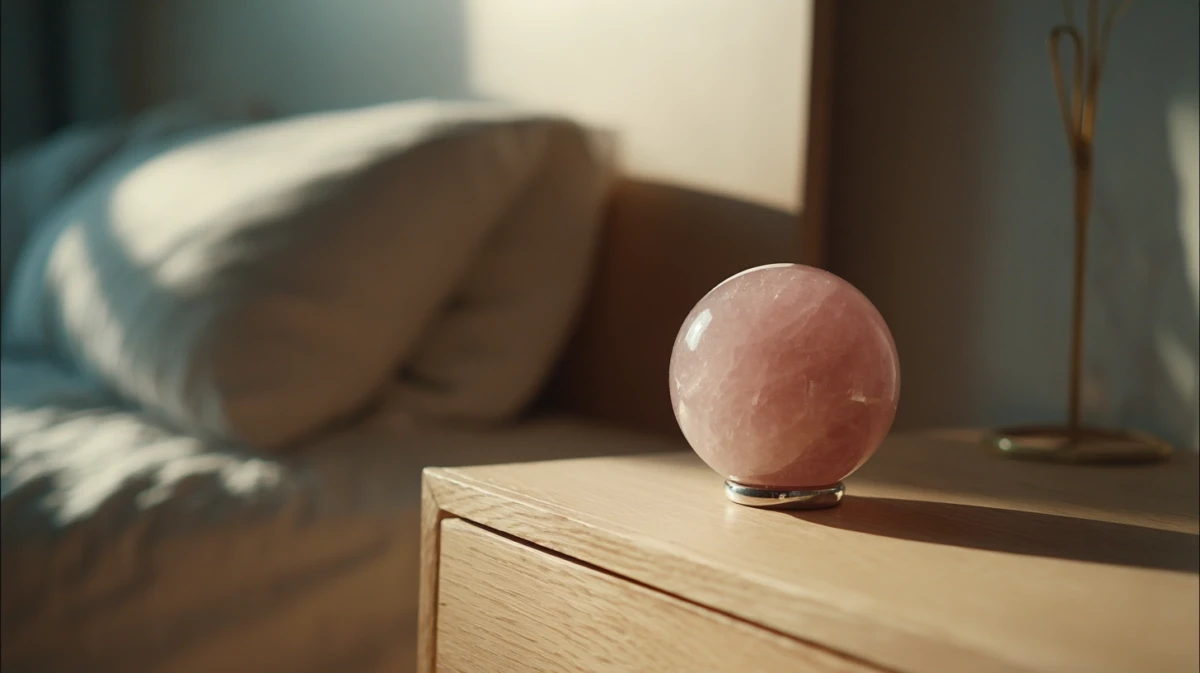
Set the stone where you'll see it when you wake up or right before sleep. The point isn't decoration. A rose quartz sphere on your nightstand works as a visual cue to check your internal tone before the day starts or after it ends. If placed behind a phone charger or a stack of books, the stone easily fades into the background and is quickly forgotten. Put it where your eyes actually land.
Holding during journaling or reflection
Pick the stone up when you sit down to write. Grip it in your non-writing hand. The weight and temperature shift give your body something to register while your mind works through whatever you're putting on paper. This pairing reinforces the connection between the object and the practice of honest self-examination. Without a paired activity, the stone just sits there.
Post-conversation cooldown
After a difficult phone call or a tense exchange, hold the stone for two minutes before you do anything else. Not as a ritual. As a physical pause that slows the jump from event to self-criticism. This use case surprises people, but it's where the stone is often most effective: the moment between friction and the story you tell yourself about it.
Why daily pocket carry rarely works
Carrying rose quartz all day dilutes its function. It becomes background noise, like a bracelet you stop noticing by noon. Stones tied to a specific moment or practice hold their associative weight far longer than ones you carry everywhere.
When it comes to maintenance, keeping it simple is best—elaborate charging rituals aren't necessary for it to serve as a practical anchor.
Common Questions About Men Using Rose Quartz
Can men wear rose quartz?
Rose quartz has no gendered properties. It's silicon dioxide, and wearing it as a bracelet or pendant puts it near the heart, which aligns with how most people use it for emotional awareness. Plenty of men wear it daily without it looking out of place.
If you prefer a more understated look, matte rose quartz beads mixed with darker stones like onyx or lava rock offer a subtle way to keep the stone close without drawing unwanted attention.
Is there scientific evidence that rose quartz works?
No peer-reviewed research supports crystal healing claims. The benefits people report—calmer reactions, softer self-talk, and better emotional check-ins—likely come from the intentional practice tied to the stone rather than the mineral itself. The stone works as a physical anchor for a habit, not as medicine.
How do you cleanse and charge rose quartz?
A quick rinse under cool running water once a week is enough. Some people leave it in moonlight overnight or set it on selenite, but those steps are optional. Skip salt water, which can dull the surface over time.
Can you carry rose quartz every day?
Yes, though using it during specific moments of reflection often builds a stronger mental association than simply keeping it in your pocket all day.
If you want the full breakdown — the science, all ten stones, a daily carry practice, and a quiz that tells you exactly which stone to start with — the field guide has everything in one place.
The Unspoken Man
Rose quartz is the stone most closely tied to shadow work and self-compassion. If you're ready to go deeper into the patterns it surfaces, The Unspoken Man gives you the full framework.