Carnelian Jewelry for Men: How to Wear the Drive Stone

This article contains affiliate links. If you purchase through our links, we may earn a small commission at no extra cost to you.
Carnelian scores 6.5 to 7 on the Mohs hardness scale, which puts it in the same durability range as quartz and makes it practical for daily-wear jewelry. For men's carnelian jewelry, the difference between looking intentional and looking like a costume prop comes down to three things: darker red-brown tones over bright orange, metal accents in oxidized or brushed finishes rather than polished gold, and pairing with neutral or dark companion stones instead of wearing carnelian alone in large quantities.
Carnelian Bracelets: Bead Size, Stacking, and Wrist Placement
An 8 mm bead bracelet sits close to the skin and reads almost like a plain accessory from a distance. That works on thinner wrists (under about 17 cm circumference), where larger beads can look bulky and toy-like. At 10 mm, the stone's color gradient becomes visible, and the bracelet carries enough visual weight for average to larger wrists without dominating. Going to 12 mm is a deliberate statement, and it only looks proportional on wrists above roughly 19 cm. Most men land on 10 mm as the safest middle ground, but if you're between sizes, go smaller. This carnelian bracelet on Amazon uses natural stone with a stainless steel clasp and works well as a starting point. A bracelet that looks slightly understated beats one that looks like it belongs on a display shelf.
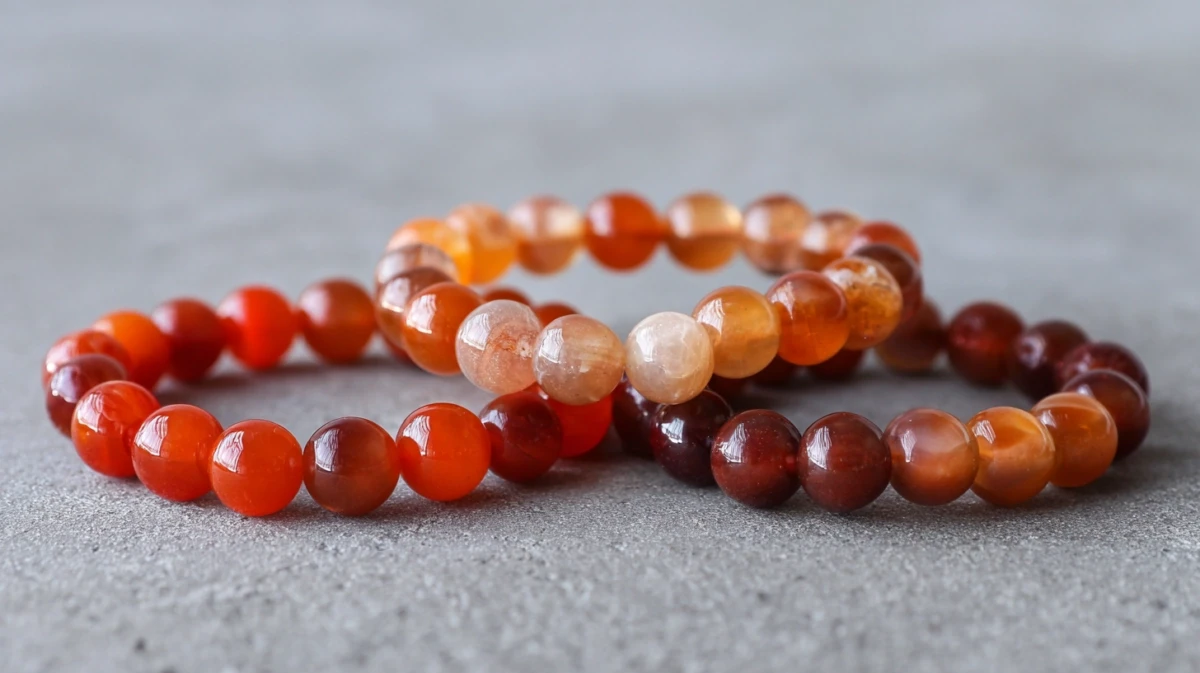
Stacking carnelian with darker stones creates contrast that keeps the warm tone from overwhelming the wrist. Black onyx is the most common pairing because the color opposition is clean and hard to get wrong—it's one of the go-to crystals for men who want contrast without complexity. Lava stone adds texture but reads more casual. Black tourmaline splits the difference. Two bracelets stacked is the practical ceiling for most men. Three starts competing with a watch, and four crosses into territory where people notice the jewelry before they notice you. Oxidized silver spacer beads between the carnelian stones anchor the warmth against something cooler and keep the bracelet from reading as a single block of orange.
If you wear a watch, it often works best to put the carnelian bracelet on the opposite wrist. Stacking a beaded bracelet against a metal watch band creates friction that wears down both, and visually, the two formats clash more often than they complement each other.
Carnelian Pendants That Work on Men
A 20-to-24-inch chain drops a pendant below the collarbone, which is the range that keeps carnelian stone meaning visible without crossing into ornamental territory. If the chain is shorter than that, the stone sits too high and competes with the neckline in a way that reads decorative.
Keep in mind that pendants worn against the chest are constantly exposed to sweat and body oils, which won't harm the carnelian but will quickly degrade leather cords. If you plan to wear the piece daily without taking it off for workouts or showers, a stainless steel or titanium chain is a much more practical anchor than leather or sterling silver.
Wire-Wrapped Raw Chip
An unpolished carnelian chip in a simple wire wrap looks rugged and unfinished. It works best on a leather cord, where the organic texture of both materials reinforces each other. On a silver chain, the same chip can look like it wandered off a craft fair table. Stick with brown or black cord, roughly 2 mm thick, and keep the wrap minimal: three or four loops of oxidized copper or blackened silver wire.
Bezel-Set Polished Drop
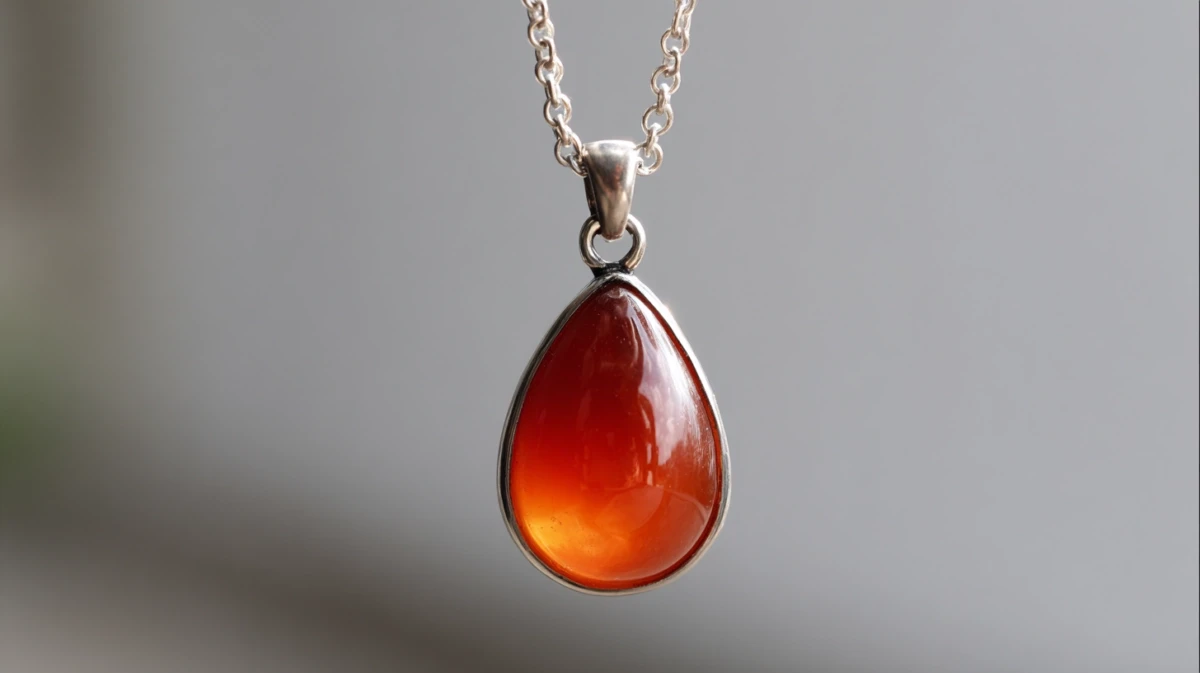
A smooth, teardrop-shaped cabochon in a closed bezel setting is the cleanest pendant option. Gunmetal or brushed sterling frames the stone without adding shine that competes with it. This format pairs well with a fine-link silver chain (around 2 mm width) and sits comfortably under a crew neck without catching. If you layer, add one plain chain about two inches shorter and stop there.
Tube or Cylinder Bead
A single carnelian cylinder threaded directly onto a cord eliminates the pendant silhouette entirely. The stone becomes part of the line rather than hanging from it. This format reads the most understated and works on both leather and waxed cotton cord. Where it falls short: the bead needs to be at least 15 mm long to register visually; otherwise, it disappears against the skin.
Carnelian Rings: Signet, Cabochon, or Minimal Band?
Three ring formats account for most carnelian jewelry for men, and each sits differently on the hand.
Signet (inset stone) | Cabochon dome | Thin-band accent | |
|---|---|---|---|
Profile height | Low, stone sits flush | Medium to high dome | Nearly flat |
Strongest finger | Pinky or index | Index or middle | Any, including thumb |
Formality range | Smart casual to formal | Casual to smart casual | Everyday |
Best metal pairing | Sterling silver, gold | Brass, oxidized silver | Brushed silver, steel |
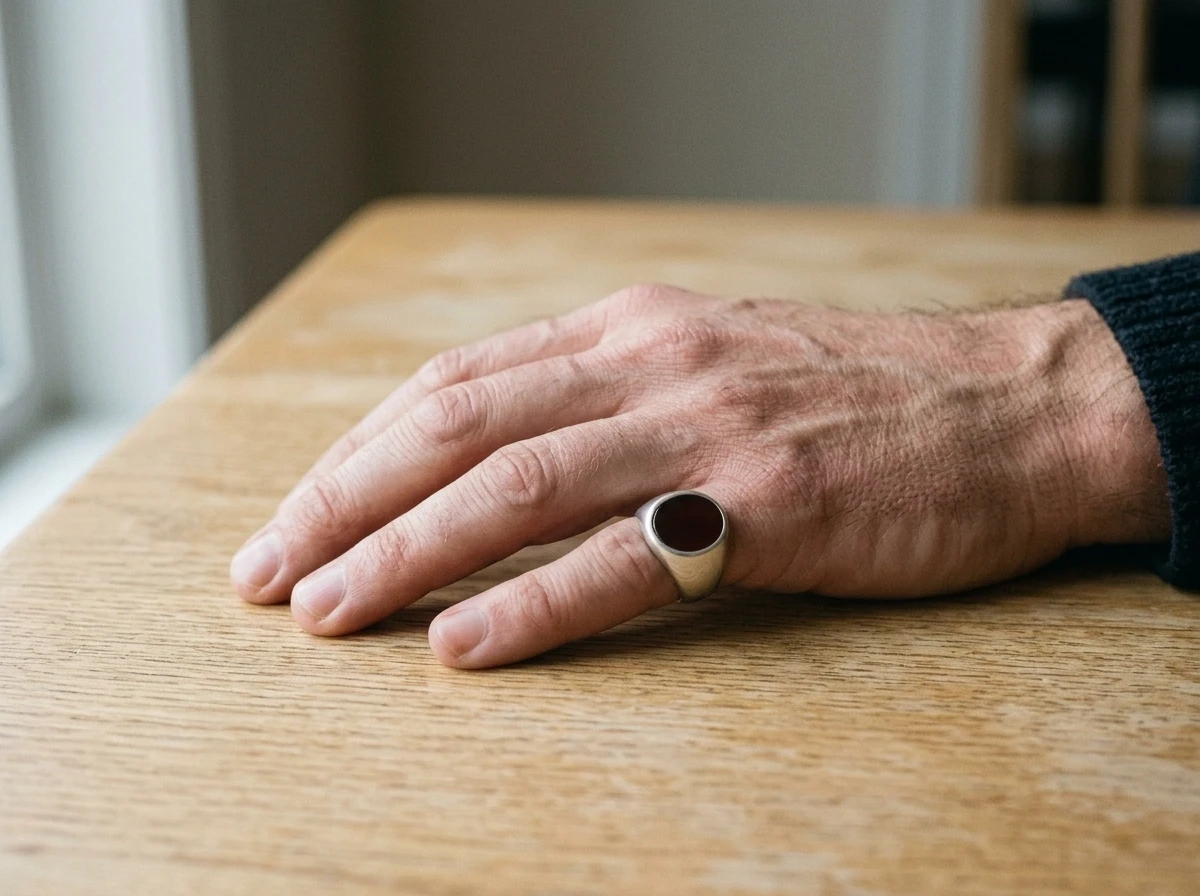
A signet with a flat-cut carnelian inset reads closest to traditional men's jewelry. This sterling silver carnelian signet ring on Amazon is a clean example of the format — cushion cut stone, proper men's proportions. The stone stays flush with the bezel, so it rarely catches on things. Pinky finger keeps it understated; index finger makes it a conversation piece without the romantic connotation of the ring finger. Sterling silver frames cost roughly a third of gold and pair naturally with carnelian's warm tone.
Cabochon domes show more of the stone's translucency and color depth, but the raised profile can feel bulky on smaller hands. Index or middle finger gives it room. Brass settings pull out the orange warmth, though brass tarnishes faster than silver and needs occasional polishing.
Because cabochon stones carry most of their weight at the top, the ring often spins sideways if the band isn't sized perfectly snug. If you are between ring sizes, size down for a cabochon or stick to a flat signet that sits closer to the finger.
Thin-band accent rings work when you want the color without the statement. They stack well with plain metal bands but disappear visually at a distance, which defeats the purpose if the stone itself is the point.
Skip the ring finger for a stone ring unless you want questions about its significance. Pinky or index reads as intentional style rather than symbolism.
How to Spot Real Carnelian and Avoid Dyed Agate
Dyed agate flooding the carnelian jewelry for men market is the single biggest reason buyers end up with pieces that look plasticky within months. Four checks, none requiring tools, sort most fakes from genuine stone before you commit:
Hold the piece against a phone flashlight. Natural carnelian transmits light unevenly, with cloudy patches, subtle color shifts from pale orange to deeper rust, and occasional milky spots. Dyed agate glows with uniform, almost neon saturation throughout.
Look for banding. Real carnelian shows soft, irregular bands that drift and fade. If the banding looks perfectly parallel or the color boundary between bands is razor-sharp, the stone was likely soaked in pigment.
Touch-test the temperature. Carnelian feels noticeably cool against skin and warms slowly over 20 to 30 seconds. Glass imitations warm almost instantly.
Apply the price filter. A single 8 mm carnelian bead bracelet selling for under five dollars with perfectly uniform bright orange beads is almost certainly dyed. Genuine carnelian costs more and rarely looks identical bead to bead.
One distinction worth understanding: heat-treated carnelian is not fake. Most commercial carnelian has been gently heated to deepen its orange tone, and the gem trade considers this standard practice, similar to how amethyst is routinely heated. The stone is still natural chalcedony. Dyed agate, on the other hand, is a different mineral soaked in chemical pigment to mimic carnelian's color. The dye can fade with sun exposure or sweat, leaving a grayish, blotchy surface. When buying online, uneven color in product photos is actually a good sign.
Cleaning and Storing Carnelian Jewelry
Lukewarm water with a drop of mild dish soap and a soft cloth is all carnelian needs. Soak the piece for a minute or two, wipe gently, and pat dry. Skip ultrasonic cleaners entirely: the vibrations can stress natural inclusions and loosen bezel settings over time.
Carnelian's orange-red tones fade gradually under prolonged direct sunlight. A windowsill display or a dashboard mount will dull the color over months, sometimes unevenly. Store pieces in a lined pouch or a compartment where daylight doesn't reach.
Carnelian sits at about 6.5 to 7 on the Mohs scale, which means harder stones like quartz or sapphire will scratch it if they share a drawer. Metal chains and clasps can do the same. Keep carnelian jewelry in its own soft pouch, separated from rings or bracelets made of harder materials. That single habit does more for longevity than any cleaning routine.
Frequently Asked Questions About Men's Carnelian
What stones pair well with carnelian in men's jewelry?
Onyx and tiger's eye are the most common companions. Onyx adds contrast without competing for attention, while tiger's eye shares carnelian's warm tone range and keeps the palette grounded rather than busy.
Is carnelian durable enough for an everyday ring?
Carnelian sits at 6.5 to 7 on the Mohs scale, which handles daily wear reasonably well. The real risk comes from impact rather than abrasion, so a bezel setting protects the stone far better than prongs for rings worn to work.
How can you tell if carnelian is real when buying online?
Ask the seller for a backlit photo. Genuine carnelian transmits light unevenly with visible banding, while dyed agate glows uniformly or shows concentrated color along fracture lines. Sellers who refuse that request are usually hiding something.
Does carnelian fade in sunlight?
Prolonged direct sunlight can gradually lighten carnelian over months, especially pieces with deeper red tones. Wearing it outdoors is fine, but leaving a ring on a windowsill day after day will eventually wash out some of the color.
Crystals for Men: The No-Nonsense Field Guide
If you want the full breakdown — the science, all ten stones, a daily carry practice, and a quiz that tells you exactly which stone to start with — the field guide has everything in one place.