Crystals for Shadow Work: The Stones That Support the Deeper Work

This article contains affiliate links. If you purchase through our links, we may earn a small commission at no extra cost to you.
Black Obsidian is the most commonly recommended crystal for shadow work, and for good reason: volcanic glass cuts through avoidance faster than gentler stones. Pair it with a grounding stone like Smoky Quartz to absorb the emotional weight the practice generates, or with Rose Quartz when the inner critic runs harsh after a session. Labradorite fills a different role entirely, supporting pattern recognition when honest self-examination starts to feel disorienting.
Match the Stone to What You're Confronting Right Now
Buried anger that surfaces during journaling or breathwork responds well to Black Obsidian, which functions like a mirror for material you'd rather not look at. Shame loops, the kind that replay the same scene on a timer, tend to soften faster with Rose Quartz nearby because the stone anchors self-compassion before the critic can spiral. Grief that sits heavy in the chest after a session pairs naturally with Smoky Quartz, which absorbs emotional density without numbing the process. Control patterns, where you catch yourself managing every outcome instead of feeling anything, crack open more easily under Labradorite because the stone supports the disorientation that real pattern-breaking requires. Self-sabotage, especially the quiet kind where you abandon a practice right when it starts working, benefits from combining Black Obsidian with Smoky Quartz: one reveals the pattern, the other keeps you grounded enough to stay with it.
Not every stone fits every confrontation, which is why understanding the broader landscape of crystals for men helps you choose the right tool for the specific work you're doing. Starting with the wrong one, like jumping straight to Black Obsidian during raw grief, can overwhelm rather than clarify.
Black Obsidian During Active Confrontation
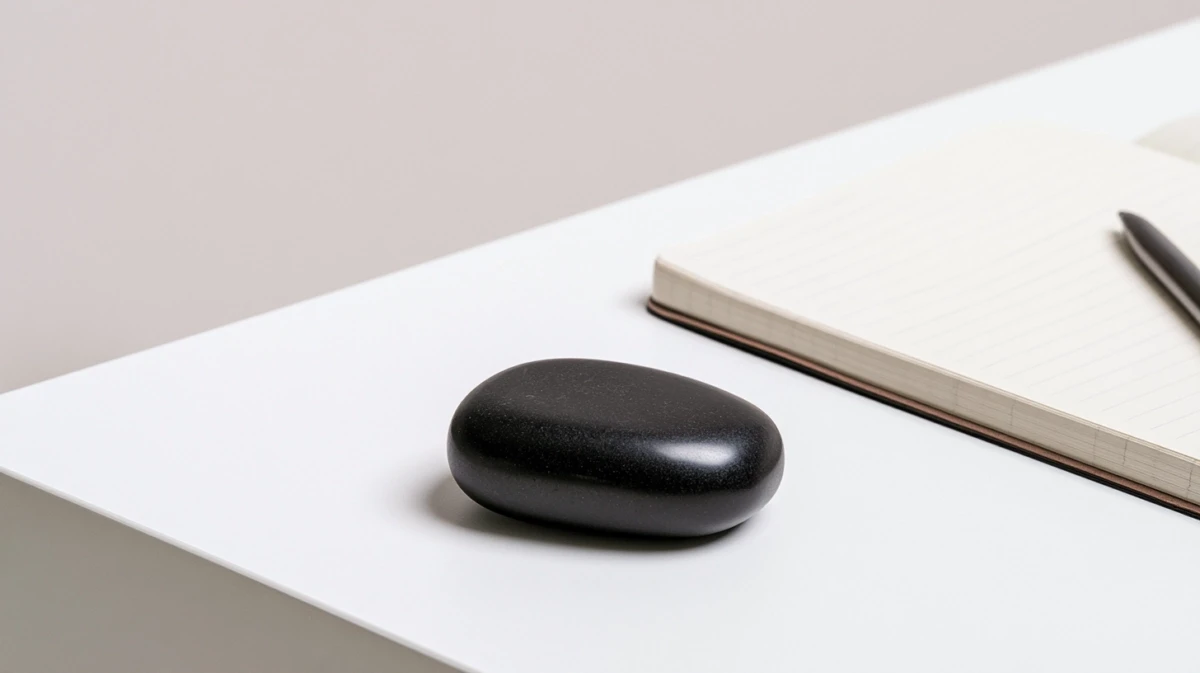
Journaling with a Black Obsidian palm stone on the desk often brings up material that feels different from what surfaces during general meditation. Meditation tends to produce floating impressions, half-formed images, loose emotional tones. Written shadow work with obsidian nearby tends to pull up specifics, like a particular conversation you handled badly or the exact moment you chose comfort over honesty. The stone doesn't cause that, but the combination of focused writing and a physical anchor associated with truth-telling seems to shorten the gap between "I'm fine" and the thing you've been avoiding.
When this shift happens, you will often notice a sudden spike in physical resistance—like a sudden urge to check your phone or a tightness in your jaw. That friction often signals that you have hit a nerve worth exploring rather than abandoning the session.
The distinction from other dark stones matters here. Hematite grounds you after emotional flooding, pulling scattered energy downward. Smoky Quartz absorbs stress so the emotional load doesn't overwhelm the session. Black Obsidian does neither of those things well. Its role sits earlier in the process: during the confrontation itself, when you need to stay with an uncomfortable truth long enough to write it down instead of deflecting. That's why pairing it with Smoky Quartz makes sense. Obsidian helps maintain focus on the issue, while Smoky Quartz prevents the emotional load from becoming too heavy.
For placement, set an obsidian palm stone on the desk beside your journal, not in your hand. Holding it while writing splits your attention. Resting it within sight anchors the intention without competing with the pen. Understanding its broader symbolism can also add depth to your practice.
Labradorite and Smoky Quartz: Two Different Stabilizers for Two Different Problems
Labradorite and Smoky Quartz both show up in crystals for shadow work recommendations, but they solve opposite problems. Using the wrong one for your specific state can make the practice less effective.
Labradorite addresses the cognitive fog that hits when you keep circling the same trigger without understanding why it controls you. You journal about the same pattern for the third week straight, and the connections stay blurry. A labradorite palm stone held during reflection tends to sharpen the moment when two seemingly unrelated reactions click into a single root. That pattern-recognition quality makes it useful specifically during the disorientation phase, when the work has already started surfacing material but nothing coheres yet.
Smoky Quartz works on a different layer entirely. When a session cracks something open and the emotional weight sits heavy in your chest afterward, Smoky Quartz absorbs that residual intensity so you can re-enter your day without carrying the session's charge for hours. It grounds downward rather than clarifying inward. It is best used for discharging heavy emotions after the active reflection is over.
In practice, Labradorite helps resolve confusion, while Smoky Quartz is better suited for calming a rattled nervous system. Pairing Hematite with Labradorite adds physical grounding to the clarity work. Pairing Smoky Quartz with Rose Quartz softens the discharge with self-compassion, which matters when what surfaced was shame rather than anger. Pick the pair that matches where the session left you, not a fixed combination you repeat every time.
Rose Quartz and the Inner Critic Problem
Shadow work that surfaces painful material but meets it with self-punishment creates a loop: you see the pattern, judge yourself for having it, and push the whole thing back underground. The confrontation happened, but nothing integrates. This cycle can leave you feeling worse after a journaling session instead of finding clarity.
Rose Quartz works as a counterweight to that specific dynamic. It maintains the focus on honest reflection without adding unnecessary harshness. It interrupts the reflex where your inner critic takes whatever you've uncovered and turns it into ammunition. The earlier pairing of Smoky Quartz with Rose Quartz when shame surfaces targets exactly this moment: you've already absorbed the emotional charge, and now you need something that keeps you from converting honesty into self-attack.
For men who run a harsh internal voice, skipping this stone often means the shadow work stalls. The journaling might happen, but the insights fail to integrate when they are immediately buried under criticism. Rose Quartz doesn't ask you to be gentle with yourself in some abstract way. It holds the space between seeing a truth and deciding what to do with it, before the critic steps in and shuts the process down.
Rose Quartz also has applications for men outside of dedicated shadow work contexts.
How to Set Up Crystals for a Shadow Work Session
Place Black Obsidian on the desk or table where you write, not in your hand. Obsidian works best as a visual anchor during the confrontation phase, sitting in your line of sight while you journal. Holding it tends to become a fidget object that pulls attention away from the page.

If you prefer doing your shadow work on the floor or a meditation cushion, place the stone just beyond the top edge of your journal. The goal is to keep it in your peripheral vision without letting it physically obstruct your writing space.
Start the session with Smoky Quartz in your non-dominant hand during two to three minutes of slow breathing. This grounds the nervous system before you open anything difficult. If you use a breathwork practice, keep the Smoky Quartz against your palm through the entire sequence, then set it down when you pick up the pen.
Once you're writing, Obsidian stays visible and Smoky Quartz moves to the edge of your workspace. This physical shift helps transition your focus from preparation to active exploration. If confusion surfaces mid-session (the kind where you can't tell what you're actually feeling), swap Smoky Quartz for Labradorite in your hand and sit with the disorientation for a minute before continuing.
Close the session with Rose Quartz. Hold it during a brief body scan after you've finished writing. This is where the inner critic tends to rush in, reinterpreting what you just uncovered as evidence of failure. Rose Quartz in hand during that final two-minute scan interrupts the reflex before it rewrites the session.
A full setup for one sitting: Obsidian on the desk, Smoky Quartz for the opening breathwork, Rose Quartz for the closing scan. Having a clear practice structure with specific journaling prompts can further support this setup.
FAQ
What is the best crystal for shadow work beginners?
Smoky Quartz works well as a starting point because it grounds without forcing anything to the surface. Black Obsidian is more effective for actual confrontation, but it can feel overwhelming if you haven't built a grounding habit first.
Do you need to cleanse crystals after shadow work?
Running them under cool water or setting them on selenite overnight is a common practice between sessions. Whether you frame it as energetic hygiene or simple ritual closure, the reset marks a clean boundary between one session and the next.
Because shadow work specifically deals with dense, repressed emotions, stones like Smoky Quartz and Black Obsidian can feel energetically "heavy" much faster than they would during standard meditation. If a stone starts feeling physically dull or you feel unusually agitated when picking it up, it is time for a thorough cleanse.
Can you use multiple crystals during one shadow work session?
Two or three stones assigned to different phases of the session tends to work better than holding several at once. Stacking too many dilutes your focus and turns the practice into crystal management rather than inner work.
How often should you do shadow work with crystals?
Once or twice a week gives enough space to process what surfaces without turning it into a compulsive habit. Daily sessions often lead to emotional fatigue, especially with confrontation-heavy stones like Black Obsidian.
The Unspoken Man
Shadow work with crystals goes deeper when you have a structured framework for the journaling itself. The Unspoken Man gives you that — 40 pages of prompts and practices built specifically for men doing this kind of work.
Crystals for Men: The No-Nonsense Field Guide
If you want the full science and carry guide for all ten stones — including a quiz that tells you which stone fits your current situation — the field guide has everything in one place.